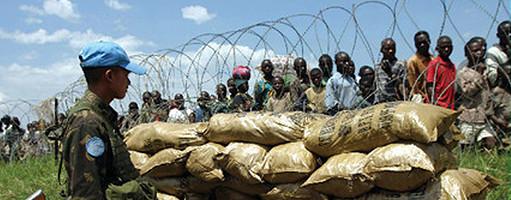
Peacekeeping in the Political Marketplace
Conventional peacekeeping operations are designed as stop-gap measures, either for a brief period of time or with a limited brief in a frozen conflict. This can be functional if the peacekeepers are dealing with institutionalized belligerents, with functioning hierarchies. It worked in the Ethio-Eritrean conflict, as for example in Cyprus. But in so-called ‘fragile states’, there is a risk that peacekeeping missions will turn into open-ended commitments.
Fragile states are typically defined by what they are not–they are not Weberian states in which autonomous state institutions administer the rule of law and regulate political conflicts, and not states in which governments deliver services on an efficient and impartial basis. International policies for dealing with such states, from Afghanistan to Congo, assume that these states can build ‘normal’ institutions in a brief historical span. Kofi Annan’s 2001 report, ‘No Exit Without Strategy,’ defined the criteria for success for peacekeeping operations in an identical way: ‘domestic peace becomes sustainable, when the natural conflicts of society can be resolved through the exercise of State sovereignty and, generally, participatory governance.’ This is, I fear, a formula for peacekeeping missions without end.
In this month’s International Affairs I have an article, “Mission without End” which outlines my analysis of why this is so. I argue that our starting point should be, how these states actually function–often as a patrimonial political marketplace, in which loyalties are up for auction at every level, and violence is a routine tool for political bargaining. Because international peace support missions enter these countries with a legal-technocratic frame of mind, they assume that problems are amenable to institutionalized fixes and that every agreement is legally binding. This isn’t the case, and a mission that tries to operate in this way becomes both frustrated and deeply enmeshed in the host country’s socio-political fabric. And because a mission will act, by design or default, as a patron itself, it influences the price of loyalty, inflating or deflating the cost according to which groups it supports or opposes. Which in turn means that a peacekeeping mission cannot withdraw without expecting a ‘market correction’, usually violent. I do not have any ready to hand fixes for this problem, but begin to sketch the outlines of how we might better understand it.