
A civil society deferred: the tertiary grip of violence in the Sudan – reviewed for Chatham House
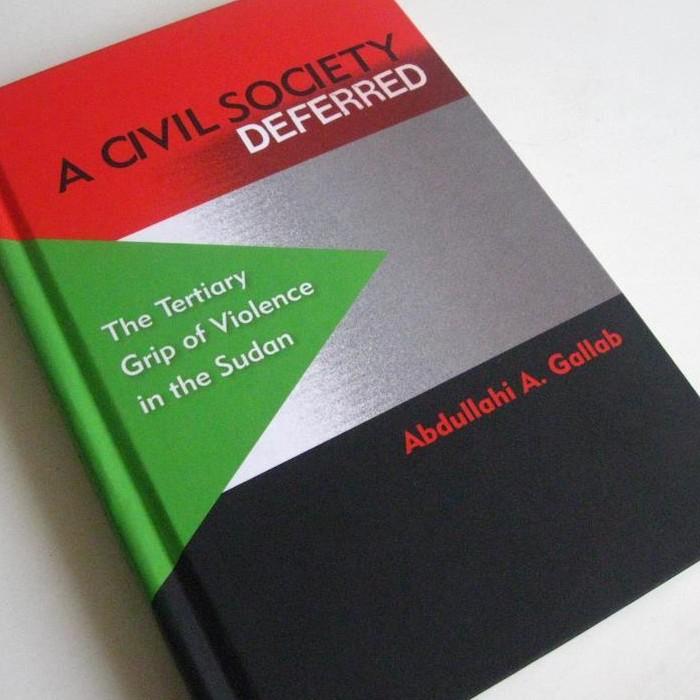
Review by Aly Verjee – Rift Valley Institute – previously published by Chatham House here (p.664). A debate on the book was also published on Making Sense of Sudan here
A civil society deferred is published as Sudan’s crisis of state failure continues. With domestic wars on three fronts and the aftermath of the secession of South Sudan in July 2011 turning ever more acrimonious, Sudan is beset by problems. Abdullahi Gallab’s passionate concern for the development of a country and society that is tolerant and humane is the deeper reference in the title’s deferred civil society, a term broader than discussion of the third sector alone. But those seeking further insight into Sudan’s current struggles may be unsatisfied by Gallab’s latest book. In this highly philosophical account, the author provides a wealth of detail for the scholar of Sudan’s colonial era, but teases the reader with only acursory treatment of more contemporary conclusions.
Gallab seeks to situate Sudan in a broader, more comparative philosophical framework, and the opening three chapters on the construction of identity and the colonial state seek to connect Sudan’s nineteenth- and early twentieth-century history to the analysis of figures as diverse as Jean-Paul Sartre, Crawford Young and the poet Ahmed wad Sa’d. However, Gallab ultimately falls back on two familiar ideas: the destructiveness of colonialism, a “˜malignant tumor … that has stayed alive ever since’ (p. 43); and the thesis of Sudanese exceptionalism: “˜the Sudanese experience [of the colonial state] added unique characteristics of naked power, violence, and odd relationships between the colonizer and the colonized’ (p. 24).
Scholars of Sudan will find Gallab at his best in the middle chapters. The “˜Tale of three cities’ provides engaging histories of Sudan’s twin metropolises of Khartoum and Omdurman as well as the empire’s colonial seat of Cairo. To a former resident of Sudan’s capital, Gallab’s descriptions of Khartoum’s master plan of urban design and Omdurman’s foundation as an “˜anticolonial entity’ (p. 62) were absorbing. The book’s emphasis on the three cities of the Nile’s riverine centre illustrates Sudan’s historic centre–periphery analysis: other cities, other areas, no matter their potential significance, are subordinate to the decisions and influence of the cities and attitudes of the centre. The contemporary Sudanese state remains strongly orientated towards the Nile valley.
Gallab returns to a broader analysis in the final chapters, presenting other scholars of Sudan in comparative perspective. The reader is left wanting arguments to be more substantially developed. For example, Gallab validly points out the flaw in rooting analyses that rely on conceptions of the country as a set of permanent strictures, rather than as a dynamic construction, but does not pursue the critique.
Hints of application to contemporary situations are contained throughout. The author writes of an “˜informal resemblance between [nineteenth-century colonial official] Wingate and [current President of Sudan] Omar al-Bashir’s counterinsurgency on the cheap [which] might draw our attention to the similar strategies of domination regimes pursue and the decentralized forms their counterinsurgencies take, regardless of dissimilar players, times, and circumstances’ (p. 52). While this is an apt warning to all those analysing Sudan today, it is also, frustratingly, an incomplete one. The author himself seems to conclude that change will come through popular disobedience leading to the fall of the regime, as in the 1964 and 1985 revolutions. There is hope of ending the “˜different, inherited, and current forms of tyranny and totalitarianism of the state’ (p. 196). Revolution may come, as it has in neighbouring Egypt and Libya. But Gallab’s own analysis confirms that Sudan’s problems will not be solved by revolution alone.