Beyond Kony 2012: a new E-book
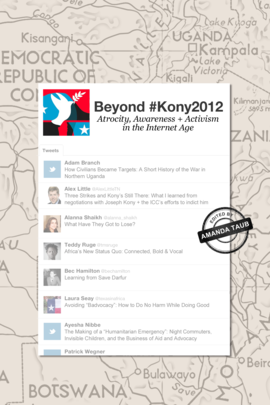 Amanda Taub – blogger at Wronging Rights – has been quick out of the blocks in producing what would appear to be the first book-length analysis of the Kony 2012 phenomenon.
Taub is clearly well-connected, and has managed to attract an impressive line-up including Adam Branch (long-time academic on N.Uganda), Bec Hamilton (of Fighting for Darfur fame) and Laura Seay (@texasinafrica).
You can buy for $0 to $3 here
The book’s description tells us that it’s “˜for those who know a little about Joseph Kony and the Lord’s Resistance Army, and want to know more.’
And it looks at the “˜story’ systematically and analytically from the history of the conflict to the phenomenon of viral advocacy videos in campaigns related to African conflicts.
You can see the full description here:
“˜Invisible Children’s Kony 2012 has become the most viral video ever. Concerned citizens around the world, from middle school students to celebrities like Oprah and Justin Bieber, watched the film and shared it with their friends. It has now been viewed more than 87 million times.
That success was soon met by a critical backlash. Critics nearly as varied as the campaign’s supporters pointed out that Invisible Children was offering an oversimplified, even misleading narrative. They faulted the campaign for failing to provide a context for the LRA conflict, and pointed out that the video portrayed Africans as either helpless victims, or heartless killers.
This book is both a collection of that criticism, and a constructive response to it. The authors each wrote a short essay offering information that they felt was missing from the video, or explaining how they thought the campaign could be improved.
The first several chapters provide historical and political context. Adam Branch, Daniel Kalinaki, and Ayesha Nibbe explain the roots of the conflict, and how it has persisted for so many years. Alex Little and Patrick Wegner discuss various attempts to end the conflict through peace negotiations, ICC arrest warrants, and military operations, and why they have not been successful.
Later chapters consider the ethics and effectiveness of awareness campaigns like Kony 2012. Glenna Gordon and Jina Moore draw on their experiences as journalists to critique the video’s portrayal of Africa and the people who live there. Rebecca Hamilton, Laura Seay, Kate Cronin-Furman, and Amanda Taub examine the weakness of “awareness” advocacy. Alanna Shaikh explains the ethical dangers of bad aid work. Teddy Ruge offers a different view of Africa, as a place of dynamic innovation instead of violence and helplessness. And youth activist Sam Menefee-Libey describes his frustration with the tone and substance of the campaign meant to target his generation.’
Table of Contents
Preface
Contributors
How Civilians Became Targets: A Short History of the War in Northern Uganda
Adam Branch
Kony2012: Treat the Political Causes of the LRA, Not Just Its Violent Symptoms
Daniel Kalinaki
The Making of a “Humanitarian Emergency”: Night Commuters, Invisible Children, and the Business of Aid and Advocacy
Ayesha Nibbe
Three Strikes and Kony’s Still There: What I Learned from Negotiations with Joseph Kony and the International Criminal Court’s Efforts to Indict Him
Alex Little
Peace from Juba: Peace Talks between the LRA and the Government of Uganda (2006-2008)
Mark Kersten
Can a Military Intervention Stop the Lord’s Resistance Army?
Patrick Wegner
Ethical or Exploitative?: Stories, Advocacy and Suffering
Jina Moore
The Power of Images: Who Gets Made Visible?
Glenna Gordon
Learning From Save Darfur
Rebecca Hamilton
Avoiding “Badvocacy”: How to Do No Harm While Doing Good
Laura Seay
What Have They Got to Lose?
Alanna Shaikh
Moral Agents and Patients: Trayvon Martin and Invisible Children
Hawa Allan
Armchair Critics Respond
Kate Cronin-Furman and Amanda Taub
Africa’s New Status Quo: Connected, Bold and Vocal
TMS Ruge
Beyond Kony2012 – Reasserting the Transformative Power of Youth Activism
Sam Menefee-Libey