
Portfolio Diplomacy: Rethinking African Economic Statecraft in a Multipolar World
Walk through Nairobi and the twenty-first century global economy comes into view.
Chinese-built expressways carry commuters to office towers occupied by American technology firms. French retailer Carrefour has become one of the country’s largest supermarket chains. Japanese vehicles dominate the roads while Indian pharmaceutical companies supply hospitals and pharmacies. Increasingly, Gulf investors are financing the logistics corridors that connect Kenya to regional markets. None of these relationships is unusual on its own. Most people experience them as disconnected features of everyday life.

The Nairobi Expressway approaching Westlands. The GTC Complex, one of Nairobi’s tallest commercial developments, is visible in the background.
Yet, this is rarely the lens through which Kenya’s foreign policy is viewed. Public debate has instead become dominated by President Ruto’s extensive international travel. To supporters, those journeys reflect energetic economic diplomacy. To critics, they have become shorthand for a presidency more comfortable abroad than confronting rising taxes, public debt and domestic discontent at home. Both perspectives, however, overlook a more important shift. The debate has focused on where Kenya’s president travels rather than where Kenya’s economy is connected.
That distinction matters because the international economy that shaped African diplomacy over the past three decades is rapidly changing.
The End of the Old Development Model
For much of the post-Cold War period, African governments operated within a relatively stable political economy of development finance. External capital flowed through a relatively small number of actors: Western bilateral donors, multilateral development banks and, from the early 2000s, increasingly Chinese policy banks. Diplomatic success largely meant securing access within that ecosystem.
That ecosystem is now fragmenting. The retrenchment of traditional development assistance provides perhaps the clearest illustration. According to the OECD, net official development assistance fell by 23.3 per cent in 2025 (the largest annual contraction on record) following an 8.5 per cent decline in 2024. Further reductions are projected for 2026, making this only the second time on record that ODA has declined for three consecutive years, after the period between 1992 and 1995. It’s the first time since that period that the United States, United Kingdom, Germany and France have all cut aid simultaneously.
Unsurprisingly, the sharpest reductions are expected to fall on low-income countries, with bilateral aid to sub-Saharan Africa projected to decline by as much as 28 per cent. The implication is not merely fiscal, the shrinking of aid budgets. It is structural. One of the central pillars of the post-Cold War political economy of development is becoming progressively less reliable.
A More Competitive Marketplace for Capital
Aid is only one pillar of a broader transformation.
China’s role has also evolved. The era of rapidly expanding policy-bank lending for large-scale infrastructure has given way to a more selective approach, with greater emphasis on debt sustainability, commercial viability and strategically targeted investment. Yet, this is not simply a story of one source of finance retreating. It is a story of many others emerging.
Gulf sovereign wealth funds have become increasingly important investors in ports, logistics, renewable energy and digital infrastructure. According to the Africa Center for Strategic Studies, the United Arab Emirates alone has announced around US$47 billion in projects across East Africa, with Saudi Arabia committing a further US$15.6 billion. Climate finance and private capital are also playing an increasingly prominent role in financing Africa’s development.
The result is a profound shift in the political economy of development: governments no longer navigate a relatively small ecosystem of donors and development banks. Instead, they operate within an increasingly competitive marketplace of capital that includes bilateral partners, sovereign wealth funds, institutional investors, multinational corporations and regional markets. In that ecosystem, diplomatic success may no longer be measured simply by how much capital a country attracts, but by how successfully it diversifies the sources from which that capital is drawn.
A Different Model of Integration
Judged by headline foreign investment alone, Kenya does not immediately stand out.
Countries such as Côte d’Ivoire, Egypt and Morocco have often attracted larger annual inflows, driven by hydrocarbons, manufacturing or other large-scale projects, according to a UNCTAD report. On those terms, Kenya appears respectable rather than exceptional. But headline FDI measures scale, not composition.
Whether Kenya attracts marginally more or less investment than Côte d’Ivoire in any given year is ultimately less important than what that investment reveals about the structure of each country’s external relationships. Côte d’Ivoire’s recent success has been built around a relatively concentrated model of external integration. A recently published IMF review notes that cocoa and rubber alone accounted for 92 per cent of its exports to the United States in 2024, illustrating the continued importance of a relatively small number of commodities and strategic sectors.
Kenya’s external economy is organised differently. The Kenya National Bureau of Statistics’ Foreign Investment Surveyshows an investment profile that is geographically striking in its breadth. Europe accounts for 35 per cent of foreign liabilities, Africa a further 26.4 per cent, while Asia (9.3 per cent) and the Americas (9.1 per cent) also account for significant shares.
That diversity is mirrored across sectors, where foreign direct investment spans finance and insurance, manufacturing, information and communication, wholesale and retail trade, energy and a broad range of service industries. The point is not that Kenya attracts more capital than its peers. It is that it has assembled a broader architecture of external economic relationships.
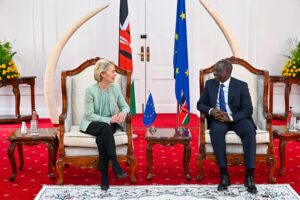
: President William Ruto meets European Commission President Ursula von der Leyen in Nairobi, December 2023. Kenya’s economic diplomacy increasingly spans multiple centres of global economic influence.
The same pattern extends beyond investment stocks. Findings from the KNBS Economic Survey 2026 reveal that in 2025 alone, Kenya raised US$1.5 billion through an international sovereign bond, issued two further US$750 million tranches later that year, and secured an additional US$500 million through a private placement with the United Arab Emirates.
Its diplomacy reflects the same logic: maintaining deep commercial ties with China while strengthening economic relationships with the European Union, the United Kingdom, the United States, the Gulf and regional African markets through the African Continental Free Trade Area. The government’s balance sheet tells much the same story as its diplomacy.
Kenya has not out-invested its peers. It has out-diversified them.
Beyond alignment
Much of the language we use to describe foreign policy belongs to an earlier era. Analysts still ask whether countries are aligned with the West or with China, balancing or hedging between competing powers. Those concepts remain useful for understanding geopolitics. They are less useful for explaining how governments pursue economic development.
Kenya is not choosing between Washington and Beijing. It is building relationships with both while expanding ties with Europe, the Gulf, India and its African neighbours. This emerging approach might best be understood as portfolio diplomacy: deliberately diversifying external economic relationships to reduce dependence on any single partner. Like a financial portfolio, the objective is not to maximise exposure, but to build resilience.
None of this suggests that Kenya has found a perfect model, nor is it unique. Morocco, Rwanda, Ghana and Côte d’Ivoire each illustrate different responses to the same structural shift. Kenya simply offers an unusually clear case study.
For decades, African diplomacy was judged by the blocs governments joined and later by the volume of aid and investment they secured. Those measures still matter. But as development finance fragments and new centres of economic influence emerge, they no longer tell the whole story.
The world has changed. The way we evaluate African diplomacy should change with it. Kenya’s experience suggests that resilience may increasingly depend not on who governments align with, but on how broadly they diversify their economic relationships.