Ethiopia’s Foretold War Arrives
No one can claim that a return to war in Tigray and northern Ethiopia is a surprise, but it makes it no less horrifying. In just a handful of days, and after months of spiralling tensions and sporadic fighting, the ‘grey conflict’ the federal government pursued against Tigray has escalated into ‘‘full-blown war,’ in the words of Tigray People’s Liberation Front (TPLF) vice president Ammanuel Assefa. The atrocities of the Tigray war are all too recent in the mind; the estimated deaths of 600,000 people, massacres at Axum and Adigrat, the incessant drone strikes on schools, hospitals, and industry, the rape and sexual assault of over 120,000 girls and women, and the harrowing consequences of the man-made famine. To be facing a return to a broader conflict not even four short years after the Pretoria agreement was signed is catastrophic, and this time, threatens to intersect with the metastasising Sudanese civil war.
On Sunday, a diverse coalition of Ethiopia’s ethnic-based opposition movements announced a new alliance, unveiled by Fano commander Zemane Kassie on Tigrai TV. Among them are the TPLF, the Amhara Fano National Movement (AFNM), the Oromo Liberation Army (OLA), the Ogaden National Liberation Front (ONLF), and three smaller ethno-nationalist movements from Afar and the Benishangul-Gumuz regions. Operating under the title of the Ethiopian Peoples’ Forces Alliance for Survival, these groups are united by their stated intention to oust the federal government led by PM Abiy Ahmed, and little else. The alliance has been a year in the making, emerging out of the Eritrea–TPLF rapprochement known as ‘Tsimdo,’ with its core appearing to be the TPLF and Fano; the OLA’s commitment seems more circumspect. Still, by mid-week, fighting had renewed on a large scale on several fronts in Amhara and Afar, with over two dozen federal airstrikes reported in several locations, whilst the TPLF seized control of three key airports in Tigray.
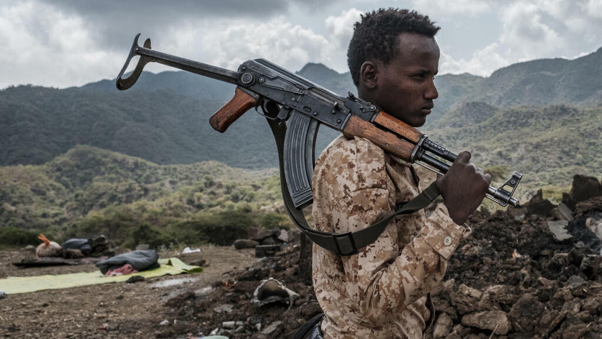
An Afar Special Forces member stands beside a damaged house near the village of Bisober in Ethiopia’s Tigray region. The village was damaged during fighting between Tigrayan and Ethiopian federal forces. AFP – EDUARDO SOTERAS
The fog of war is immense, and with the situation on the ground so fluid, much remains unknown. Both sides are seeking to paint the other as the aggressor, and how this escalates in the volatile theatre of northern Ethiopia–partially bordering Eritrea and Sudan–is of huge concern. So far, though, fighting has reportedly been concentrated along the Tigray-Afar and Tigray-Amhara borders, as well as the Kobo-Tumuga road in North Wollo, with Tigrayan and Fano purportedly fighting side by side for the first time. Including Abala and Erebti in Afar, Tigrayan units have seized several towns, setting up a potential push across the edge of the Danakil’s salt and potash belt towards the Djibouti Corridor, through which most of Ethiopia’s trade flows. Armed movement toward the ancient town of Lalibela has also been reported, with Ethiopian Airlines cancelling flights there, as well as to Mekelle, Aksum, and Shire.
Significantly, reports of fresh fighting along the Tekeze River near the Eritrean border emerged yesterday as well, accompanying government drone strikes and Eritrean troop advances into Western Tigray, suggesting that Asmara may be throwing its weight behind its Amhara nationalist and TPLF allies. Eritrea’s potential role in the coming days and weeks– beyond shaping the Tigrayan, Fano, and Sudanese army ties and facilitating weapons— will no doubt prove hugely significant. Ironically, Asmara’s transformation from pariah state in the Horn to king-maker lies at the door of Abiy and the Gulf states who ushered in the transactional ‘peace deal’ in 2018 that paved the way for the Tigray war. It is another cruel twist of fate, and Addis’s own short-sighted regional strategy, that places Mekelle and Asmara on the same side after Eritrean troops plundered and massacred their way across much of Tigray in the last war. But– as ever– Isaias Afwerki’s strategic logic is one of survival, seeking to place any burden of war on Ethiopia and spare his depleted army. Whether Addis has the appetite to strike at the Eritrean supply lines that will furnish this war remains to be seen.
Mekelle and Addis, as well as Asmara, have been on a war footing for months, reshuffling respective units and commanders, sourcing weapons for the looming conflict, and trading barbs on a host of issues, particularly the status of the Pretoria agreement– which ended the fighting but failed to resolve the brutal Tigray war of 2020-2022– and PM Abiy Ahmed’s quasi-imperial desire for ‘access to the sea.’ In February, battle-ready federal forces were redeployed from the raging insurgencies in Oromia and Amhara to the edges of Tigray, then abruptly stood down. Some had hoped that the surging fuel costs from the US-Iran war might have deterred a return to war, with Addis having budgeted for 4.2 million tonnes of fuel this year before the metastasising war across the Middle East sent costs skyrocketing. But the reprieve has lasted just a season.
In August, substantial, multi-day clashes erupted in Western Tigray between federal and Tigrayan forces. Even then, flickers of diplomacy did nothing to avert the impending broader conflict, with global attention still trained on the fallout of American adventurism in the Middle East now spilling over into Yemen. At the same time, government drone strikes ramped up in Tigray, one of Addis’s favoured tools, which have been deployed en masse against the Fano and OLA insurgencies in the Amhara and Oromia regions, respectively. As such, the growing conflagration in northern Ethiopia is another indictment of Abiy’s militarised, marketplace style of politics. Unable to conquer Tigray in 2020-2022, Addis has wielded the Pretoria agreement to delegitimise Mekelle, disregarding its responsibilities for dialogue to instead stoke division and pressure Tigray. In particular, Western Tigray was never restored to Mekelle’s control, nor was the broader region reintegrated into the federal contract, stranding it in a debilitating limbo.
Mekelle has hardly helped itself either. In the past 18 months, the TPLF has steadily asserted increasing political and military control of the region, stifling dissenting voices and introducing forced conscription. In May, it pushed out Tadesse Werede and installed a council headed by Debretsion Gebremichael, who led Tigray through the last war. But the TPLF is not the party it was six years ago, let alone thirty. It is a poor simulacrum of its former self, bitterly divided and inward-looking, unable to muster support from a wearied Tigrayan population. The cohesion that sustained Tigray against the Derg and the 2020-2022 war has dissipated, and tens of thousands of Tigrayans have fled ahead of the renewed conflict in recent months. Reports from Tigray in the past 48 hours further suggest that those suspected of potential disloyalty, including Tadesse Werede, have been detained.
Questions, too, about the broader alliance remain. Though Fano, Eritrea, and Tigray actors have been coordinating for months, the extent of the new alliance is less clear. Kjetil Tronvoll has aptly referred to it as one of “constructive ambiguity“, with the parties bound by little more than an antipathy towards the Addis regime. And though the TPLF vice-president Ammanuel Assefa has pledged to “sit at the table later to solve our problems peacefully,” the situation today reflects how fractured the Ethiopian body politic is. For instance, whilst the Fano commanders in Gojjam and Wollo may have fewer qualms with this Tigrayan alliance, those closer to the disputed territories in Western Tigray – who actively participated in the ethnic cleansing of the fertile region in late 2020 and 2021 – are likely to baulk. Still, if these arrayed forces can establish a coherent command centre to coordinate operations in several regions, it will no doubt heap further pressure on the federal government.
The international community—or what remains of it—has responded by urging dialogue and cooler heads to prevail. But on Sudan, and now on Ethiopia, the African Union and foreign capitals have repeatedly failed to rein in the belligerents or their foreign backers. Pretoria was a hastily expanded cessation-of-hostilities document, a flawed handful of paragraphs that failed to address the war’s root causes. Even so, the African Union abdicated its role as mediator, whilst its observers failed to hold the parties accountable or convene comprehensive talks. This week, a handful of embassies issued condemnatory statements, including the US offering fulsome support for Abiy, but hopes for any serious intervention remain low. Washington– whilst simultaneously seeking to rehabilitate Eritrea on its prime maritime real estate– and Brussels have broadly prioritised renewing their ties with Addis over holding the federal government accountable to Pretoria despite the drumbeat of a widening war.
What is clear is that humanitarian suffering is set to intensify across northern Ethiopia. Last year, Tigrayan scholar Teklehaymanot G. Weldemichel described Tigray as a “death world“, a region deliberately kept in awful precarity. Though Tigray today is not encircled as it was in 2020, a drone strike on a truck ferrying 41 tonnes of food aid bound for the displaced in Sheraro on 20 September recalled the logic of the last war, when famine was induced through the deliberate destruction of the means of survival. Cash is already running short, and with the rains failing and the campaigning season beginning, the lean months will fall inside the war. The humanitarian situation in much of the Amhara region – with the countryside dominated by Fano and urban centres by government forces – is equally dire.
2026 is not 2020, and this cascading Ethiopian conflict comes with Sudan, and the Red Sea, aflame. For the past two years, fears of a renewed Tigrayan-Ethiopian-Eritrean conflict have centred on its convergence with broader Horn instability, with Sudan’s internationalised civil war and competing Gulf and Middle Eastern powers backing its protagonists, increasingly connecting conflicts once treated as separate. Since late 2025, Ethiopia has moved more squarely into supporting the paramilitary Rapid Support Forces (RSF), with whom it shares an Emirati paymaster, hosting an Emirati-facilitated camp for the paramilitaries at Mengi near the Sudanese border. At the same time, another ally of the Sudanese army, Egypt, has aggressively pursued Ethiopia’s encirclement over disputes over the Grand Ethiopian Renaissance Dam (GERD) and the Nile water basin, forging closer ties with Eritrea and, to a lesser extent, Somalia and Djibouti.
Though this conflict is intimately shaped by distinctly Ethiopian grievances, it may quickly assume the intractable characteristics that have dominated the Sudan war —and the tools of the 21st century. External patrons would further complicate the battlefield, making a negotiated settlement harder to reach and military escalation easier to sustain. With the UAE and Saudi Arabia squaring off across the Red Sea and Gulf of Aden, yet another conflict offers space for regional competition to seep further into Ethiopia’s war. Still, it is early days, and if and how the Sudan war might intersect with the unfolding situation in Ethiopia remains to be seen, but the prospect of a conflict system stretching from Chad to the Djiboutian border makes one shudder.
If this descends into a broader conflict—and the augurs are bleak—it will not follow the script of 2020. Then, the war was broadly contained within Ethiopia’s borders. Today, several wars are already running at once, with a host of patrons, no single mediator able to end them and the margins between Ethiopia’s conflict and others wafer-thin. And so, in the face of the horrors of 2020-2022 and neighbouring Sudan, Ethiopia has returned to war.