The Sudan War series is a joint collaboration between the Center for Economic, Legal, and Social Studies and Documentation – Khartoum (CEDEJ-K), Sudan-Norway Academic Cooperation (SNAC) and African Arguments – Debating Ideas. Through a number of themes that explore the intersections of war, displacement, identities and capital, Sudanese researchers, many of whom are themselves displaced, highlight their own experiences, the unique dynamisms within the larger communities affected by war, and readings of their possible futures.
Images of everyday life in Kiryandongo refugee settlement camp in western Uganda. The camp is a long-time home for refugees fleeing regional conflicts from Burundi, the DRC, Rwanda, Kenya, Sudan and South Sudan. © Eric Mukalazi
Pain is often framed within the discourse of power. States, institutions, and dominant structures impose suffering as a tool of control. However, a more nuanced understanding of pain must centre human agency in its reflection, particularly the accounts of the life experiences of displaced people. Refugees and forcibly displaced people experience pain not just as victims of systemic oppression but as agents navigating their suffering. This does not imply a theological or Freudian embrace of pain but rather a utilitarian reckoning – where valued action is measured by its ability to reduce suffering.
Within this framework, agency and the alleviation of pain are deeply intertwined. Freedom and well-being are closely tied to the ability to act in ways that reduce suffering. However, for displaced individuals, this agency is severely constrained. The central challenge is how to create a sense of home in exile? How can identity and belonging be reconstructed in an unfamiliar environment where social and economic structures are often exclusionary?
Since value is socially constructed, success in exile is not predetermined; it is shaped by the displaced person’s ability to establish new foundations of stability. But does this process contradict agency? Traditionally, agency is linked to participation in political, social, and economic networks. Displacement often removes people from these structures, leaving them in precarious conditions, stripped of citizenship based rights, employment, and social capital. The paradox here is striking – success in exile may be necessary for survival, yet it remains a condition imposed by loss.
I call this paradox the “economy of pain”. It refers to the paradoxical condition of refugees who must survive through economic and cultural practices that often result in alienation and commodification. It accounts for how agency is restricted by systemic exclusion, and how cultural identity is transformed into tradable commodities as a means to survival – thus turning pain into a structured mode of existence under biopolitical and necropolitical governmentalities.
It is particularly evident in the experiences of Sudanese refugees in Uganda and Egypt who live at the intersection of biopolitical management and necropolitical exclusion. These frameworks enable a deeper analysis of how states, humanitarian organizations, and international systems govern Sudanese refugees, determining the boundaries of life, death, and precarity in host countries. While Uganda’s Refugee Act of 2006 allows for integration, access to land, and basic services, Sudanese refugees in Egypt navigate urban displacement with no formal protections, confronting systemic racism and bureaucratic barriers.
The concept of biopolitics, as articulated by Michel Foucault in his book The Birth of Biopolitics (1978–79) provides a crucial lens for understanding how central authorities such as states regulate life and populations. Foucault’s work highlights the ways in which governmentality operates through mechanisms of control, surveillance, and care. Giorgio Agamben’s development of the idea of “bare life” in Homo Sacer (1998) builds on this framework by exploring how certain populations – such as refugees – are reduced to mere existence, excluded from political and social recognition, to be speechless emissaries, as contextualized by Lisa H. Malkki (1996). Similarly, Achille Mbembe’s Necropolitics (2003) extends the analysis to examine how sovereignty determines life and death, particularly in postcolonial contexts. The war-displacement complex entails a double loss: the erosion of autonomy over one’s body and the deprivation of the collective networks of care once sustained by the place understood as homeland and home. Sovereignty away from home is no longer defined by the autonomy of free bodies, but rather, in Mbembe’s terms, becomes the exercise of power through the work of death. These theoretical tools are invaluable for analysing the conditions under which Sudanese refugees are governed, both as lives to be protected and as bodies to be excluded.
Despite differences in policy, in both Uganda and Egypt, contexts limit refugee agency through biopolitical governmentality. Humanitarians, while providing aid and emphasizing suffering over rights, often enforce sustainable dependency – restricting refugees’ self-determination and fostering a system that manages rather than empowers displaced populations, as extensively critiqued by scholars such as Ticktin (2011). Legal precarity prevents full societal inclusion, exposing refugees to economic and social vulnerabilities. In both contexts, experiences of displacement highlight how varying biopolitical regimes shape the lived realities of displacement, marginalization, and survival.
The sensory cost of survival
Economic survival in exile often forces refugees into informal labour markets, where they must commodify aspects of their cultural identity. Sudanese refugees frequently establish small businesses selling traditional foods, crafts, and perfumes – products imbued with personal and collective memory. This economic participation demonstrates both resilience and systemic barriers. Yet, it also reveals the economy of pain, where survival is intertwined with cultural commodification.
Drawing on Marx’s theory of alienation in the Economic and Philosophic Manuscripts of 1844, the economy of pain highlights the estrangement of refugees from the products of their labour and their social networks, and ultimately, themselves. For Sudanese refugees, this phenomenon manifests when they attempt to carve out economic livelihoods outside the domestic sphere. The distinction between public and private spaces, once clearly delineated by cultural practices and intimate aspects of daily life, begins to dissolve. As refugees engage in informal labour, particularly by transforming cultural symbols into commodities, the home becomes less a site of refuge and more a space of economic production, reflecting a blurred line between the market and the domestic sphere.
From foods to perfumes, Sudanese women, whether in Cairo’s Ard El-Lewa or Kampala’s Kansanga, are transforming what was once a private sensory practice – a symbol of intimacy, home, and kinship – into a product for trade. Scent and taste that once signalled closeness and cultural continuity now floats through the cracks of displacement, commodified and re-contextualized. Their home, in turn, is no longer purely a site of rest or memory, but a temporary workshop of survival, where traditions become transaction disseminated in markets away from home.
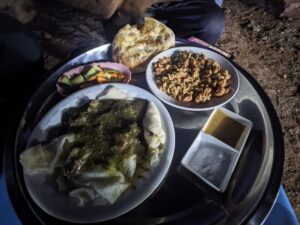
Traditional Sudanese meals find their way to the camp life. Food continues to carry the essence of collective sharing and eating habits despite the economic crisis. © Eric Mukalazi
This transformation echoes Marx’s concept of reification (Chapter 1), where cultural practices and intimate objects are objectified and reduced to mere commodities. The process of commodification strips these items of their cultural significance, particularly the sensory aspects of intimacy, such as smell, which, as Sara Ahmed emphasizes, often holds profound emotional and cultural meaning. For example, traditional Sudanese foods or handmade crafts, once linked to familial bonds and cultural memory, are now repurposed for market exchange. As Arendt (1958) suggests, the commercialization of personal and cultural life leads to the fragmentation of human experiences, where the intimate aspects of life are subsumed by economic imperatives. In this way, Sudanese refugees face a dual alienation: both from the home as a private space, and from their labour, which is now estranged from its original purpose of sustaining life and instead directed toward market survival. Thus, the “economy of pain” becomes a site of both economic survival and cultural alienation.
Rethinking humanitarianism
Beyond economic survival, displaced Sudanese communities actively engage in resistance and solidarity. In Uganda’s Kiryandongo refugee settlement, grassroots movements foster economic cooperation and advocacy for rights. These initiatives challenge restrictive economic structures while redefining agency beyond mere survival. Refugee agency manifests not only in economic adaptation but also in the negotiation of symbolic spaces. The sensory dimensions of displacement – such as the smells of home – become sites of emotional and economic negotiation, sustaining identity while navigating exile. Refugees engage in cultural reproduction as a form of resistance, ensuring continuity despite displacement. And yet, this resistance is in the very systems which produce precarity and displacement. As Foucault would inform us, wherever there is power, there will be resistance – and resistance is never outside of power, but present as entwined with power. Refugees resist through exactly the same economic and social actions that are based on exclusion, so that their agency is as much a result of as response to what they are done with.
Moreover, the intersection of sensory and material experiences in exile plays a critical role in sustaining identity and well-being. The act of cooking traditional foods, creating familiar scents, or performing cultural rituals functions as a form of embodied resistance against displacement. These cultural economies, though shaped by pain, offer alternative pathways for agency and self-determination.
Existing literature in refugee studies and biopolitics has extensively discussed the ways in which states govern displacement through restrictive legal and economic measures. However, there is a gap in analysing how displaced populations themselves navigate and resist these imposed structures. Jennifer Hyndman’s (2000) work on managing displacement highlights how humanitarianism often reproduces state logics of control rather than offering genuine empowerment. These perspectives illuminate the systemic barriers that refugees face but also call for greater attention to refugee-led economies of survival.
The economy of pain is not merely about suffering but about the transformation of displacement into a structured form of economic and social existence. Refugees operate within a paradox – they must succeed in exile, yet their success remains constrained by legal, economic, and social exclusion. Recognizing these dynamics calls for more empathetic and agency-driven humanitarian responses that move beyond mere survival strategies toward sustainable inclusion. Engaging with Arendt’s (1958) ideas on public and private spheres, we can see that the challenge of exile is not just economic but existential – refugees must continuously negotiate between visibility, economic survival, and the struggle for recognition in their host societies.
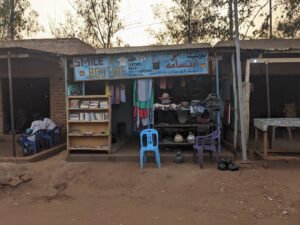
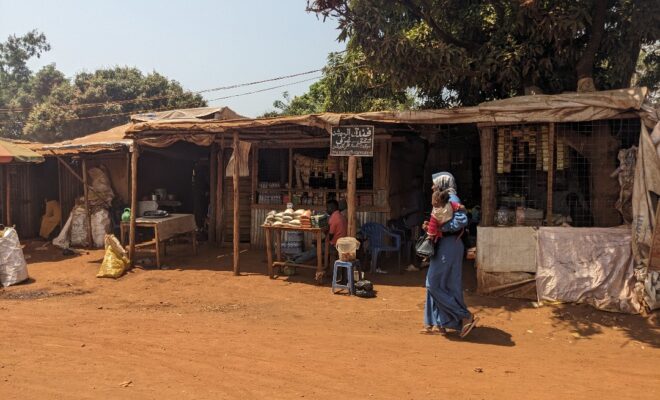
Refugee-run shops at Kiryandongo refugee settlement camp in western Uganda. © Eric Mukalazi
Addressing these complexities requires not only policy reforms but also a shift in how displacement is conceptualized. Rather than viewing refugees solely as recipients of aid, there is a need to acknowledge their role as economic and cultural agents reshaping their own futures. This recognition, in turn, challenges the broader structures that sustain the economy of pain and calls for a reimagining of agency beyond the constraints of exile. Additionally, interdisciplinary approaches combining political economy, affect theory, and migration studies can further illuminate how refugees navigate precarity and assert autonomy within systems designed to manage and contain their suffering.
Ultimately, rethinking displacement beyond the framework of victimhood allows for a more holistic understanding of how pain is experienced, resisted, and transformed into new forms of agency. By centring refugee voices and lived experiences, we can move toward more inclusive and sustainable policies that recognize the complexities of exile, economic survival, and the enduring struggle for recognition.
Debating Ideas reflects the values and editorial ethos of the African Arguments book series, publishing engaged, often radical, scholarship, original and activist writing from within the African continent and beyond. It offers debates and engagements, contexts and controversies, and reviews and responses flowing from the African Arguments books. It is edited and managed by the International African Institute, hosted at SOAS University of London, the owners of the book series of the same name.