
Debating Ideas reflects the values and editorial ethos of the African Arguments book series, publishing engaged, often radical, scholarship, original and activist writing from within the African continent and beyond. It offers debates and engagements, contexts and controversies, and reviews and responses flowing from the African Arguments books. It is edited and managed by the International African Institute, hosted at SOAS University of London, the owners of the book series of the same name.
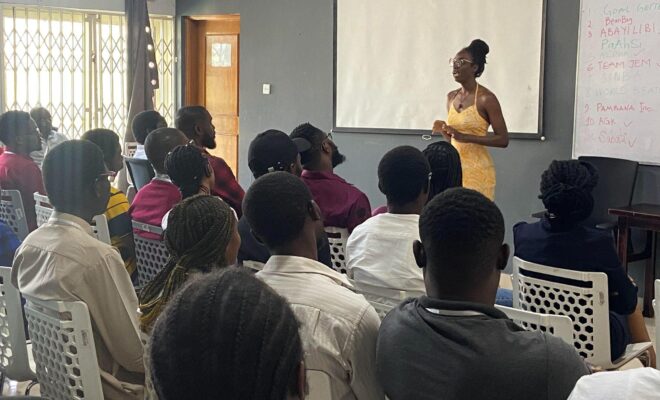
Delivering a talk on mental health and wellbeing to young entrepreneurs. © Araba Ofori-Acquah
The silence echoed through the room with the formless heaviness of an unpleasant smell. The joyful greetings of these ambitious founders that usually lit up the room on my entry were now missing. For a year, these young, talented Africans with dreams of changing the world – and their own lives – had poured their hearts into an intensive programme. The one-year incubator was designed not only to upskill individuals, but also to bring like-minded people together to form exciting new startups. However, in a world defined by funding as a measure of success and opportunity for progress, little else mattered on this day. Despite the undeniable achievement of completing such a rigorous programme, despite the doors that would inevitably open as a result, a sense of failure burdened those walking away without investment. The weight of unfulfilled expectations, anxieties about returning home empty-handed, and questions about whether they had made the right choices hung heavy. For me, this experience encapsulates an often-overlooked truth: the psychological burden on African founders is different from that of their Western peers. This piece sets out to highlight why existing resources and support systems should reflect, rather than downplay or ignore, this difference.
My work with startups began back in my marketing and business development days, which gave me an insight into what it takes to run and scale a small business on a practical level. After retraining as a wellness coach – a move inspired by my own battles with anxiety and burnout – I turned my attention to the mental and emotional health of those who keep the cogs turning. Over the last few years, I worked with a prestigious incubator that trains the most promising young entrepreneurs from across Africa, providing wellness and mental health support. Winning a place on this accelerator is a huge career achievement. However, each year, when I meet this cohort of bright, young talent, their sense of achievement is eclipsed by guilt and anxiety. They speak of the consequences of their entrepreneurial presence; shirked family obligations, an inability to provide financial or practical support and, for a few, fractured or entirely broken family relationships. At the end of the programme, those who do not receive funding can’t help but wonder if they’ve wasted a year.

Interviewing Ghanaian startup founders. ©Araba Ofori-Acquah
In a Western context, a startup failing hits hard. Money, time and energy go down the drain. But there’s also a level of glorification. “All the best entrepreneurs had a few failures before they hit the jackpot,” they say. In fact, having failures under your belt can even add credibility – at least, if you’re a white man. For Ghanaians, it’s a different story. In my book Return to Source: unlock the power of African-centred wellness I put forward three values that make up the African worldview, drawing from the work of philosophers such as Kwasi Wiredu and John Mbiti, and my own research and musings in African traditions and theologies. Community is one of these core values. This often manifests as a fierce duty to one’s extended family – especially if you are the first-born child, male or highly educated – a duty that usually carries a financial expectation. Beyond family, community plays an important role in the lives of many Ghanaians; school mates, church groups, work colleagues. While this communal approach to life has benefits, it can also have a dark side; a lack of boundaries that manifests in the extended community’s approval (or not) of one’s life choices and what constitutes success. As a young entrepreneur in Ghana, there is a level of unavoidable public spectacle that comes along with the territory, as news of successes and failures permeates the community. All this responsibility and expectation is a huge burden even at the building stage of a startup. It’s no wonder then, that founders often feel the need to keep up appearances. But the research shows that Ghanaian entrepreneurs report low life satisfaction and my own interactions point to high levels of stress and anxiety within this demographic.
As defined by the World Health Organization, mental health is not merely the absence of mental illness. Rather, it is “a state of well-being in which an individual realizes his or her own abilities and can cope with the normal stresses of life, work productively and is able to make a contribution to his or her community”. Poor mental health doesn’t automatically point to a diagnosable mental illness. My clients complain of trouble sleeping, intrusive thought patterns, lack of self-esteem, imposter syndrome, crippling perfectionism and pervasive anxiety, all symptoms of poor mental health.

Delivering a meditation session for young professionals. © Araba Ofori-Acquah
In traditional medicine – an indigenous approach to medicine found across the world – poor mental health is viewed as an imbalance to be addressed holistically, likely with a combination of herbs, ritual and spiritual counselling. As colonialism fractured traditional healing systems through criminalization and demonization, an incomplete narrative emerged. Now, many Ghanaians view any kind of mental affliction as exclusively spiritual, with responses like “You just need to pray more,” or “Come to church with me,” common replies to complaints of poor mental health. Studies in Ghana have even found a correlation between high religiosity and high mental ill health stigma. The cure, the churchgoers say, will be administered through repentance, prayer and counselling from church leaders.
After almost a decade of providing one-on-one coaching and counselling, organizing retreats and running wellness and mental health workshops, I see a shift. The younger generations particularly – perhaps due to their exposure to a larger worldview enabled by the technology revolution – are not only aware but intentional about prioritizing mental health. And yet, I still engage with so many young founders who believe that poor mental health is a necessary and unavoidable rite of passage to success. Or who seek psychological support in family and church groups instead of with professionals. While our cultural nuances play a role in this, the Western-imported image of successful founders has a lot to answer for.
Sacrifice everything to build your dream. Sleep is for the weak. Move fast and break things. This approach might work in a society where it’s every man for himself, and there’s a robust system of government support to cushion your landing when you fall. But Ghana – and Africa – requires a different model. The journey to becoming a successful founder should honour our community values, not cause friction with them. To provide adequate support, we must take an African-centred approach, using community and storytelling as our tools. Community-centric entrepreneur programmes might include; widely attended opening and closing ceremonies, a non-resident or termly schedule that provides flexibility to meet family obligations, and – crucially – fair payment that reflects the time and investment these programmes require. We can harness the power of storytelling to promote good mental health by sharing more complete, relatable stories. My own work with founders has included delivering wellness lectures as part of training programmes, facilitating open, honest conversations with successful founders and offering one-to-one support through coaching that centres wellbeing rather than productivity. By telling better stories, we can shift our reality.
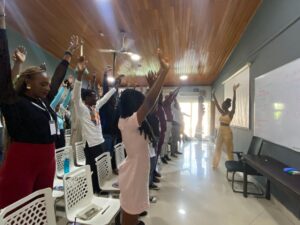
Power posing and positive affirmations session. © Araba Ofori-Acquah
Addressing the challenge of deteriorating mental health for Ghanaian startup founders is urgent for their individual wellbeing, their families, and the national economy, which is hugely boosted through entrepreneurship. For Ghanaian entrepreneurs, it can sometimes feel like social values and family life are working against one’s success. But leaning into our cultural beliefs could be the route to a more sustainable and supportive ecosystem. By shifting the focus from a purely individualistic model of success to one that embraces community, we can begin to reframe failure, challenge stigma and give founders the tools to thrive. The silence in that incubator room, heavy with fear, doubt and sadness, serves as a potent reminder; for Ghanaians, entrepreneurship is a journey taken shouldering a huge weight of family, community and society obligations and expectations. Therefore, nurturing the mental health of those who dare to dream is not just a matter of individual grit, but of collective responsibility.