Somalia in the Crosshairs: the Consequences of the Iran War on Somalia
The US-Israel war on Iran has had global ramifications in the cost of daily life and geopolitical calculations. Because of geographical proximity, political instability, and relative poverty of countries in the Horn of Africa, the spillover and the impact of this war on this region is particularly consequential. In this piece, we take a closer at the potential geopolitical ramification and the impact on the cost of living of the Iran War in Somalia.
Geopolitical ramifications
For many, the Iran war has underscored the significance of maritime chokepoints for the global economy, but Somalia’s politics has been enmeshed and shaped in recent times by global competition for control of coastlines and chokepoints for trade and military purposes. Somalia is nestled geostrategically along the Indian Ocean, with an extensive coastline that abuts the critical Bab el-Mandab Strait leading to the Red Sea. The global competition over this important maritime chokepoint has resulted in contest for influence and control over Somalia’s coastline, which has increasingly shaped domestic politics. Reports of the prospects of finding oil in Somalia’s waters since the 2000s have only added to the scramble for influence.
The regional and global competition for Somalia’s coastline and ports has embroiled the country in competitive and escalatory proxy dynamics, undermining progress towards the peaceful resolution of domestic grievances. Regional actors have raced to construct commercial/military ports across Somalia’s coastline and invested in its domestic politics, including the United Arab Emirates, Ethiopia, Turkiye, Egypt and others. These dynamics have overlapped with the relative autonomy that Somalia’s regions – Federal Member States – have acquired over the past decade or more, as decentralised governments have developed their own ports and airports, often with the assistance of outside powers. These tensions and dynamics are exemplified in the now outdated MoU of Somaliland government with Ethiopia for the lease of its coast, and the Israeli recognition of Somaliland (a region that the Federal Government of Somalia and the rest of the world view as part of Somalia’s sovereign territory) in December 2025 that included the establishment of an Israel military base. The UAE has also been a major investor in Berbera port in Somaliland. Simultaneously, Turkiye, an important partner to the Somali Federal Government, has sent its first deep sea drilling vessels to Mogadishu this week, and has made significant investments in the seaport and airport at Mogadishu over the last 10-15 years as well as in a military base in the Somali capital.
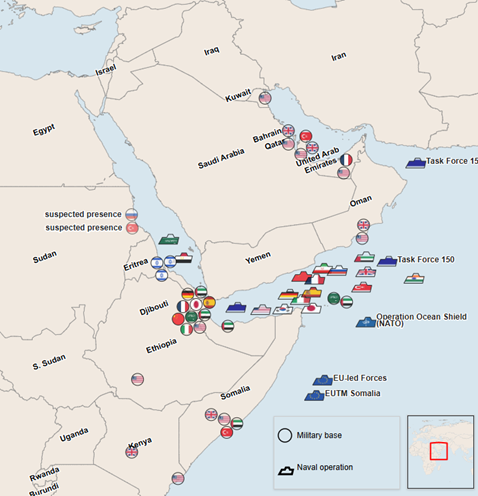
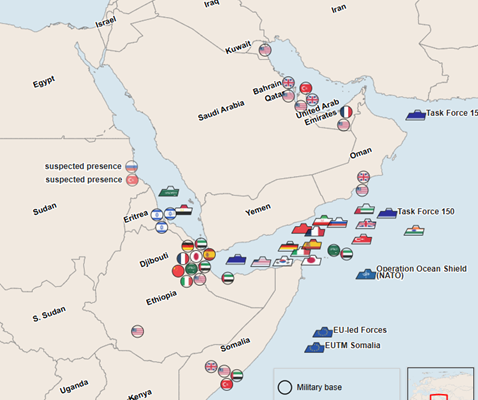
Foreign military presence in the Horn of Africa (2019). GIGA
Materially, the increasing footprint of regional states could draw Somali territory into intensified competition. The Iran War and the blockade of the Straits of Hormuz has further underlined the importance of critical maritime chokepoints, such as Bab el-Mandab. This is likely to generate further scrambling by regional and global powers for influence and military presence in the countries around Bab el-Mandab, including Somalia. As well as the recent Israeli recognition of Somaliland, and the potential lifting of sanctions on Eritrea by the U.S. is part of this playbook. This will further exacerbate political fragmentation in Somalia and undermine the fragile statebuilding efforts.
Impact on the cost of living
In central Somalia, a women’s rights NGO finalising a recreation pitch for youth is feeling the effects of the Iran War – the price of nails has skyrocketed. Tuk-tuk drivers, ubiquitous in Somalia’s bigger towns and cities, have raised prices for short trips reflecting increases in fuel prices. As an economy that relies on imports of food, fuel, and most commodities for everyday life, ordinary Somalis are feeling the effects of another war, only this one is outside the Somali territory.
The immediate impact of this war, like in many regions of the world, will be most keenly felt in how people carry out their livelihoods, especially for the poorest and most vulnerable populations as the cost-of-living rises. The ongoing Iran impasse will play out across the Somalia economy and peoples’ livelihoods in different ways.
Prior to the Iran war, due to poor seasonal rains and dramatic cuts to international aid, concerns were already high regarding the potential for increased food insecurity, mortality and famine conditions to develop in Somalia. This, in a country that has had two major famines in the last 35 years (in 1992 and 2011). One of the consequences of the aid cuts for example, has been a reduction in the number of health centres in the country, thereby increasing risk of disease loads.
Food supply itself has been minimally disrupted by the war as traders can still source commodities, so far, but prices are being affected by increased transportation costs due to both rising fuel and insurance prices. A major importer to Somalia reported that freight costs from India, the primary source of rice, sugar and wheat flour for the country, has roughly doubled in recent weeks. Similarly, the same importer estimated that goods coming from Turkey, another important source of imported food and clothes, through the Suez Canal have now been shifted to larger container ships which are travelling around the entire African continent, and where the cost of using containers has tripled since the start of the Iran war.
While some analysts were privately warning that the risk of famine was being over-stated, rising prices will no doubt push a greater number of people into hardship and increased hunger. The most vulnerable communities, including internally displaced persons, are likely to bear the brunt of volatile price hikes. These populations have moved from rural areas over the years due to insecurity, recurrent drought and the attraction of towns for services, job opportunities and access to aid.
There are however some mitigating factors. An estimated 30-50% of Somalia’s GNP comes from remittances,. A significant proportion of households in Somalia – an estimated 40% – receive some form of remittance, directly or indirectly. and so these flows should not be directly affected by the Gulf war and will continue to flow. However, the populations that are considered most vulnerable to food insecurity, such as the displaced, will tend to have the least access to remittances and so will find it harder to absorb the effects of price increases.
Somalia is famed for the export of its livestock, having large numbers of camel, cattle, sheep and goats which provide food (milk and meat) as well as income for pastoralists/nomads and farming populations. While some of these animals are sold for domestic consumption, a greater share is for export. A major market for livestock is the Gulf countries, particularly the annual Hajj pilgrimage to Mecca in Saudi Arabia, which took place just last month. Although there were concerns that the Hajj would be disrupted due to the Iran war numbers were very similar to last year – an estimated 1.5m travelled. Sales of Somali livestock – particularly sheep – have remained relatively stable.
As with the rest of the world, the Iran war will be most immediately felt in Somalia in the increased cost of living. While this immediate impact should be a priority for policymakers, the potential medium to long-term impact of this conflict is important to recognise. The total or partial closure of the Straits of Hormuz and the significant impact this is having on the global economy, may well further intensify the competition over another significant chokepoint of global maritime trade, Bab el-Mandab. As one of the countries whose shores abut Bab al-Mandab, Somalia and its domestic politics could be further entangled in this global geopolitical competition. We have recently seen evidence of this in Israel’s recognition of Somaliland and the subsequent condemnations and diplomatic manoeuvres by Mogadishu and regional powers. Somalia is already highly fragmented in political and territorial terms; the Iran war may deepen this further.