Why Lesotho’s remittance ‘safety net’ was never really its own, and why it is failing again in 2026
Lesotho is two years into a national state of disaster: US tariffs have gutted its garment factories, unemployment has passed 30%, and its main trade lifeline is guaranteed for less than a year. To understand how the mountain kingdom keeps ending up here, start almost forty years earlier.In 1987, something extraordinary happened in this small kingdom, completely surrounded by South Africa. Money sent home by Basotho men working in South African gold mines reached 236% of Lesotho’s entire GDP. Not 23%. Not 60%. More than double the value of everything the country itself produced in a year. Today, that figure sits at around a fifth of GDP. The money didn’t slow down gradually. It collapsed, and it has never recovered. To understand why, you have to understand what that money actually was.
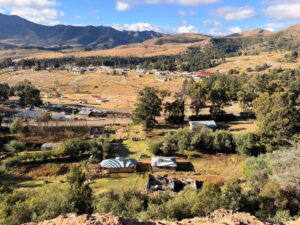
A mountain village in Lesotho.
Why one country’s economy ran on someone else’s mines
For over a century, Lesotho had almost no domestic industry of its own. What it had instead was proximity: a small, mountainous, landlocked territory sitting right next to the richest goldfields on Earth. South African mining houses needed enormous numbers of workers willing to do dangerous, underground labour for low pay, and they built an entire recruitment system to draw men from Lesotho, in their hundreds of thousands, to fill that need.
This wasn’t diversification. It was concentration. An entire national economy came to depend not on a sector but on the hiring decisions of one industry, in one neighbouring country, that Lesotho had no ownership of and no influence over. The arrangement generated enormous sums of money. But it meant Lesotho’s prosperity was never really Lesotho’s to control. It belonged to the price of gold, the depth and cost of South African ore bodies, and the mining houses’ own calculations about profitability: decisions made in boardrooms far from Lesotho.
Why the mines emptied out
South Africa’s gold mining industry has been declining for decades. Ore grades have thinned, extraction has moved ever deeper and more expensive, and profitability has steadily eroded. Industry data shows gold mine employment falling from around 536,000 workers in the late 1980s to roughly 94,000 in 2023, a loss of more than 440,000 jobs. What is far less well understood is when that decline first showed up on the ground in Lesotho. That is what our research set out to trace.
The illusion of insurance
Here is the idea we set out to test, in ongoing research that is not yet peer-reviewed: a common assumption in development economics holds that remittances act like insurance for vulnerable countries. When disaster strikes at home, such as a drought or a bad harvest, the theory goes, migrant workers send extra money to cushion their families. It appears again and again in World Bank reports and climate-adaptation policy documents. If it were true anywhere, it should have been true in Lesotho. So we tested it every way we could think of: immediate effects and delayed ones, good mining years and bad, average years and the very worst.
So far, we have found nothing. At no point did Lesotho’s own climate conditions appear to move the money flowing into the country. This work is ongoing. But that absence is the whole point. Real insurance responds to your shocks: your drought, your bad year. What Lesotho had was money that moved in response to conditions entirely outside its own borders. That isn’t insurance. It’s exposure to a risk you don’t control, wearing the appearance of a safety net.
What the sequence suggests, and what it does not prove
Our analysis cannot show that the mining industry’s decline directly caused Lesotho’s remittance collapse. Establishing causation from national data alone is genuinely difficult, and we want to be honest about that limit. What we can show is a sequence, dated using statistical tools that detect when a long-running trend breaks.
Net migration out of Lesotho reversed course in 1986: families were already pulling back from the mines before anything else in the data moved. Just two years later, in 1988, around the same time mine employment across the industry peaked before its long decline, Lesotho’s remittances began their long, uninterrupted fall. It would be a full decade, until 1998, before international aid to Lesotho showed any measurable shift. That was also the year of Lesotho’s post-election crisis and SADC intervention, so donors may have been answering the political emergency; either way, aid moved ten years after the money did. And South Africa’s own gold production statistics did not formally register a structural decline until 2004, sixteen years after Lesotho’s remittances had already begun falling.
That gap matters. Ordinary households were responding to what was happening in the mines well before it showed in industry figures, and years before aid responded. We treat this as a striking, dated pattern worth taking seriously, not proof of a single mechanism.
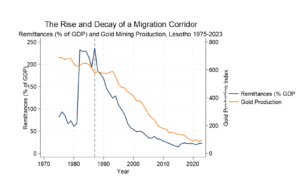
The navy line tracks remittances as a share of Lesotho’s economy; the orange line tracks South African gold mining output; the vertical dashed line marks the 1987 remittance peak. Both series trend downward over the long run, though their statistical turning points sit sixteen years apart (1988 and 2004). The closer, two-year link we found is between Lesotho’s own migration reversal (1986) and its remittance collapse (1988). Data: World Bank (remittances); South African Reserve Bank (gold production). Chart: authors.
The sequel is playing now
If this were only history, it would be warning enough. But Lesotho is living the sequel. After the gold remittances collapsed, the country rebuilt its external lifeline around textiles: garment factories serving American brands under the African Growth and Opportunity Act (AGOA), which became the country’s largest private employer. Then, in April 2025, the United States imposed steep tariffs on Lesotho’s exports. Orders from American buyers dried up, factories cut shifts or closed, and the government declared a two-year national state of disasteras unemployment passed 30%. The 2026 renewal of AGOA guarantees market access for less than a year, so orders remain cautious and investment is on hold.
Swap Johannesburg’s gold for Washington’s tariffs and the structure of the story is identical. An economy leans its external income on an industry it neither owns nor controls, located in, or dependent on, someone else’s country. Decisions taken far away determinewhether Basotho households eat. The mechanism is the same one, wearing different clothes.
Why this matters beyond one small country
It would be easy to read this as a specific, unfortunate story about Lesotho. It isn’t. It’s a warning about an assumption embedded in much development thinking: that migration and the remittances it generates are a durable form of resilience a vulnerable country can lean on.
Individual families may well cushion each other when disaster strikes; household studies elsewhere have found exactly that. But the version of this idea that matters for policy is the national one, and Lesotho was the strongest possible test case, and so far it fails. Its remittances never moved with Lesotho’s own climate shocks. And when the broader system they depended on began to weaken, there was no cushion, because there had never really been one built at home. There was only ever a single foreign employer, and an economy that had quietly organised itself around never asking what would happen if that employer changed its mind.
For Lesotho, whose garment workers are today learning the lesson its miners’ families learned forty years ago, and for the many other economies whose fortunes are tied to a single foreign industry or a single migration corridor, that is the real lesson: a safety net that depends entirely on someone else’s decisions was never a safety net to begin with. It was a bet, one an entire country made without ever quite realising it had.