
The Algiers-Abu Dhabi Rupture: Redefining the Geopolitical Chessboard of the Sahel

The dramatic decision by Algeria on September 10 to formally sever diplomatic ties with the United Arab Emirates may have caught casual observers by surprise, but in substance, it marks the explosive culmination in a long-festering geopolitical rivalry. The Algerian Foreign Ministry’s official statement cryptically cited ‘hostile conduct’ by the UAE, and Algiers accordingly presented the measure as a defensive strike against Abu Dhabi’s expanding financial and military footprint in its backyard. This diplomatic divorce not only shatters decades of conventional Arab alliances but also signals a high-stakes battle for hierarchical power stretching from the Mediterranean basin to the volatile African Sahel.
The Gradual Path to Rupture and Its Main Motives
In international practice, representation is not withdrawn in a single stroke. Messages first travel through diplomatic channels, technical and then political. If they fail, the language is raised in public. If public language fails, technical cooperation is frozen in the economy, transport or the media or other.
The relationship between Algiers and Abu Dhabi degraded in an unusually public manner. Cooling set in as Abu Dhabi moved to normalise relations with Israel. That step did not operate alone. It was bound up, in the Algerian reading, with a growing Emirati role in neighbouring Libya, where Algiers has long made calls for restraint by other regional actors in line with its own reluctance to intervene directly.
From early 2024 through mid-2026, Algeria sent public messages accusing Abu Dhabi of using money to sabotage the surrounding region and of spreading harm in more than one theatre. Then, Algiers reduced technical cooperation, and on 7 February 2026 it announced cancellation of its air-services agreement. Then came a complete diplomatic rupture.
Normalisation with Israel was not itself the fuse. Egypt maintains relations with Israel, and this is not a barrier to another close relationship with Algeria. The comparison suggests that Algiers objects less to the existence of those ties than to their regional uses.
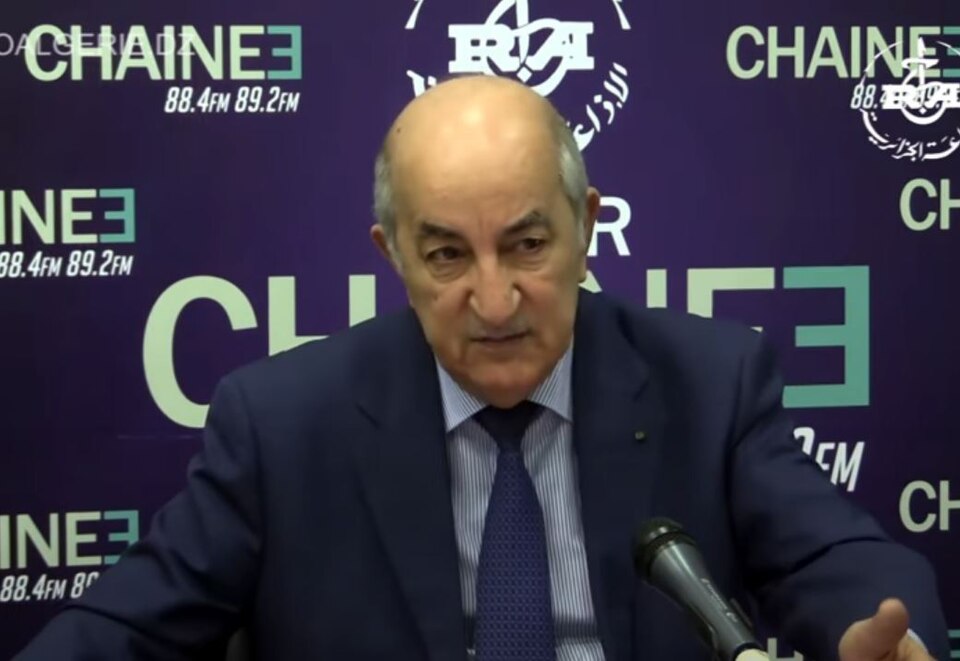
Algerian president Abdelmadjid Tebboune said in 2025 that relations with all GCC countries were warm with one exception, according to Reuters.
Emirati Activity That Disturbs Algeria’s Place in the Hierarchy of Power
Since 2011, Abu Dhabi has built an anticipatory foreign policy designed to shape the regional balance of power before shocks reach the home front. That approach can be described as offensive defence: activity abroad to maximise interests and keep negative effects away from domestic order. The sequence includes support for the 2013 coup in Egypt; alignment with Khalifa Haftar after 2014; participation in Operation Decisive Storm; bridges to Somaliland; the 2017 boycott of Qatar; alignment with the Kurdish independence referendum 2017; observer status in the East Mediterranean Gas Forum while Turkey and Algeria remained outside it; and cooperation with Russia in backing Mali’s military council against northern movements, especially the Azawad movement, bringing the risk of war closer to the Algerian border.
These moves exceed the UAE’s rank as a small power by conventional measures of population, industrial base and autonomous military capacity. Independent action is also constrained by the search for influence through alignment with American and Israeli orientations, as in the Emirati stance toward Hamas and in Western Sahara.
A small state that wants more influence looks for a functional role that can raise its rank. Abu Dhabi has pursued that role through ports, alliances and hard methods: support for secessionist tracks in Yemen and Somalia; control of selected raw materials, especially gold, in Mali and Sudan; containment of regional rivals; and the sharing of geopolitical space with major or regional powers, visible in ties with Israel, India and Ethiopia in the Red Sea basin and Somalia.
From Algeria’s standpoint, the problem is not activity as such. It is the transfer of this activity from West Asia into the Mediterranean basin and the African Sahel. A space Algiers wanted as a zone of understanding becomes a theatre of confrontation in which Algerian military intervention had been rare. Algeria has also maintained courteous working relations with external powers in this region such as Russia and France, but there is a fear that the UAE may now usurp this role, especially in the relationship with France.
The Conflict Between Power and Threat
What Abu Dhabi is doing around Algeria is closer, in this analysis, to a balance of threat than to a classical balance of power, and it is asymmetric.
That pattern has been visible in Libya, Mali, Sudan and the Sahel, and more sharply in Western Sahara. Algeria holds to the Sahrawi people’s right of self-determination. The Emirates opened a consulate in Laayoune in 2020, a practical recognition of Moroccan sovereignty. Added to this is qualitative Emirati–Israeli cooperation that strengthens Morocco, Algeria’s historic rival for leadership in the space Algiers regards as its strategic depth. In energy, the UAE expressed willingness to join financing of the Nigeria–Morocco pipeline, alongside the EIB, OPEC Fund and IsDB. Algiers is likely to read this as competition with the Trans-Saharan Algerian–Nigerian route. It should be noted, however, that no open source records an Emirati statement opposing the Trans-Saharan line.
Algeria is therefore compelled to strengthen its own capacities and widen alliances inside and beyond the region.
Emirati ‘Offensive Defence’ and Algerian National Security
In the Algerian reading, Emirati activity did not remain an external contest over rank. It became a national-security question because the files sit on Algeria’s immediate perimeter: a fragmented Libya, a militarised Sahel, a hardened support for Morocco over Western Sahara, and extra-regional partnerships that Algiers believes can be turned toward its neighbourhood. Official language in 2024–2026 framed Abu Dhabi’s role as the use of money and influence to unsettle that neighbourhood. The September statement did not list incidents. It said the conduct had passed the point at which it could still be tolerated between two sovereign states.
That is why the rupture was presented as defensive rather than theatrical. Algeria’s traditional doctrine preferred diplomatic management. Once the leadership concluded that the surrounding balance was being rewritten without its consent, non-entanglement itself appeared costly. Cutting ties was the available instrument short of a wider confrontation: a signal that the surrounding space is treated as a security perimeter, not as an open field for competing projects.
Both countries are members of the Arab League, but the League has no binding mechanism that can prevent a collision between members. Egyptian mediation therefore appeared as a substitute. Mediation of this kind usually takes a long time once a crisis has become public.
Repercussions of the Rupture
Economically, bilateral exchange is limited and does not exceed about $625 million on 2024 figures. The surplus runs to the Emirates: some $605 million in Emirati exports to Algeria against about $20 million in Algerian exports. The trade balance is not large and can be replaced through other partners.
The economy remains secondary so long as higher policy in Algiers treats the dispute as a threat to national security and regional standing. Limited commerce can be rerouted. A perceived threat to the surrounding balance cannot be priced in the same way. A relatively active Algerian move on diplomatic and military tracks is likely to appear in three forms.
First, an increase in national capabilities to build greater geopolitical influence in the surrounding region.
Second, regional cooperation that may include Saudi Arabia, Türkiye and Qatar.
Third, alignment or cooperation with major powers for leverage: Spain, Italy and, to a relative degree, Frans, together with a wider return to coordination with Russia. China is not excluded.
Only if these moves are pursued in parallel and followed with persistence can Algeria meet Emirati activity with real effect.
Conclusion
Algeria saw in Abu Dhabi’s expansion a disturbance of its standing and a possible injury to national security. The Emirates saw in dense external presence a substitute for small size. The two sides will therefore remain in discord until a genuine mediation appears that can define zones of influence they agree to share—or agree not to touch.