Electrification in Africa means closing the energy access gap and reducing energy poverty
At the United Nations climate summit in Antalya, Turkey, the COP31 presidency is pushing for a global target to increase electricity’s share of final energy consumption to 35% by 2035, a central pillar of the conference.
The COP31 Turkish presidency proposed the global electrification target at the 2026 Bonn Climate Change Conference in June to encourage countries and businesses worldwide to electrify transport, buildings, and industry using renewable energy, helping to accelerate the shift away from fossil fuels.
But as delegates gather in the Mediterranean country for the climate summit known as Conference of the Parties 31 (COP31), the target risks overlooking the different energy realities Africa faces unless they place energy access and development at its centre.
For industrialised economies, electrification is all about replacing existing fossil fuel systems, while in Africa, some countries still want to build electricity infrastructure and distribution networks.
The new target, up from the current global rate of electrification of about 20%, comes at a time when Africa faces energy poverty and a huge electricity access gap.
About 600 million people lack electricity access, with half of them living in three countries, namely Nigeria, Ethiopia and the Democratic Republic of Congo, according to the International Energy Agency.
Sub-Saharan Africa accounts for roughly 85% of the global population lacking electricity.
The 35 by 35 risks widening existing energy inequality
Dr Chigozie Nweke-Eze, founder of the Integrated Africa Power (IAP), an enterprise focused on solving energy and infrastructure deficits across the African continent, said the proposed 35 by 35 target risks overlooking the different energy realities Africa faces.
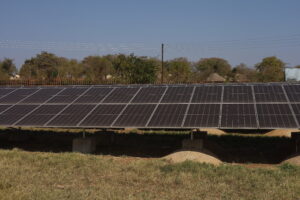
Some of the solar panels which are part of a solar mini grid in Hakwata Chipinge in Zimbabwe. Photo by Farai Shawn Matiashe.
“There is a fundamental distinction between the energy transition in industrialised economies and that in many African countries,” he said.
“There is also a risk that a global target expressed as the share of electricity in final energy consumption could obscure inequalities between countries.”
Nweke-Eze said a global increase in electricity consumption does not mean improved energy access for populations that remain disconnected from the grid.
“Nor does it automatically address the affordability and reliability of electricity for households and small businesses,” he said.
In industrialised economies, electrification is largely about replacing petrol and diesel vehicles with electric vehicles, and industrial gas boilers and household gas heaters with electric heat pumps.
For Africa, it means it must build entirely new energy systems to support its expanding population and development aspirations. The continent is simultaneously attempting to shift towards renewable energy that is both cleaner and more sustainable.
Nweke-Eze said electrification cannot happen at scale without adequate generation capacity, transmission and distribution networks, reliable electricity supply, and affordable connections.
But Nweke-Eze said that Africa should be an integral part of the 35-by-35 ambition, with the target adapted to the continent’s unique energy context, recognising its diverse starting points and prioritising pathways that expand energy access and address the needs of underserved communities.
Another initiative launched at COP31 is the Global Rooftop Solar Declaration, which aims to double the number of solar-powered households globally to 300 million by 2030. Endorsed by a cross-continental coalition including Kenya and Nigeria, the initiative offers a practical pathway to addressing Africa’s energy access gap by accelerating the deployment of household solar, particularly in communities underserved by centralised electricity grids.
It focuses on overcoming barriers such as high upfront costs, complex permitting processes and skills shortages that can slow the adoption of decentralised solar solutions.
This, Nweke-Eze argued, also requires a broader understanding of how progress towards electrification is measured. Africa should not be judged solely against the pace at which industrialised economies replace fossil-fuel technologies, but also by how effectively its countries expand electricity access, develop productive energy infrastructure and improve the quality of energy services.
Nearly 80 houses have been connected to this solar mini grid in Hakwata, Chipinge in Zimbabwe. Photo by Farai Shawn Matiashe.
“The real challenge, therefore, is ensuring that the global electrification agenda does not inadvertently reproduce existing inequalities in the global energy system,” he said.
The 35 by 35 must place energy access and development at its centre
Benjamin Boakye, an energy governance professional and the Executive Director of the Africa Centre for Energy Policy (ACEP), based in Ghana, said energy access and development must be at the centre of the global agenda.
“Beyond setting targets, we must focus on how investment is mobilised and who finances rapid deployment,” he said.
“Solar technologies can accelerate access, but the ambition must go beyond lighting to support productive activities such as agriculture, refrigeration and small businesses.”
Nearly a billion people in Sub-Saharan Africa lack access to modern and clean cooking solutions.
Many across the continent cannot cook with electricity because the tariffs are expensive and beyond their reach.
Boakye said it is vital to link electrification to clean cooking through affordable technologies, reliable electricity and appropriate financing.
“Africa’s development needs should be the reason we accelerate electrification, not an obstacle to it,” he said.
Nweke-Eze said that for Africa, electrification is not only a climate mitigation instrument but also a fundamental development enabler.
“Access to reliable electricity is essential for industrialisation, agricultural transformation, healthcare delivery, education, digital connectivity, job creation and the development of small and medium-sized enterprises,” he said.
Nweke-Eze said that clear commitments should accompany the 35-by-35 target to expand electricity access in countries with the largest deficits and this requires accelerating investments in generation, transmission and distribution infrastructure.
But conventional grid expansion alone will not reach every community economically or quickly enough, he said. Therefore, decentralised renewable energy solutions, including mini-grids, standalone solar systems and battery storage, should form an integral part of the strategy.
Removing barriers
Africa possesses world-class solar, wind, and hydropower potential, alongside critical minerals needed for clean technologies.
It contains 60% of the world’s best solar resources, yet accounts for only about 1% of installed solar PV, according to the IEA.
Other countries like Ethiopia, Kenya and Morocco are expanding their renewable energy ventures.
Ethiopia is moving aggressively on electric mobility and banning internal combustion engines in cars and other vehicles to cut reliance on imported oil, while Kenya is blending a renewable grid with rapid growth in electric motorcycles and Morocco is actively developing renewable energy and localised battery supply chains.
But barriers like capital inequality, lack of infrastructure development, lack of technology and poor distribution systems delay renewables expansion.
Africa lacks affordable capital. African countries face some of the highest borrowing costs globally, making commercially viable projects prohibitively expensive because of systemic inequalities in the international financial system.
There is minimal investment in grids, transmission networks, and battery storage to support the planned widespread switching to clean energy.
The IEA has shown that financing a power project in Africa costs at least twice what it costs in an advanced economy.
Dr Dolapo Oluteye, an expert in Energy and Transport Policy within the Shipping Group at University College London’s Energy Institute, said the cost of capital is the big issue, and achieving energy security in Africa is contingent on dealing squarely with this ‘beast’.
“A solar farm in Kenya and another in Spain receive the same sunlight and the same panels. The difference in the tariff a Kenyan household pays is almost entirely the price of money,” Oluteye said.
“Until that is addressed, every electrification pledge is a statement of intent by the countries that already have cheap capital, addressed to countries that do not. This imbalance will continue to promote energy and economic inequality and economic imperialism.”
She said that local currency lending by the multilateral banks and a well-funded exchange rate guarantee facility would remove the single largest reason that African power tariffs are unaffordable.
Oluteye said that Antalya should ensure that the 35 by 35 tracking mechanism tracks finance to Africa alongside the share of electricity so that Africans cannot remain at a standstill while they record a rise in the global percentage.
“The pledge should recognise first-time connections as electrification, so that access counts rather than only substitution,” she said.
Critical minerals must support industrialisation
Africa holds about 30% of the global reserves of critical energy transition minerals, including cobalt, copper, graphite, lithium, manganese, nickel, platinum group metals and rare earth elements, according to the Economic Commission for Africa (ECA).
But there is a risk of repeating the extractive models of the past, where raw materials support industrialisation elsewhere while Africa remains dependent on imported technologies.
Boakye said Africa needs deliberate strategies to promote local processing, manufacturing, technology transfer, skills development and regional markets.
“This requires competitive energy, infrastructure, capital and policies that create meaningful opportunities for local businesses and workers,” he said.
“Africa’s mineral resources should become a foundation for its own industrialisation and energy transition.”
Countries like Zimbabwe are pushing for local value addition by banning the export of raw lithium. In the southern African nation, a ban on lithium concentrate exports kicks in early 2027.