Women move gender equality fight to the lake
The fishing sector has for generations been dominated by men with women being pushed to household chores. Overall, women in the fishing sector make up over half of the workforce but their roles are limited to processing, small-scale fishing and net-mending and marketing of fisheries.
The UN Food and Agricultural Organization (FAO) estimates that globally in aquaculture, women account for 28% of the workforce in the primary sector; in fisheries 18%; and across the pre- and post-harvest components of the value chain an estimated 50%.
In sub-Saharan Africa, more than 80% of fish processors and traders are women, with men dominating the fishing activities and owning fishing equipment such as nets, canoes and boats.
Sex-for-fish
For a long time women have fallen victim to men who have used fisheries resources as bait to lure women to have sex in exchange for fish. This is a situation that puts desperate women into a corner and this has had an impact on the management of sexually transmitted diseases including HIV/AIDS.
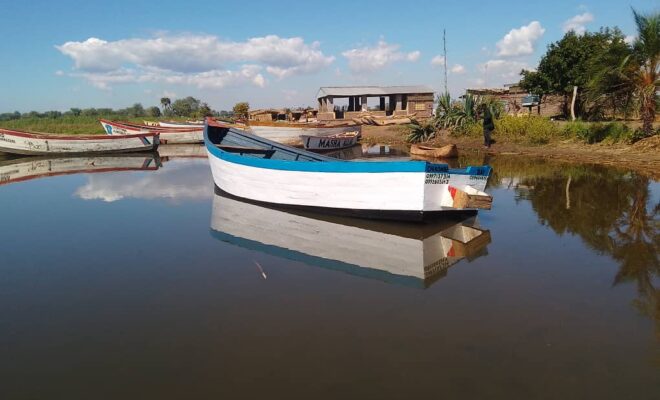
Fishing boats at a landing site on Lake Malawi.
Women have now risen to the occasion. They say they have been oppressed for too long and it is now time to change the narrative. They are now buying and owning the boats, canoes and fish nets moving on par with men.
“Culture has hindered women progress for too long and we want that to be checked and stopped,” says Ellen Zaya.
Zaya, 53, owns two boats and nets. She says she decided to buy the fishing gears after noticing that there was a lot of money in the business and she now employs men who do the fishing for her.
“It was not easy for men to accept us to be with them in the waters and catch fish,” she says, adding, “Men at first resisted but now they have accepted us as a part of them.”
Zaya and many other women from Liwalazi fish landing site in Nkhota Kota district in the central region of Malawi say that they are so determined to end what they call the sex-for-fish trade which they say has increased the rate of HIV infection and threatens lives.
To protect families from sexually transmitted diseases within the fish landing sites fishers have set up the beach village committees (BVCs) and cooperatives.
More women have been deliberately put in these committees to empower them so that they make decisions that favour them more than men.
“We have deliberately put more women in decision making positions because we want to encourage them to do business and let them make decisions that are good for them,” says Stanford Masina, Chair of Tukombo Fisheries Cooperative in Nkhata Bay district.
The BVCs and cooperatives are local organisations set up in almost all the fisheries landing sites with the objectives of protecting the fisheries resources, ending sex-for-fish trade and economic empowerment of local fish traders.
“We have introduced a system where no fisherman will be selling his fish secretly. The owners of the boats and fish will have to sell fish by auction where the highest bidder buys,” says Maggie Chiumia, a fisher who owns a boat and a net at Tukombo fish landing site in Nkhata Bay District in the Northern Region of Malawi.
Chiumia says the practice of auctioning fish in public discourages men from coercing women to have sex in exchange for fish. This, she says, empowers women because now women believe in themselves and that they can have the fish without having sex with men.
For women sex-for-fish is abuse and gender-based violence and they have vowed to completely stop it in all the fish landing sites across the country.
“Women have been victims for a long time. The selling of fish through auction protects not only them but men too from HIV and other sexually transmitted diseases,” says Levision Kondowe, a member of the BVC in Nkhota Kota.
Herbert Mwalukomo, Executive Director of Centre for Environmental Policy and Advocacy (CEPA), says sex-for-fish is a serious problem in the fishing sector and this can be minimised by a transparent trading system.
“It goes without saying that sex-for-fish which is known to be a common problem in fish landing sites can be minimized with a transparent trading system where everyone has equal chances of buying fish. The tendency will reduce further HIV infections as more women become active in all stages of the fishing value chain,” says Mwalukomo.
George Jobe, Executive Director of Malawi Health Equity Network (MHEN) says sex-for-fish remains a serious public health, human rights, gender equality, and HIV prevention concern.
He observes that although significant progress has been made through community sensitization, the establishment of Beach Village Committees, fisheries cooperatives, and women’s empowerment initiatives, isolated cases continue to be reported in some fishing communities.
“Sex-for-fish is not only a fisheries issue but also a public health and social justice issue. Eliminating it completely will require sustained investment in women’s economic empowerment, HIV prevention, community accountability, and protection of human rights,” says Jobe.
Women’s economic empowerment

A cold room constructed under an African Development Bank fisheries project, part of the infrastructure supporting women in the fish trade.
A number of women in the fishing business understand that gender inequality can only be fought successfully by empowering them. Many want their business to thrive and it can only happen through capital investments and this is what women say they need.
“It is not enough to just tell women to be strong in their businesses. These women need capital investment and when they are financially stable their husbands will realise that chasing them from their homes will require some courage they know the women have enough financial resources to maintain their lives,” says Zaya.
Levison Kondowe, 45, who started fishing in 2010 says, “For our fishing business to grow we need money to invest in it. Our boats require fuel and even those women who do the fish processing and trading need modern kiln to dry their fish.”
Mwalukomo says women have low capital investment in the fisheries business, their access to information about the sector is limited, culture is another limiting factor and their participation in the decision making process is low. And these, he says, are some of the reasons that make them not fully participate in the fisheries sector.
He, however, says he appreciates the bold steps taken by some women in the sector to invest in fishing. He says this shows that women can challenge the status quo.
A study published in 2021 observes that women “who earn an income from the fisheries value chain have more access to savings and credit and have more equal household bargaining power”.
Women’s participation in different fisheries projects over the years has empowered them to move from being small-scale traders to owning these assets through cooperatives which are local financial groups.
Projects within the sector in Malawi have enabled more women to own fishing boats and nets with some statistics indicating 5% of women owning gears but the Department of Fisheries says the number is even higher.
One of the projects funded by the African Development Bank (AfDB/ADB) has improved the economic lives of many women. The five-year project which ended in December 2025, targeted close to 20,000 fishers and entrepreneurs, with 50% of the participants being female.
“I have benefited from this project. Today I am a proud mother because I own two boats and nets. I have built a house and I am able to pay school fees for my children, ” says Agness Mkandawire who is based at Tukombo fish landing site in Nkhata Bay district.
Mkandawire who has been in the fishing business since 2012 says women in the fishing sector “are now emancipated from the abuse they faced from men, especially gender based violence.”
“People have learnt and realised that some cultural beliefs were bad for development,” says Patrick Zakeyo, Fisheries Officer at the Department of Fisheries in Salima district in central Malawi.
He says many women are investing in businesses such as fishing, fish processing and even trading. This means that the ground is becoming conducive for gender diversity for all to enjoy equal rights, responsibilities and opportunities.
“This now tells us that gender is becoming irrelevant in determining participation in the fishing and other associated activities,” says Zakeyo.
Women empowerment also reduces cases of gender-based violence within households and the communities at large. The UN Women estimates that nearly 46% of women in Malawi have experienced physical or sexual violence, while 38% of girls are married before the age of 18.
“If a woman is economically empowered, no husband will abuse the wife. We are not only respected by our men, but we are also being supported by them because we have the means to economically survive. There is a reduction in domestic and gender-based violence, sexual abuse and exploitation,” says Tamala Mwenda.
Mwenda owns a boat and a fishing net. She explained that when she first started going in deep waters to fish, accompanied by crew men, she was scared but not now.
“It is a demonstration of determination by women to earn income for improving their livelihoods. While actual fishing is traditionally considered to be a male dominated industry, women are capable of breaking traditional barriers such as culture to achieve gender equality for livelihood and economic goals,” says Mwalukomo.