What Washington Agreed to Last Month
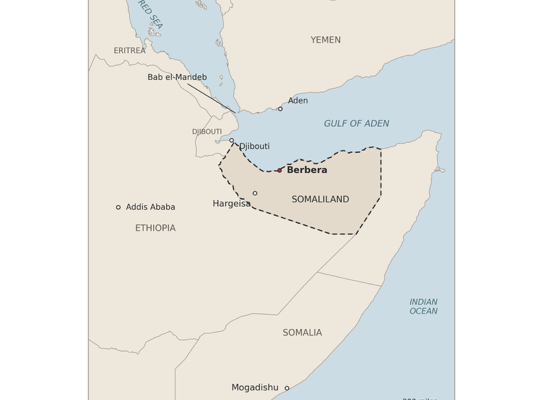
Berbera sits on the Gulf of Aden, about 150 miles south of Yemen. Its deep-water berth and the Emirati investment behind it are what Somaliland has been offering Washington. Illustration generated by the author, not a photograph of the port.
Somaliland’s president spent two weeks in Washington this month offering almost everything he has. Access to the port at Berbera. Access to the territory’s minerals. Military access, which he called a matter for negotiation and declined to rule out. He only asked for one thing in return. Recognition. He went home without it. The same month, the United States secured expanded security rights in Greenland and agreed in writing that sovereignty stays with Denmark.
What Somaliland Offered
Abdirahman Mohamed Abdullahi, known as Irro, arrived on September 5 for his first visit to the United States since winning Somaliland’s presidency in November 2024. On the 14th, he gave the keynote address at the Hudson Institute, at an event titled Somaliland as a Strategic Partner in the Horn of Africa.
His pitch was the seaport. Irro described Berbera as a modern deep water facility that United States Africa Command had already assessed and in which the Emirati operator DP World has invested $442 million. More than twelve percent of global maritime trade passes through the Bab el-Mandeb strait every day. He argued that Somaliland has protected its coastline from militants and pirates for three decades without any recognition at all.
Two days later he went further. In an interview with Semafor he said Somaliland was not giving anything away for free. He offered American investors the port and the minerals. On military access he said it was a matter for negotiation, and he would not rule out a future base agreement. Ten days later he added more. In an interview with the Council on Foreign Relations he suggested renaming Berbera International Airport after President Trump, having earlier floated a Trump Tower in Hargeisa.
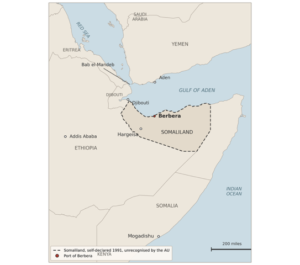
Berbera lies inside Somaliland, which declared the restoration of its independence in 1991 and which no African state recognises. Mogadishu, which holds the recognition, is about 600 miles to the south. Map by the author, using public-domain Natural Earth boundary data.
What They Got
Nothing, so far. Irro himself said there is no American promise on recognition. A source told Politico there is no change in American policy towards Somaliland.
On September 16, China warned Irro that crossing its line on Taiwan would bring serious consequences, and publicly affirmed that Somaliland remains part of Somalia. That handed Mogadishu an endorsement from a permanent member of the Security Council in the middle of a rival’s tour.
The Hudson appearance also drew criticism at home. Clips circulated of Irro hesitating on questions about minerals and regional security. The event’s moderator, Joshua Meservey of the Hudson Institute, said afterwards that Irro had made the right argument, while also observing that Somaliland has not consistently made the case for the reason recognition is necessary.
What Happened For Greenland
On the evening of September 18, President Trump announced an agreement with Denmark and Greenland giving the United States permanent control over security in Greenland. He described it as an agreement with no end, at no cost. The three governments signed it in New York on September 22, and the White House released the text the same day.
Copenhagen and Nuuk described something narrower. Greenland’s prime minister, Jens-Frederik Nielsen, said the agreement recognises the sovereignty and territorial integrity of the Kingdom and the right of Greenlanders to self-determination. A State Department official told CBS News it gives permanent access and overflight rights, allows more bases and bars non-NATO members from building their own.
None of this is new ground. American forces have been in Greenland since 1941, and a 1951 defence agreement gave the United States the right to operate bases there, with Danish sovereignty expressly preserved. Reading the text signed this month, ABC News reported that it does not appear to add materially to that access. What Washington secured was a broader scope and a bar on rival powers. The access itself it already had.
Set the two outcomes beside each other. In Greenland, Washington obtained security control, overflight rights and the option of more bases, and conceded in writing that sovereignty is unchanged. In Somaliland, Washington was offered a deep-water port, a mineral concession and a negotiable military base, and conceded nothing.
Two Governments, One Port
The Greenland agreement works because everyone with a claim signed it. Denmark holds sovereignty. Greenland holds self-government. The United States holds the access. Three parties, one signature page.
That page does not exist for Berbera. Two governments have now offered Washington the same port. In a letter dated March 16, 2025, Somalia’s president offered the United States exclusive operational control of the port and air base at Berbera. Somalia’s foreign ministry confirmed the letter to the Associated Press as an authentic draft, and Semafor reported that the offer was made to head off any American recognition of Somaliland, and that Mogadishu does not control the sites it was offering.
This month Hargeisa offered the same port. So the government with the recognition does not control Berbera, and the government that controls Berbera does not have the recognition. Each has offered the port to Washington. The Greenland model needs both names on one page, and these two will not sign the same page.
What the Continent Has Not Done
Somaliland declared the restoration of its independence in 1991, three decades after joining the former Italian-administered south to form Somalia. No state recognised it until Israel did in December 2025. The African Union has been asked directly. In 2005 it sent a fact-finding mission to Hargeisa, which reported that the 1960 union had never been ratified and called Somaliland’s search for recognition historically unique in African political history. It recommended that the Union find a special method of handling the case, and never adopted the report.
The reason is Article 4(b) of the AU Constitutive Act, which carries forward the 1964 decision of the Organisation of African Unity that the borders states held at independence are to be respected. The chairperson of the AU Commission, Mahmoud Ali Youssouf, said in December 2025 that recognising Somaliland would set a dangerous precedent for Somalia’s unity and territorial integrity. The closest any neighbour has come was Ethiopia’s memorandum with Hargeisa in January 2024, which traded access to the sea for the prospect of recognition. Mogadishu treated it as an act of aggression, and the two governments buried it in Ankara that December.
A Hidden Cost
The argument for recognition, as it is being made in Washington, is about maritime security and great power competition. It has a hole in it, and it is the counterterrorism side.
Israel recognised Somaliland in December 2025. Within days the Houthi leader, Abdul-Malik al-Houthi, warned that any Israeli assets in Somaliland would be legitimate military targets. The Wall Street Journal reported in August that a four-member Houthi delegation crossed from Yemen in June to Jilib, al-Shabaab’s stronghold in southern Somalia, to discuss countering Israeli activity around Berbera.
The cost is not hypothetical. Maersk suspended new cargo bookings to and from Berbera in April, citing scheduling changes. It came days after the Houthi authorities in Sanaa warned about expanding Israeli engagement in the Horn. One country’s recognition of Somaliland has already cost the port Irro is selling one of the world’s largest shipping lines.
The larger cost is in the south. The United States fights al-Shabaab through the federal government in Mogadishu, which offered Washington Berbera for the express purpose of preventing recognition of Somaliland. A deal with Hargeisa over the same port is a deal made against the government the southern fight depends on.
What to Watch
Whether any American official says anything on the record about Somaliland. Whether the African Union revisits the findings of its own 2005 mission. Whether the Berbera offer appears in a written instrument rather than an interview. And whether Maersk or any other line resumes bookings at Berbera, which would be the first real signal that the Red Sea risk calculation has changed.
Somaliland is selling something Washington has stopped buying.