
Beyond Load Shedding: How South Africa’s Electricity Crisis Scarred Industry
South Africa’s electricity system has staged a remarkable recovery. On 4 September 2026, Eskom reported that the country had gone 476 consecutive days without load shedding, while the performance of its power stations reached its highest level since 2020. South Africa also made it through the 2026 winter with electricity demand fully met.
After years in which loadshedding disrupted almost every part of economic and social life, this is an important achievement. But it also makes now the right time to ask a different question: what did the electricity crisis leave behind?
Loadshedding was usually measured in hours without electricity, stages of power cuts or megawatts unavailable from the grid. These measures captured the immediate crisis. They tell us much less about the longer-term damage to businesses, workers and South Africa’s industrial base.
Factories do not simply return to where they were once electricity becomes reliable. During years of power shortages, firms cut jobs, postponed investment, bought expensive backup power and lost export opportunities. Some close. Others abandoned expansion plans.
The lights may thus be back on, but some of that damage remains. This matters because South Africa wants to rebuild its manufacturing sector and create more productive jobs. Ending load shedding is an essential part of that effort. But it is only the beginning.
From Electricity Crises to Structural Damage to Industry
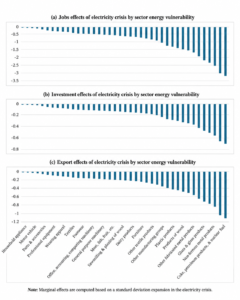
We examined this problem in two recent studies published in Energy Policy and Energy Economics. Our findings point to three important ways in which the electricity crisis weakened South African manufacturing. This includes the job, investment, and export channel, respectively.
Manufacturing employment depends on production being sustained long enough for firms to keep workers productively engaged. Repeated electricity interruptions broke that continuity. When machinery stops, production lines are disrupted and output falls, firms face an immediate labour problem: maintaining employment becomes more costly even as production becomes less predictable. Our research confirms this relationship as we found that the electricity crisis was associated with significant job losses in South African manufacturing, particularly in sectors that depend more on the energy sector through output and input linkages. These losses affected both formal and informal employment.
But the significance of those job losses extends beyond the number of workers displaced. Factories are also places where workers gain experience and learn how to use machines, manage production processes and solve technical problems. When manufacturing jobs disappear, some of these skills and capabilities disappear with them. The economy thus loses part of the human and organisational capabilities needed to raise productivity and build more sophisticated industries. The job effect of the electricity crisis was therefore also a capability effect that can adversely affect the future industrial development.
The investment channel, though less visible, constituted the second way electricity crisis weakened South African manufacturing. Businesses invest when they believe they will be able to produce and earn a return in the future. Years of unreliable electricity made those calculations much harder. Manufacturers facing repeated power cuts had less reason to expand factories, buy new machinery or introduce new technologies. Money that could have financed expansion was often redirected towards generators, diesel, batteries and other ways of keeping existing production running. These investments were necessary for survival. But a generator that allows a factory to keep operating is not the same as a new machine that allows it to produce more efficiently or make a more sophisticated product.
Our research finds that the electricity crisis reduced capital investment among manufacturing firms. This is one reason the effects of the crisis may last beyond load shedding itself. South Africa did not only lose production during power cuts. It also lost some of the investment that could have created future production. Electricity instability therefore becomes a hidden tax on industrial upgrading.
Finally, exporting depends on more than the ability to produce a competitive product. Manufacturers competing internationally must deliver the produced goods reliably, at the agreed quality and on time. Repeated electricity disruptions made that harder. A firm that cannot predict when its production line will operate may struggle to meet an export order or maintain a relationship with an overseas buyer. Our findings show that the electricity crisis also harmed the export activities of South African manufacturers. This loss goes beyond export earnings and a mixed market opportunity. Selling into demanding international markets can push firms to improve quality, learn from customers and become more productive. Losing access to those markets can therefore weaken future industrial growth.
When electricity crises leave permanent scars
These three effects reinforce each other. Job losses reduce opportunities for workers to gain industrial skills. Lower investment means fewer new machines, technologies and production lines. Weaker exports reduce firms’ exposure to competitive international markets.
This is how an electricity crisis can gradually become an industrial crisis.
South Africa was also struggling with high unemployment, weak private investment, sluggish productivity growth, and premature deindustrialisation before the worst years of load shedding. Electricity shortages did not create all these problems. But they made an already difficult industrial situation worse. This is why the recent recovery in electricity supply should not lead to complacency.
South Africa now has an opportunity to move from electricity crisis management to industrial recovery. That requires looking beyond whether electricity is available today. Policymakers also need to ask whether electricity is reliable and affordable enough to encourage firms to invest again, expand production, employ workers and compete internationally.
The challenge has also changed. National load shedding may have eased dramatically, but electricity problems have not disappeared. Distribution networks, municipal electricity systems and the cost of power increasingly shape whether households and businesses actually experience secure electricity supply.
Reform Must Become Productive Industrial Policy
Keeping the lights on is not enough. Electricity reform must be seen as part of industrial policy. This does not mean government should simply provide cheaper electricity to every business. It means recognising that decisions about electricity affect what firms can produce, where they invest and whether they can compete.
Different industries also face different electricity needs. A highly energy-dependent manufacturer is more exposed to unreliable supply than many service businesses. A large multinational may be able to finance its own backup system, while a smaller domestic manufacturer may not. Policy therefore needs to pay greater attention to which industries are strategically important, how vulnerable they are to electricity problems, and which firms have the least ability to protect themselves.
South Africa already has some foundations for doing this. The South African Renewable Energy Masterplan seeks to connect the expansion of renewable energy with domestic manufacturing, skills and technology development. The Just Energy Transition Investment Plan similarly presents the energy transition as an opportunity for industrial development and economic diversification. These ambitions will be difficult to achieve unless energy and industrial policy are brought much closer together.
Building solar panels, batteries, electric vehicles or other green industries requires more than policy targets. Firms must believe that they can obtain electricity reliably, at a price that allows them to compete, and in the places where they want to invest.
South Africa’s experience also offers a warning to other developing countries. Electricity is not simply another service supplied to the economy. It helps determine what kind of economy can develop. When power is unreliable for long periods, firms change their behaviour. They invest less, employ fewer workers, lose customers and may retreat into less productive activities.
And once factories close, skilled workers leave, and business relationships disappear, rebuilding them can be difficult. South Africa’s electricity crisis may have eased, but repairing its economic consequences will take longer.