
Not Energy, But Power: why Geothermal Energy Benefits Everyone in Iceland but not Kenya
This article draws on in-person interviews at Mt Suswa, Olkaria, and Menengai with Coalition for Human Rights in Development (CHRD) members and partners directly affected by geothermal projects. Interviews were led by the Coalition’s Research and Learning Facilitator and interviewees identified through the Community Resource Exchange (CRE), a system to facilitate collaborations and co-develop strategies with and among communities defending their rights in the context of international investments and development projects. The analysis also incorporates a review of Kenyan and Icelandic energy policy documents and insights from the Coalition’s roles in the AfDB Civil Society Working Group and its Energy Sub-Group.
In Iceland, geothermal energy – one of the cleanest solutions to the climate crisis – is widely hailed as a success story. It supplies 65 % of the country’s electricity and heats nearly 90% of its households. Everyone benefits from it.
Thousands of kilometres away, in Kenya, steam rising from the Rift Valley drives one of Africa’s largest geothermal programmes, supplying nearly half of the country’s electricity. According to recent data, Kenya is the world’s sixth-largest geothermal producer. Yet, its projects are entangled in disputes over land, livelihoods and rights, with local communities left grappling with acid rain, noise pollution and toxic soil.
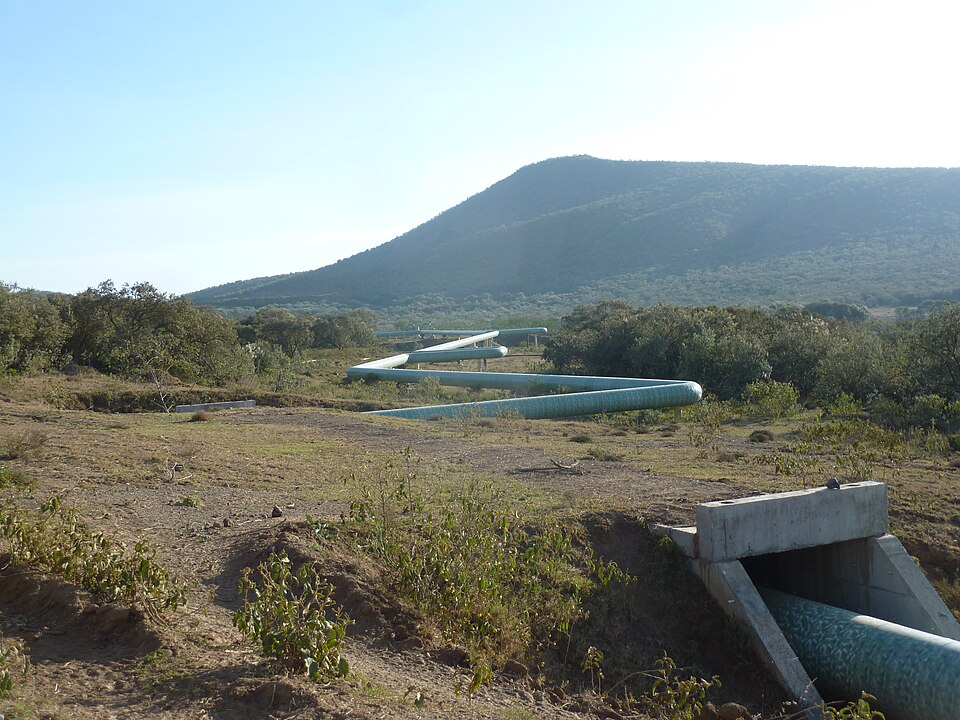
Steam pipe in Hell’s Gate natural park, Kenya. 2017. Photo credit: Wikimedia Commons.
So how can geothermal energy be celebrated as a success story in one country, and a source of conflict, contestation and environmental harm in another? The difference lies not in the energy resource itself, but in how this resource is governed, financed, and embedded within different social and political contexts. It’s not about energy, it’s about power.
Different technologies, different risks
Different technologies used in geothermal systems, particularly with regard to the management of by-products such as brine and emissions, can lead to different levels of environmental risk.
In Iceland, geothermal operations are characterised by high rates of reinjection to reduce water use, minimal use of open brine storage, and increasing efforts to capture and reinject emissions such as hydrogen sulphide. Environmental challenges are largely approached as technical problems, with the resources and institutional capacity to address them and minimize harm.
In Kenya, while water reinjection does take place, it is not always consistent or effective. In some cases, particularly during drilling or testing phases, geothermal fluids are stored in open, unattended ponds. Infrastructure limitations, cost constraints, and poor monitoring lead to air, water and noise pollution, which has a harmful impact on the health and livelihoods of affected communities.
Communities living near the Menengai Geothermal Power Project in Nakuru County, for example, complain of loud noises disrupting sleep and school activities, hydrogen sulphide emissions, dust, and water pollution. Respiratory problems, particularly among children and older people, are common. Community members are also concerned that geothermal emissions and open brine ponds could be linked to acid rains in the area, which are corroding their house roofs, water tanks and farm equipment.
A different geography, a different history
In Iceland, geothermal resources are largely located in sparsely populated volcanic zones. Land tenure is relatively stable, and there is little legacy of large-scale dispossession shaping current development.
On the contrary, the Rift Valley is a highly populated lived space, where pastoralist communities have deep historical and cultural ties to their land. Here, geothermal projects sit atop layered histories of colonial and postcolonial land alienation and violent evictions. Maasai communities still lack deeds to their land and are treated as guests of the government without their own rights. In this context, the expansion of geothermal projects has led to further resettlement, restricted access to grazing areas, loss of livelihoods, and ongoing disputes over compensation and participation.
In 2014, for example, a group of Indigenous Maasai pastoralist communities submitted a complaint to the accountability mechanisms of the World Bank and European Investment Bank for their investment in the Olkaria IV geothermal project, which caused the displacement of around 150 families (approximately one thousand people) from their ancestral land. The Maasai families used to rely on large areas of open grazing land for their livestock. However, they were resettled on land less than half the size of their previous grazing grounds and marked with steep ravines, which made their traditional way of life as pastoralists impossible. The banks’ accountability mechanisms confirmed serious weaknesses in consultation, livelihood restoration and the treatment of Indigenous land and culture, and facilitated a mediation agreement. However, several commitments were delayed or incompletely implemented. For instance, the resettlement area lacked essential infrastructure (including adequate water and roads) and communities were not provided with a share in the benefits derived from the project.
The expansion of the geothermal field in Olkaria has also led to violent conflict. In 2012 some private land claimants burned more than 50 Maasai homes in Narasha, killed livestock and assaulted residents, while the police arrested villagers who tried to intervene. Because of these violent attacks, hundreds of people were left homeless and forced to flee.
Governance, ownership and accountability
In Iceland, the development of geothermal energy has been shaped by strong state institutions, robust regulatory oversight, safeguards consistently enforced, and a model of public ownership that treats energy as a collective good. The benefits are integrated into national systems of provision and widely distributed. And when environmental concerns arise, they are addressed within a governance system capable of responding effectively.
In Kenya, geothermal projects often involve complex arrangements between state agencies such as Geothermal Development Company (GDC), public-private partnership developers such as KenGen, international private corporations, and development financiers such as the African Development Bank (AfDB), the Development Bank of Southern Africa (DBSA), and the World Bank.
In this intricate web of actors, it is difficult for affected communities to seek accountability and remedy. Communities living near the Menengai geothermal fields, for example, have repeatedly engaged the Kenyan government and international financiers to report their concerns. While they have sometimes succeeded in protecting their rights (for example winning a court case ordering a new comprehensive environmental and social assessment for the development of a new geothermal plant), their struggle and the concerns raised over the years shows that often safeguards only exist on paper.
Energy for whom?
In Iceland, geothermal energy primarily serves domestic needs, providing affordable heating and electricity. In Kenya, geothermal development is tied to broader national and export-oriented growth strategies. Even where electricity feeds into the national grid, affected communities often lack energy access at all. The benefits travel outward, while the impacts remain local. What is often celebrated as a clean energy transition begins to resemble something more familiar. Localised harm, externalised benefit, and decisions made far from those most affected.
This comparison between how these two vastly different states harness geothermal energy reveals that renewable energy technologies are not inherently just. They do not, by their nature, redistribute power or repair historical injustice. Without meaningful participation, strong accountability and respect for community rights, they risk reproducing the very dynamics they claim to replace.
Iceland’s story is not false, but it is partial. It reflects a case of geothermal best practice in which governance, ownership, and social relations align in ways that prevent conflict and distribute benefit. Kenya’s experience, by contrast, makes visible what is often obscured: that the energy transition is not only a technical shift, but a political one. The lesson is not that geothermal energy fails in Kenya and succeeds in Iceland, but that energy systems reflect the societies in which they are built. And until questions of land, rights, and decision-making are placed at the centre of the transition, the promise of “clean energy” will continue to mask deeply unequal outcomes.