The Salvador Pass: How a Nameless Desert Gap Became a Battleground for Libya’s Warlords
A failed prisoner exchange in Niger has revealed a complex network of Libyan, Nigerien, Chadian, and Russian interests converging on one of the Sahara’s most established smuggling corridors.
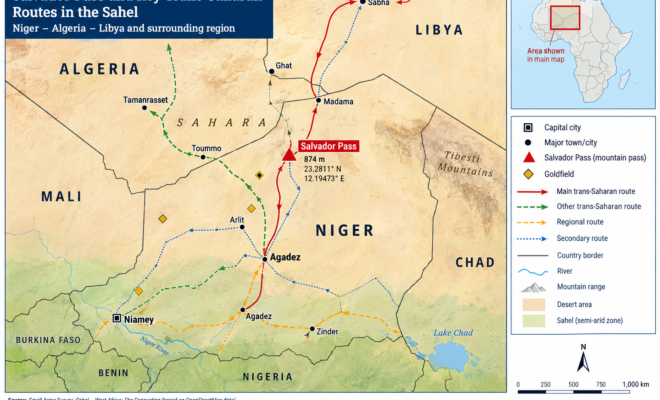
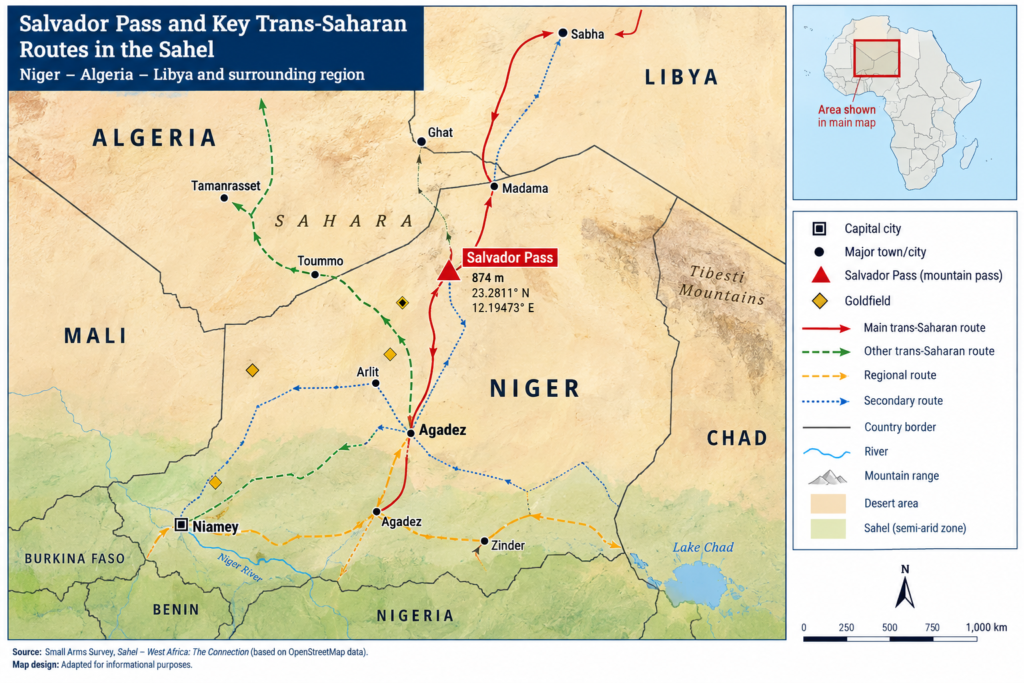
On the maps that colonial cartographers drew of the Sahara, most features carry the names of the people who ‘discovered’ them, or of the places they resembled. The origin of the name given to the gap in the escarpment where Libya, Niger and Algeria meet is murkier: old French military survey maps simply labelled it ‘Passe de Salvador,’ and no definitive account of whom or what it honours has survived into the public record. What is well documented is what the pass has been used for ever since: for centuries, it has been one of the best-known smuggling corridors in the Sahara, moving fuel, cigarettes, migrants and weapons between three states at the exact point furthest from any of their capitals.
This very obscurity is significant. In the current year, the desert region surrounding the pass, sometimes referred to as the Salvador Triangle, has emerged as an active arena for both warlords and great-power politics, with implications extending well beyond southern Libya.
For readers less familiar with the region, the essential political map is this: Libya has had two rival governments since its 2014 civil war — a UN-recognised administration in Tripoli, in the west, currently led by Abdulhamid Dbeibah, and a rival administration in the east, based in Benghazi and controlled militarily by Khalifa Haftar. Niger has been run by a military junta since a 2023 coup, led by General Abdourahamane Tiani; Chad’s government, headed by Mahamat Idriss Déby, emerged from a similar military transition after his father’s death in 2021. Algeria, the region’s traditional power broker, is a civilian-led state with its own long-standing interests in Sahelian stability. It is the overlapping ambitions of these governments — together with Russia, which backs actors on more than one side at once — that converge on the Salvador Pass.
This analysis is based on several months of interviews and documents collected by the research network, including discussions with a Libyan military source possessing direct knowledge of Benghazi’s engagement in Niger and Chad.
A prisoner swap that never happened
For years, the eastern Libyan camp led militarily by Khalifa Haftar — and increasingly run day-to-day by his son Saddam Haftar — quietly built its own channels into Niger and Chad, using tribal networks and smuggling routes around the Salvador Pass that predate every modern state in the region. At the centre of that relationship was a straightforward transaction: Benghazi wanted the extradition of a detained Libyan figure, Rifi Bahr al-Din, held in Niger since mid-2025; in exchange, it would release Mahmoud Saleh, head of the National Front for the Liberation of Niger — an armed Nigerien opposition movement —, then in eastern Libyan custody.
The agreement failed, to the disadvantage of Benghazi. According to the Libyan source, negotiations had progressed to a finalised exchange when Niger’s military authorities in Niamey instead transferred Bahr al-Din to the rival, internationally recognised government in Tripoli, led by Abdulhamid Dbeibah. Saleh was released from eastern Libyan custody at nearly the same time, a timing he attributes directly rather than to coincidence.
This sequencing raises an obvious question: if Niamey had already abandoned the exchange by handing Bahr al-Din to Tripoli, why would Benghazi still release Saleh? Two explanations are consistent with the reporting, and the available sources do not allow a choice between them. The first is a breakdown in communication: Benghazi may have set Saleh’s release in motion before the transfer to Tripoli reached the relevant officials, making the near-simultaneous timing coincidental after all. The second is a calculated gesture: eastern Libya may have proceeded regardless, betting that visibly honouring its side of the bargain — even after Niger had not honoured its own — preserved its credibility for future dealings with Niamey. Either way, the episode is an early instance of a pattern that recurs throughout this account: actors in this corridor keep extending themselves toward partners who have already begun hedging them.
For Benghazi, this was not merely losing a detainee. It was a message: Niger’s ruling council under Abdourahamane Tiani no longer saw the Haftar camp as its main channel into Libyan and Sahelian affairs instead of Tripoli.
The cell nobody talked about
The most striking disclosure to emerge from this reporting concerns something rarely acknowledged: a Nigerien liaison cell that travelled to Benghazi and met directly with Saddam Haftar and senior eastern Libyan officials, well before the prisoner-swap collapse became public. These meetings went beyond the detainee question, touching on the movement of armed groups across the Libya-Niger-Chad triangle and coordination against shared adversaries.
One file discussed in this channel involved a joint operation against fighters loyal to Mohamed Ouardougo, a rival Chadian-Libyan militia commander operating in the same border region, and his Chadian allies — complete with a proposed budget of roughly $7 million and discussion of intelligence-sharing, coordinated raids, and possibly drone strikes using eastern Libyan aircraft. That such a plan was seriously discussed suggests something closer to an undeclared alliance between Benghazi and elements inside Niger’s security establishment than has previously been reported.
The fate of that liaison cell following the collapse of relations remains unclear. Libyan sources confirm its existence and its meetings with Haftar, but provide no evidence linking its members to the officers involved in the attempted coup against Tiani on the night of 28-29 August 2026. Russian personnel from the Africa Corps assisted in suppressing the coup, alongside significant Algerian military support. The proximity of these events warrants examination, as the coup attempt occurred only weeks after the Benghazi-Niamey rupture, during a period when Haftar’s camp was expanding contacts with Tiani’s adversaries. However, temporal proximity does not establish causation, and it is important to avoid unsupported conclusions. The available evidence demonstrates that the security relationships in this corridor are more extensive and intertwined with Niger’s internal politics than previously documented.
Moscow plays every side
Russia’s role adds a further layer of contradiction. The Kremlin regards Haftar as one of its most important Libyan partners. That partnership had, until only weeks earlier, extended informally to Niamey as well: for years, Haftar’s channel to Tiani’s junta was one of Benghazi’s most valuable assets in the Sahel, which is what makes what follows worth pausing on. when Tiani’s government came under genuine threat in August, Russia’s Africa Corps fought to save it.
The tension worth noting is this: Moscow moved to preserve Tiani’s government at the very moment Haftar’s own channel to Niamey had just collapsed over the Bahr al-Din affair described above. That timing suggests the Kremlin’s calculations run directly to each capital rather than through its Libyan partner — Haftar’s falling-out with Tiani did not become Russia’s falling-out with Tiani too. (Africa Corps is the renamed, state-controlled successor to the Wagner Group.)
This approach reflects deliberate strategy rather than inconsistency. Moscow manages its Sahelian relationships as a portfolio rather than a traditional alliance system: it supports Haftar in Libya and Tiani in Niger simultaneously, Haftar has similarly adopted this approach from his own position. In August, Reuters reported that authorities under Khalifa Haftar facilitated the release of Kevin Rideout, an American missionary held for nearly ten months by an Islamic State affiliate after being abducted outside his home in Niamey. According to Reuters, this arrangement illustrates how Haftar has established himself as a significant security broker across the Sahel, serving the interests of both Washington and Moscow.
Southern Libya, in other words, is no longer simply a deployment zone. It has become a marketplace for mediation, where control of tribal and criminal networks buys standing with capitals thousands of miles away. It can work both ways at once: Haftar’s camp has for years maintained cordial security ties with Chad’s president, Mahamat Idriss Déby, whose predecessor relied on Haftar’s forces to strike Chadian rebel groups based in southern Libya, principally the Front for Change and Concord in Chad (FACT), which had fought alongside Haftar’s forces during his 2019–2020 campaign for Tripoli before turning against N’Djamena and clashing with the LNA itself in 2021, , through kinship and trading ties that connect Libyan Tuareg militias in the Fezzan — cultivated by Haftar’s general command since 2016 — to Tuareg armed factions across the border in Mali and Niger. Few actors anywhere can keep live channels open with both sides of someone else’s conflict — and that scarcity is itself a form of power.
Everyone else is losing ground
These developments have also affected the region’s traditional power broker. Algeria served for decades as the Sahel’s principal mediator, notably brokering the 2015 Algiers Accord between Mali’s government and northern armed groups. This status eroded when Mali’s junta terminated the accord in January 2024, citing Algerian interference. Relations further deteriorated before both countries restored diplomatic ties and reopened airspace in July 2026 after a 14-month hiatus. However, this tentative normalisation has not reinstated Algeria’s previous influence. The Sahel is now genuinely multipolar, with Algeria functioning as one actor among several rather than the default arbiter. Tripoli has recognised this opportunity. Dbeibah’s government has actively pursued African diplomatic engagement, seeking closer ties with Chad and Sahelian institutions that previously prioritized Benghazi. Niger’s decision to transfer Bahr al-Din to Tripoli rather than Benghazi provides the strongest indication to date that this strategy is effective. This development also underscores how Libya’s internal divisions have become a resource neighboring states can exploit, leveraging Tripoli and Benghazi against each other as circumstances dictate.
Why this matters beyond the desert
Underneath it all is a longer contest that will outlast any single crisis: who ends up controlling the route connecting the landlocked Sahel to the Mediterranean. Mali, Niger and Chad depend on northern desert corridors as their most direct link to global markets. Algeria has invested for decades in trans-Saharan transport infrastructure to make itself the answer. But Libya has geography on its side — and the Salvador Pass sits at the shortest of those routes, a natural extension of the Fezzan region toward Mediterranean ports.
If these routes are eventually secured and formalised, the pass and its surrounding desert networks could transform from symbols of smuggling and instability into a legitimate economic corridor. The actor that establishes the strongest relationships with the tribal and smuggling networks facilitating the movement of goods and people through this region will possess significant leverage over the Sahel, influence that will persist regardless of changes in government in Niamey, N’Djamena, or Bamako.
This context reveals the broader significance of the failed prisoner exchange at an obscure desert pass: it represents not merely a diplomatic dispute between two governments, but an initial episode in a protracted contest over control of Africa’s access to the Mediterranean.