How a School Project in the Amazon Is Tracing Afro-Brazilian Ancestry Back to Africa’s Great Empires
In Alcântara, a quilombola territory in Brazil’s Amazon, students are using DNA tests, historical research and oral memory to uncover ancestral connections to West Africa and reclaim histories erased by slavery and colonialism.
In the Brazilian Amazon, a school project set out to investigate a question that had long been difficult to answer: where in Africa did the ancestors of quilombola communities come from?
Quilombola communities are formed by descendants of Africans who resisted slavery and established communities where they could preserve their ways of life, traditions, collective identities and relationships with the land. Across Brazil, these communities have kept histories of resistance alive, passing them from one generation to the next.
One of the largest concentrations of quilombola communities in the Brazilian Amazon is found in Alcântara, a municipality in the state of Maranhão. Home to dozens of quilombola communities, Alcântara is part of what is often described as a Black Amazon — a region whose African and Afro-Brazilian histories are deeply rooted in its territory, yet are still frequently overlooked in narratives about the Amazon. It was in this territory that teacher Lucas Sousa began developing the Origens project. The initial question was simple: What are your origins?
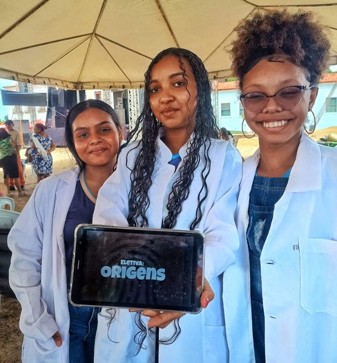
Students from the project presenting the results of their investigation.
The students’ answers revealed a gap. Many knew the history of their ancestors mainly through the experience of enslavement, but knew little about the African history that came before it. The kingdoms, empires, societies, cultures and territories that were part of their ancestors’ histories remained distant from their own family and school narratives.
From this question, the project turned the classroom into a space of investigation. The students began researching the history of their communities, listening to oral memories, searching historical records and taking DNA tests to investigate their African ancestry.
The results revealed a particularly significant connection. All of the participating students showed genetic ancestry associated with the region historically known as the Gold Coast and Slave Coast area, with particularly strong connections to the territory of the former Kingdom of Dahomey, in present-day Benin. The discovery gained an even deeper meaning when the students began to understand the relationship between this region of Africa and the cultural history of Maranhão.
In the state, one of the most important African-derived religious traditions is Tambor de Mina. Its history is connected to enslaved Africans and their descendants, and one of the figures frequently associated with the tradition is Na Agontimé, a woman of Dahomean origin who, according to historical accounts and tradition, was brought to Maranhão and played a role in the development of the religious tradition.
The investigation also revealed the diversity of African origins among the students. Other results pointed to the Senegambia region, leading to new discoveries about societies and kingdoms such as Mali, Jolof and Kaabu. What initially appeared to be a search for a single origin became a discovery of the historical diversity of the African continent and the different routes that connected Africa to Brazil.
For student Kaylla Garcia, discovering an ancestral connection to the territory of present-day Senegal prompted a different reaction. As she learned about the region and began to understand the violence produced by the transatlantic slave trade, she became indignant at the rupture slavery created in the histories of millions of Africans and their descendants. Without the project, Kaylla believes she might never have discovered this part of her own history.
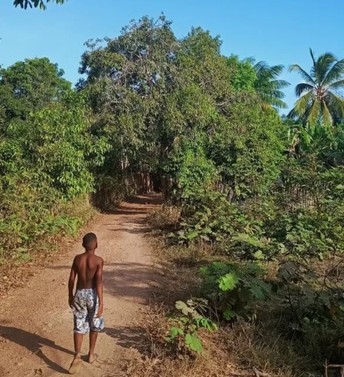
Child walking through the quilombola territory of Itamatatiua in Alcântara.
Kaylla’s experience captures one of the central discoveries of Origens: investigating ancestry was not simply about finding out where their ancestors came from, but also about understanding what had been lost, interrupted and silenced throughout history.
As they learned about these territories, the students began to see Africa differently. The continent was no longer simply the distant place from which their ancestors had been forcibly taken through slavery. It became a continent of complex societies, kingdoms, empires, cultures and histories of its own.
For many of them, the investigation also awakened a new desire: to visit the places they had discovered through their research. The project did not end with the DNA results. It created among the students a dream of crossing the Atlantic once again — this time not as people torn from their homeland, but as young quilombola people who want to know the lands of their ancestors.