Nigeria has not decided how to regulate Chinese businesses. Who will decide?
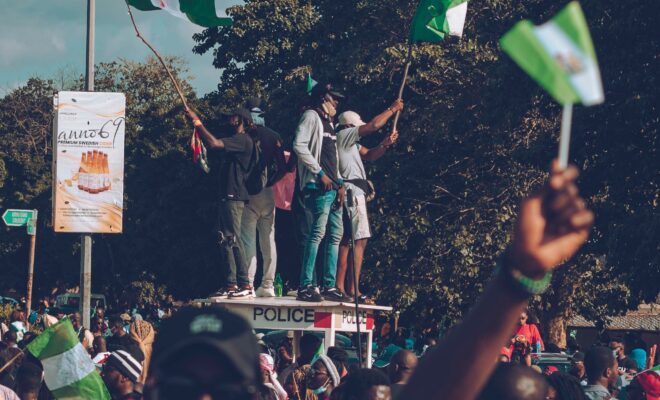
In mid-September 2026, traders in the auto spare parts section of the Lagos International Trade Fair Complex protested against Chinese traders who sell directly to customers. One protester said the Chinese had ‘built warehouses, rented shops and are now selling as we do as retailers.’ Police called the protesters ‘a few miscreants’.
Nigeria already has rules for foreign businesses. But the government has not said what it wants from Chinese businesses, or who will carry out the policy. In the two weeks after the protest, the police, a market board, a minister’s aide and a governor all spoke. None said whether the rules will change. Mining shows the same gap. In both, a policy question is being handled as a policing problem.
Competition over one supply chain
Retailer John Chidebere told Premium Times that goods from China take two to three months to arrive and leave him little profit. Meanwhile, Chinese businesses can sell directly to local customers at wholesale prices. Nigeria imported N11.01 trillion of goods from China in the first half of 2026, nearly 40 per cent of its imports, according to National Bureau of Statistics data. SBM Intelligence says the trade deficit is ‘substantially a symptom of Nigeria’s broader industrial and macroeconomic environment, not a cause in itself.’ Commentator Martin Beck Nworah said: ‘once the wholesaler becomes the middleman, the retailer is edged out.’ So this is a fight inside one supply chain, not only Nigerians against Chinese competitors.
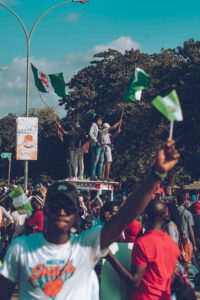
Protesters rally outdoors in Nigeria, October 2020
What the traders are asking for
Newsclick reported placards reading ‘The Chinese must go.’ But Chief Osigwe told Premium Times that Chinese traders should leave the market and trade elsewhere, not leave Nigeria. Trader Clement Ebere said: ‘I’m not saying the Chinese should leave, but it should be negotiated.’ The association’s president, Nnamdi Ngozi Emechebe, said asking the Chinese to leave Nigeria was not an option. Some of the Chinese wholesalers approached by Premium Times declined to comment. So the slogan and the demand did not match. The traders want Chinese businesses out of retail, not out of Nigeria.
The law allows it
A BusinessDay legal explainer says the Nigerian Investment Promotion Commission (NIPC) Act lets foreigners invest in most businesses. The Act’s short list of banned areas covers arms and ammunition, narcotic drugs, and military and paramilitary clothing, plus anything the Federal Executive Council adds. Retail is not on it. Foreigners still need visas, business permits and expatriate quotas. So the legal question is whether these businesses have the right permits. The political question is bigger: does Nigeria want foreign companies in retail at all?
The Centre for the Promotion of Private Enterprise and a Daily Trust editorial of 2 October both ask for the rules on foreign retailers to be reviewed. Neither asks for a ban. The rules exist. What is missing is a decision on whether to change them.
Institutions have spoken, but no decision taken
Police Area Commander ACP Chike Oti said the protesters had been cautioned and arrests would follow, but no arrest had been reported in the coverage I found. Veronica Ndanusa, who heads the Lagos International Trade Fair Complex Management Board, a body under the Federal Ministry of Industry, Trade and Investment, told traders to stay calm and said foreign investors who follow the law would be protected.
Ms Ndanusa spoke about investors, not about whether foreigners should be in retail. I found no public statement on that question, or on the protest, from the Nigerian Investment Promotion Commission, the trade ministry itself, or the Lagos State Government. The nearest Lagos voice was the governor’s new-media aide, Jubril Gawat, sharing a video of a police officer speaking about arrests.
Political comments filled the gap. Lere Olayinka, an aide to FCT Minister Nyesom Wike, mocked the protesters on X. Abia Governor Alex Otti, on 29 September, said Igbo traders were ‘moving from the market to manufacturing’. Actor Joseph Okechukwu claimed the federal government brought Chinese people in to destroy Igbo businesses. The report quoting him gave no evidence.
The same gap in mining
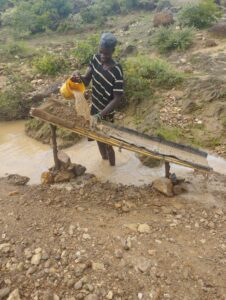
Local gold miners at work in Kano State, Nigeria, August 2022.
On 3 September 2026, Premium Times reported that Niger State’s commissioner had asked four Chinese nationals at Maiya’aki, in Lapai, to show their mining licences. They could not, and were arrested. Under the Minerals and Mining Act 2007, small-scale titles go only to Nigerian citizens, Nigerian companies or mining cooperatives, administered by a federal office.
In Nasarawa State, the lines blur. In June 2024, leaders of Amba and Agwada said their communities were fully behind two Chinese companies and knew of no consent given to the firm TIMADIX. In December 2024, TIMADIX said state officials had unlawfully licensed Chinese nationals on the same site. The state commissioner replied that TIMADIX itself was operating illegally. After arrests on 16 May 2026, federal Mining Marshals of the Nigeria Security and Civil Defence Corps (NSCDC) took 15 Chinese nationals and nine Nigerians to court, reported on 1 June 2026, over alleged illegal mining on a site licensed to TIMADIX.
In an interview reported on 20 September, Niger State Governor Umaru Bago told Channels Television he was ‘in between the devil and the Red Sea’. He said: ‘I cannot just go and order the police or military to start shooting people or arresting people.’ He asked for an executive order from the Presidency or the minerals ministry ‘to ban mining in certain locations’. Federal enforcement in his state is also under scrutiny. Thirty-seven suspected miners died in NSCDC custody on 17 September. Survivors told Reuters the cell was overcrowded and guards sprayed an unidentified substance. Reuters could not independently verify this.
Official numbers differ too. In May, Minister of Solid Minerals Dele Alake gave 327 arrests and 142 prosecutions. The Mining Marshals’ commander, Attah Onoja, gave 671 arrests and 397 charges in July, then over 600 and over 500 in September.
The link between Chinese mining and violence is disputed. In February 2026, five Republican US lawmakers, including Riley Moore and Chris Smith, introduced a bill on religious freedom in Nigeria. As Premium Times reported, it says Chinese nationals in illegal mining pay ‘protection money to Fulani militias’. SBM Intelligence and WikkiTimes had earlier reported Chinese-linked miners paying armed groups for access to sites. The Chinese embassy called the claims ‘completely baseless’. Separately, the NGO Renevlyn Development Initiative published Silent Conquest on 11 December 2025, linking Chinese mining to insecurity. The China Mining Federation of Nigeria called it ‘false, misleading and unsupported by evidence’. A Blueprint commentary says blaming Chinese firms oversimplifies a problem rooted in weak regulation.
Where are the politicians?
Senator Adams Oshiomhole has said some military generals are backing Chinese nationals in illegal mining, but named no one. Minister Alake has also accused politically connected people, but a 2024 investigation reported he had not named or arrested anyone. This article names no politician as part of Chinese mining operations, because I found no published evidence for that claim.
Nigeria must choose
Nigeria can allow foreign retailers to trade, regulate them, limit them or ban them. The government must decide, say so openly, and hear traders, importers and Chinese business owners. Kenya has made its choice: President William Ruto ordered foreign nationals to stop running small retail shops and hawking from 7 September 2026, saying such trade should be reserved for Kenyans. In mining, Nigeria needs one agency in charge, public court results, and public records of who holds each licence and for how long. Until the authorities say what the rules are, and who has been arrested and why, rumours will fill the gap between answers and policy.