How Las Anod Changed Somaliland’s Case for Recognition
Somaliland has spent three decades asking the world to trust a specific story about itself: a peaceful, democratic state exercising real authority over the territory it claims, with institutions worthy of recognition. The 2023 war in Las Anod tested all four of those claims — peace, democratic legitimacy, authority over the territory, institutional credibility — within the space of a few months. The war broke the first three claims in the open. What happened next to one critic exposed the fourth.
It began on 26 December 2022 with the assassination of Abdifatah Abdullahi Abdi, an opposition politician known as Hadrawi, in Las Anod. Protests followed; security forces fired on demonstrators. On 30 January 2023, before a shell had landed, Somaliland’s Ministry of Information ordered journalists not to publish anything that might worsen the situation. Somaliland authorities later detained and prosecuted journalists for their Las Anod coverage; one, Bushaaro Ali Mohamed, was sentenced that August to a year in prison for “tarnishing the image of state institutions.”
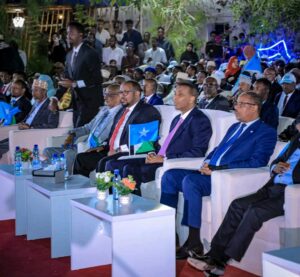
North East State President Abdulkadir Ahmed Aw-Ali Firdhiye and Somali Prime Minister Hamza Abdi Barre at celebrations marking the first anniversary of North East State in Las Anod, 3 August 2026.
On the same day as the Ministry’s directive, President Muse Bihi went on television and blamed the unrest on “terrorists.” Days later, elders across the Sool, Sanaag and Cayn regions rejected Somaliland’s authority outright, and Somaliland’s army answered by shelling the town it claimed to govern.
Amnesty International later put the toll at more than 100 dead and 600 injured, hospitals and schools among the buildings damaged, and as many as 200,000 people displaced. No international investigation supported Bihi’s framing. The UN Security Council called for the immediate withdrawal of Somaliland forces and expressed alarm over civilian casualties.
Somaliland’s government described the fighting in Las Anod as a necessary response to a terrorist insurgency by forces seeking to detach territory from Somaliland — a framing that became harder to sustain once SSC-Khaatumo, now the North East State, became a recognised federal member state of Somalia. In its view, the events posed an existential threat to the territorial integrity on which Somaliland’s claim to recognition rests. The July 2026 Ministry statement must be read against that background: after losing physical control of Las Anod to the SSC-Khaatumo administration, which has since been recognised by Mogadishu as a federal member state, Somaliland is fighting to retain control of the narrative.
The distinction mattered because the alternative was worse for Somaliland. If Las Anod could be framed as a terrorist insurgency, it remained a security problem. If it was a population inside its claimed territory rejecting its rule outright, it became a legitimacy problem — and legitimacy, not security, is the actual currency of a recognition bid.
No one made that second case with more authority than Dr Markus Hoehne. Two decades of fieldwork had already established that opposition to Somaliland’s rule in parts of Sool, Sanaag and Cayn predated Al-Shabaab by many years, rooted instead in longstanding political marginalisation and rejection of Hargeisa’s authority. During the Las Anod conflict he brought that research into a live international conversation on X (formerly Twitter), documenting developments on the ground as the war unfolded. His earlier work explained why the crisis had emerged; his reporting documented what was happening. Together, they challenged both the government’s explanation of the conflict and the narrative on which Somaliland’s recognition case depends.
The response escalated accordingly. His university in Leipzig received complaints that Hoehne has described as fabricated attempts to cost him his job. On 28 March 2023, Nimco Ali OBE — CEO of The Five Foundation and among the most vocal international defenders of Somaliland’s conduct during the war — tweeted that he was a paedophile “kicked out of Somaliland for abusing girls,” to her then 50,000 followers. Coming from the CEO of a charity built on believing survivors of abuse, the accusation carried a credibility it would not have had from an anonymous account — evidence or not. Weeks later, when the UK and 14 other governments called on Somaliland to withdraw its forces, she dismissed their statement as “rubbish” and said the international community should be backing Somaliland “against terrorism” instead — the same word Bihi had already reached for, months earlier.
He filed a defamation claim in early 2024. Over the following two years, Ali had the opportunity to substantiate her allegations in court. According to Hoehne, that included a trip to Hargeisa in 2024 to seek supporting evidence. Rather than proceeding to trial, the parties settled. Ali issued a full apology (published on 29 June 2026), agreed to pay substantial compensation for reputational damage and lost professional opportunities, undertook not to repeat the allegation, and the terms of the settlement were read into the record in open court on 6 July 2026. (Case No. KB-2024-000862).
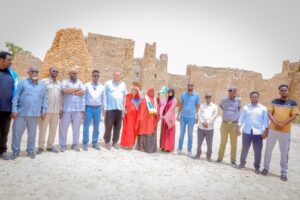
Researcher Markus Hoehne with a group at the Dervish fort complex in Taleex, Sool, 30 July 2026
On 2 July 2026 — three days after Ali published her apology — Somaliland’s Ministry of Labour, Social Affairs and Family issued a statement about a case it had never been party to and that never once names Ali. It “reaffirms” a position on Hoehne’s 2004 deportation that the government had not stated publicly in the more than twenty years — not during his many subsequent visits, not during the 2023 war, and not in the three years after Nimco Ali first made her allegation. It says Hoehne was deported over “documented concerns relating to the alleged abuse and exploitation of young girls” — a sentence that qualifies every serious word in it: not documented evidence, but documented concerns; not established abuse, but alleged abuse; not a criminal finding, but an “administrative measure.” It provides no complainant, investigation or criminal finding.
It claims the decision remains “fully in force” and “neither rescinded nor withdrawn” — but the only deportation on Hoehne’s record is the one he disclosed in his 2013 thesis: expelled in 2004 as a PhD student for travelling into contested eastern territory for political reasons. He returned repeatedly from 2008 onward, cooperating openly with government ministries. For the specific window Ali had to specify — Hargeisa, late 2003 into early 2004 — Hoehne has contemporaneous evidence placing him elsewhere, material archived years earlier as part of his normal academic work.
The statement then broadens. It devotes its final paragraphs to his social media activity “since 2023” — not his twenty-year career, but specifically the period in which he became a vocal critic of the shelling — then to his “academic work, research methodology, and professional conduct,” none of it specified. None of that establishes abuse. Instead, it broadens from attaching child-abuse concerns to an old deportation into a wider argument about why its most prominent academic critic should not be regarded as credible.
Las Anod highlighted something more fundamental than military defeat. It brought into the open the gap between the story Somaliland tells the world and developments inside the territory it claims. That claim rested on authority over the territory and institutions worthy of trust. When communities across Sool, Sanaag and Cayn rejected that authority and SSC-Khaatumo took control of Las Anod — and was later recognised by Mogadishu as a federal member state — those claims came under unprecedented strain.
Somaliland lost the argument on the ground. It then lost the narrative battle that followed. Even Abdirahman Irro, who is now Somaliland’s president, later described the episode as the product of “calamitous mismanagement” that ended in a “humiliating defeat.”
Rather than address the legitimacy questions raised by a population inside its claimed territory rejecting its rule, the government and its defenders reached for the old tools of narrative control: framing the conflict as terrorism, pressuring journalists, and launching personal attacks on the most authoritative independent voice documenting the crisis.
When Dr Hoehne’s research made that legitimacy problem harder to dismiss, the response took a different form. A smear campaign was followed, three days after Ali published her apology, by a Ministry statement that attempted to salvage the story by recharacterising a 2004 administrative deportation — still offering no complainant, no investigation and no criminal finding.
The institutions Somaliland asks the world to trust were deployed not to answer difficult questions through independent scrutiny, but to protect a narrative that events on the ground had already overtaken. That is the deeper damage Las Anod inflicted on Somaliland’s case for recognition.