
Present but Displaced: What Western Objections to Reparations Fail to See
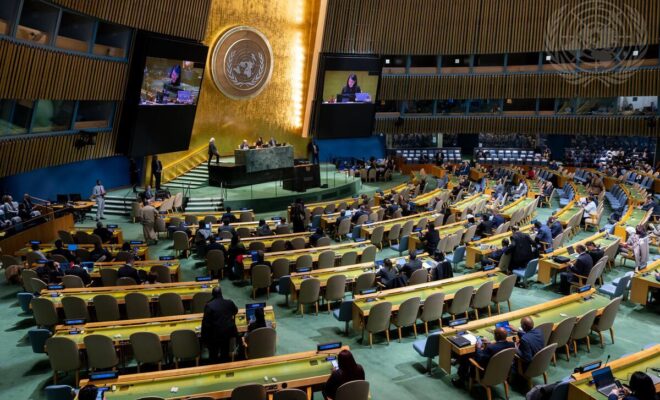
On 25 March 2026, the United Nations General Assembly (UNGA) adopted a Ghana-led resolution declaring the trafficking and racialised chattel enslavement of Africans the gravest crime against humanity. It passed by 123 votes to three, with 52 abstentions. Argentina, Israel and the United States voted against it, while the United Kingdom and European Union member states abstained. The resolution forms part of an African–Caribbean effort to move reparatory justice from advocacy into international diplomacy. Importantly, it did not create a tribunal, name liable states or order transfers. Instead, the resolution called for dialogue on apologies, restitution, compensation, rehabilitation, cultural property and institutional measures against racism. Its importance therefore lies in creating a multilateral platform for pursuing repair.
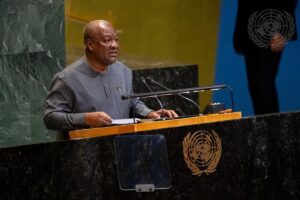
John Dramani Mahama, President of the Republic of Ghana, addresses the United Nations General Assembly during its commemorative meeting marking the abolition of slavery and the transatlantic slave trade.
However, the dispute over the March UNGA resolution was not principally over whether slavery was abhorrent. The United States argued that it does not recognise a legal right to reparations for acts not prohibited by international law when they occurred, rejected ranking crimes against humanity, and objected to using historical wrongs to reallocate present resources. Similarly, the European Union questioned the resolution’s legal and factual formulations, particularly retroactivity and reparations, while the United Kingdom invoked intertemporality and non-retroactivity. Taken together, these objections deserve consideration. Yet they narrow the issue in a way that shields slavery’s institutional consequences from scrutiny. They ask whether today’s law can be applied to yesterday’s conduct. The harder question is whether today’s institutions still distribute yesterday’s exclusions.
To answer that question, slavery and colonialism must be understood not only as past atrocities but as systems that organised property, labour, territory, authority and human value. Abolition ended the legal status of enslavement, while independence transferred constitutional sovereignty. Nevertheless, neither automatically redistributed assets, authority or institutional capacity accumulated under the preceding order. A person may become legally free without gaining meaningful control over an economy built through ancestral exploitation; a state may become independent while operating within international rules it did not design.

The United Nations General Assembly convenes for a commemorative meeting marking the abolition of slavery and the transatlantic slave trade, chaired by Annalena Baerbock, President of the eightieth session of the Assembly.
Against this background, I describe the resulting contradiction as in-situ displacement: the condition in which people remain physically present and formally included within a political order but are structurally separated from its resources, authority, recognition and opportunities. It differs from physical displacement because the affected population has not necessarily been expelled. It also exceeds poverty or discrimination because its defining feature is the gap between presence and power. People belong in law and sustain society through labour and historical contribution yet remain excluded from determining its priorities or sharing its benefits. Crucially, in-situ displacement does not claim that every contemporary inequality can be traced directly to slavery or colonialism. Domestic policy choices, class structures, political leadership, conflict and newer economic forces also shape outcomes. Nor does the concept absolve African and Caribbean governments of responsibility for exclusions they preserve or create. Its narrower purpose is to identify historically produced inequalities embedded in institutions despite formal legal and political transformation.
Consequently, non-retroactivity cannot settle the reparations debate. The principle protects against imposing legal penalties under rules that did not exist when conduct occurred. But Western objections move from that safeguard to a broader conclusion: contemporary institutions bear no responsibility for conditions shaped by historical injustice. This collapses two questions: liability for a completed historical act and responsibility for a continuing institutional condition. More precisely, the first asks whether a present court can hold a state legally liable for conduct committed centuries ago. The second asks whether institutions that now control accumulated resources, cultural property, archives and decision-making authority have obligations to address how those advantages were created and transmitted. These questions may overlap, but they are not identical.
Indeed, the resolution’s political rather than judicial character makes that distinction important. Disputing retroactive legal liability does not invalidate every form of repair. Returning an identifiable artefact is not equivalent to imposing a retrospective criminal penalty. Opening archives or reforming discriminatory procedures addresses present institutions. Non-retroactivity may constrain adjudication; it cannot alone determine what justice or institutional reform requires now. Similarly, the dispute over “gravest” risks narrowing the argument further. The US, EU and UK maintained that crimes against humanity should not be ranked. That concern merits strategic attention: justice for one atrocity does not require diminishing another. Nonetheless, reparations do not depend entirely on proving that African enslavement was worse than every other crime. The case rests on the system’s duration, scale, conversion of people and descendants into inheritable property, incorporation into state and commercial activity, and role in constructing racial hierarchy. Thus, the analytical question is not merely where slavery belongs in a hierarchy of evil. It is which institutions it produced, which survived abolition and who continues to bear their consequences. When semantic disagreement displaces these questions, legal precision becomes a route around institutional responsibility.

Delegates cast their ballots during the United Nations General Assembly vote on Resolution A/80/L.48, which declares the trafficking and racialised chattel enslavement of Africans as the gravest crime against humanity.
Moreover, the US objection to reallocating contemporary resources assumes that reparations are a transaction between identifiable perpetrators and descendants. Under that model, time weakens the claim because the original actors are dead. Yet reparatory claims also concern institutions. States, corporations, churches, universities, monarchies, museums and legal systems can preserve assets, records and authority across generations. Historical advantage travels not only through bloodlines but through property, public finance, corporate succession and cultural possession. Likewise, exclusion can persist through land ownership, access to capital, education, political representation and control over public memory. This does not mean every inequality results directly from slavery, every Western citizen carries equal responsibility, or every African or Caribbean government represents affected communities faithfully. Rather, it changes the question from who inherited guilt to who inherited institutional position.
Accordingly, reparations should not be reduced to a cheque moving between governments. From the perspective of in-situ displacement, the test is whether repair enables affected populations to re-enter institutions from which they remain structurally excluded. Restitution may restore control over cultural property; community-directed investment may expand access to land, health and education; institutional reform may redistribute decision-making authority. At the same time, no measure becomes reparatory simply by adopting the label. A fund controlled by elites may reproduce exclusion. Returned objects placed in a national museum may remain beyond the authority of source communities. Development finance may create dependency, while representation without decision-making power may preserve existing hierarchies. The decisive test is whether a programme changes who owns, who decides, and who benefits.
This is why the next phase of African–Caribbean reparative diplomacy cannot focus solely on global apologies or state-to-state transfers. If redress is administered through state bureaucracies without transforming internal hierarchies governing access to land, capital and public resources, it risks reproducing Narrative Inertia: reparations may advance institutionally while leaving ordinary citizens materially untouched. Reparative programmes must therefore be designed explicitly to reverse in-situ displacement. Ultimately, historical redress requires not only transfers between states but reform of domestic economic and institutional rules so that territorial sovereignty translates into meaningful access, authority and opportunity for those within its borders. Time separates generations; it does not redistribute property, return archives or transfer authority. A society cannot claim that an injustice is over merely because the people it displaced have never left.