
China’s Humanoid Robots: A New Test for African Technology Sovereignty
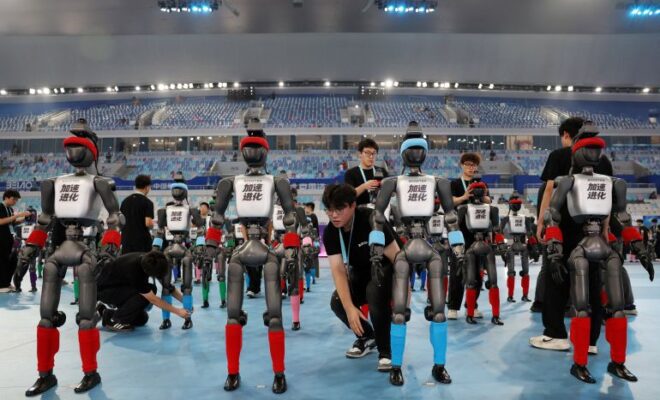
For African governments, the significance of China’s humanoid-robotics programme is not that robots may one day appear on African battlefields. It is a diagnostic case of how a dual-use technology can move from commercial deployment to military relevance faster than the institutions responsible for assessing and governing it can adapt. Africa’s stake is therefore not speculative. African states already operate within global technology and defence supply chains dominated by external suppliers, including China. Humanoid robotics adds another layer to an existing problem, regarding how to acquire advanced technologies without becoming dependent on systems that governments cannot independently evaluate, secure or govern
That matters because humanoid robotics is not simply another consumer technology. It brings together artificial intelligence, machine perception, sensors, autonomous navigation, manipulation, communications and advanced manufacturing. Those capabilities can be developed for civilian purposes and subsequently adapted to military environments. The significance for Africa lies precisely in that movement across boundaries, because the continent enters this technological transition with substantial differences in technical, industrial and institutional capacity.
When civilian technology acquires military relevance
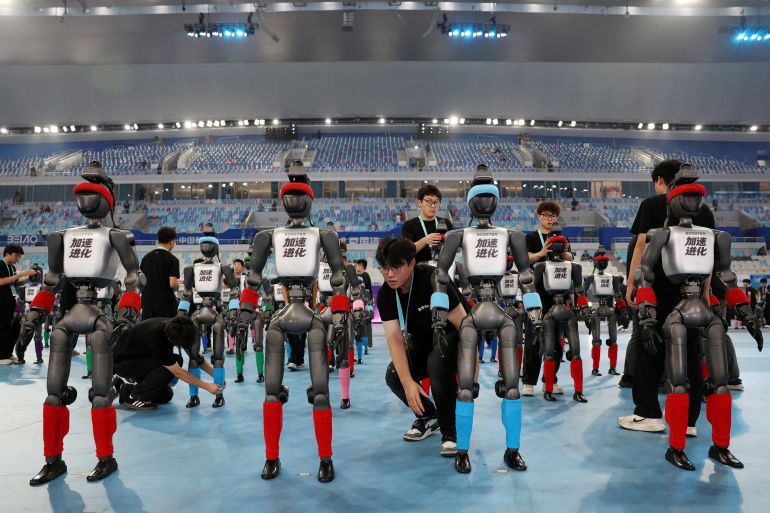
At last month’s World Humanoid Robot Games in Beijing, China’s Tiangong Ultra completed 100 metres in 8.64 seconds, faster than Usain Bolt’s human world record. Shortly afterwards, the People’s Liberation Army’s official newspaper discussed moving frontier robotics technologies from laboratories towards military training and described humanoid robots as potential “combatants”. The important point is not simply the robot’s performance. It is how quickly a technology demonstrated in a commercial and sporting setting can enter military thinking. That narrowing distance between civilian innovation and military application is precisely what African policymakers need to begin tracking.
China’s military interest in humanoid robots is no longer hypothetical. A Reuters investigation drawing on more than 100 Chinese military procurement notices, patents, academic papers and defence-industry records found research into applications including reconnaissance, logistics, hazardous environments and urban operations. Reuters found no evidence that armed humanoid robots have been deployed with an active PLA unit, while energy consumption and reliability remain significant technical constraints. The development is nevertheless important because China’s commercial robotics ecosystem is already providing an industrial base from which military applications can develop. Chinese manufacturers accounted for approximately 95% of global humanoid-robot shipments in 2025, according to BofA Global Research figures cited by Reuters. China is not alone in exploring military applications of humanoid systems, but its unusually large commercial manufacturing base gives the civil-military convergence particular significance.
Africa is not a bystander
For Africa, this convergence is occurring against an established pattern of technological and defence dependence. SIPRI’s latest data show that the United States, China, Russia and France collectively accounted for almost 60% of Africa’s major arms imports between 2021 and 2025, with China accounting for 17% of African major arms imports overall and 22% of those to sub-Saharan Africa. Africa is therefore not external to the global defence-industrial systems from which emerging capabilities are developing. It is already a significant recipient of technologies produced elsewhere.
This matters because the next generation of military-relevant technologies may not arrive through conventional defence procurement. A humanoid platform could enter an African market as a logistics, inspection, industrial or disaster-response system before acquiring military significance through changes to its software, sensors, communications architecture or operational role. The issue is consequently not whether African governments will suddenly purchase “robot soldiers”. It is whether procurement systems can recognise military relevance while a technology is still being classified and sold as civilian.
The dual-use problem
A conventional weapons platform is recognisable as a military asset when it is transferred, making its end use subject to established procurement, export-control and arms-transfer processes. Humanoid robotics is more complicated. A platform can perform civilian functions while possessing capabilities that are transferable to military environments. Machine perception, autonomous navigation, manipulation and networked communication do not become fundamentally different technologies because the operating environment changes.
That creates a governance problem for African states. If military relevance is assessed only according to the declared purpose of a system when it is purchased, governments may overlook capabilities that become strategically significant later. The concern is not that every humanoid platform is a latent weapon. A robot delivering medical supplies after a disaster is not in itself an autonomous weapons system. The concern is that procurement frameworks need to account for plausible changes in capability and use over the life of the technology, particularly where the acquiring state lacks the technical capacity to verify those changes independently.
The verification gap
This is where Africa’s existing technological inequalities become a security issue. The critical question for an acquiring government is not simply whether it can afford a system, but whether it can understand and verify what it is buying. Can the system’s behaviour be independently tested? Can its cybersecurity be audited? Can its data flows be understood? Can software updates be assessed before deployment? Can the government determine what changes have been made to the system over its operational life?
Where those capabilities are weak, the supplier can retain considerable technical influence after the initial procurement through proprietary software, maintenance arrangements, upgrades, training and access to specialised components. This creates a structural information asymmetry between the buyer and the technology provider. In conventional procurement, that asymmetry is already difficult to manage. With highly software-dependent dual-use systems, it can become a continuing dependency embedded in the technology itself.
Sovereignty is not self-sufficiency
The answer is not for every African state to build its own humanoid robots. That would confuse technological sovereignty with technological self-sufficiency. What matters is whether states possess enough independent technical and institutional capacity to decide what to acquire, test what they acquire, understand its vulnerabilities and determine how it can be used.
That requires several changes. Dual-use assessment should become a routine part of advanced-technology procurement rather than an issue considered only after acquisition. African states should develop independent testing, cybersecurity and technology-evaluation capacity, including through regional arrangements where individual countries cannot sustain such infrastructure alone. The African Union and regional organisations could also develop common principles and technical standards for emerging dual-use systems, giving African governments greater collective leverage when dealing with much larger technology suppliers.
The foundations for such an approach already exist. The AU’s Continental Artificial Intelligence Strategy calls for African capacity in infrastructure, talent, datasets, research and innovation, alongside safeguards and stronger governance. Humanoid robotics does not require an entirely separate policy architecture; it requires African governments to apply existing ambitions for technological capability and governance to a technology in which civilian and military applications increasingly overlap.
Governance cannot wait for deployment
The biggest mistake would be to wait until an armed humanoid robot appears on an African battlefield before treating the technology as a defence-policy issue. The strategic transformation happens earlier – when civilian technologies acquire military significance, when commercial supply chains become strategically important, and when governments become dependent on systems they cannot independently evaluate or govern.
Humanoid robots are not about to replace soldiers in Africa. The more immediate issue is the changing boundary between civilian innovation, commercial technology and defence capability. Africa is already exposed to that boundary through its dependence on imported technologies and defence systems. The question now is whether African states will build enough technical and institutional capacity to participate meaningfully in deciding how emerging technologies are tested, procured, secured and governed – or whether those decisions will increasingly be made elsewhere.