Somalia: A Government With One Foot Out the Door
Somalia’s foreign passport crackdown reveals a governance crisis hiding in plain sight
On the afternoon of June 24, 2026, Somalia’s Second Deputy Prime Minister, Jibril Abdirashid Haji, arrived at Nairobi’s Jomo Kenyatta International Airport aboard a flight from Mogadishu. Kenyan immigration officers stopped him at the gate. According to multiple reports, his Kenyan passport had been fraudulently obtained. He was deported back to Mogadishu — back to the country he was supposed to be governing.
The incident was not isolated. On July 26, State Minister at the Presidency Abshir Bukhaari — a former First Deputy Speaker of Somalia’s Senate — was also denied entry at the same airport after immigration officials raised questions about his travel documents. He was placed on a return flight to Mogadishu. Neither the Kenyan nor the Somali government has officially confirmed the reasons behind the incident. Somalia’s Foreign Ministry summoned Kenya’s ambassador for consultations the following day.
Six weeks after the first deportation, Jibril became the first senior official to publicly comply with President Hassan Sheikh Mohamud’s July ultimatum ordering all cabinet ministers to surrender their foreign passports or resign. Multiple sources report that a wave of cabinet ministers is now finalising similar arrangements. The crackdown is real. But it still does not reach the deeper layers of Somalia’s governing class — the advisors, the technical staff, the parliamentary majority — where the foreign passport has functioned not as a travel document but as a structural instrument of governance, and of exit.
The geography of power
When senior officials want to meet with traditional community leaders, they do not travel to the elders’ homes. They summon the elders to their hotels — clustered, almost without exception, near the airport.
‘They do not go to the neighbourhoods to see how civilians live their lives day by day,’ one employee at a Mogadishu ministry told me, speaking on condition of anonymity. ‘They only come to town after midnight, when the streets are half empty — and even then they have a lot of military guards. They are normally between Villa Somalia and the airport area.’
A second ministry employee described something more troubling. According to this source, state ministers and deputy ministers who hold dual citizenship do not come to the ministry at all — official stamps, documents, and administrative tools have been relocated to their airport hotels. ‘Only a secretary is at the ministry office,’ this second source said. ‘She is there to oversee the daily operations — who comes, who goes in the ministry building.’ The function of the state, in other words, has relocated to a departure lounge.
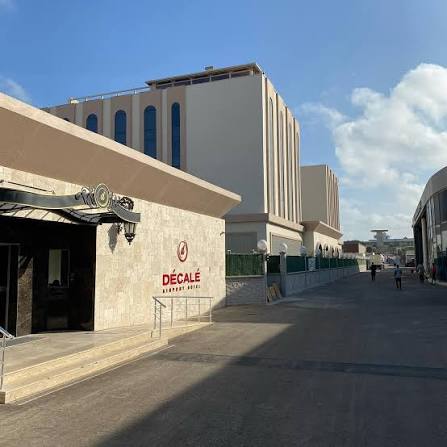
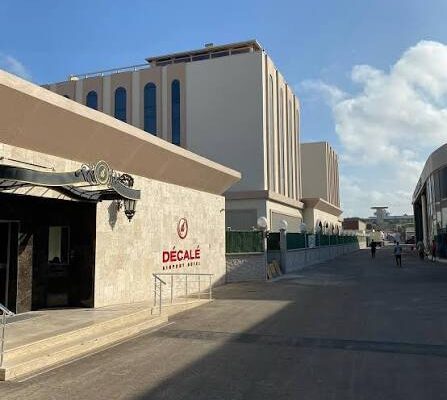
Décalé airport departure lounge, Mogadishu.
In December 2022, President Hassan Sheikh Mohamud publicly acknowledged that the government’s own biometric attendance system showed only 1,500 of more than 5,000 registered civil servants present at their offices. The remaining 3,500 — seventy percent of the civil service payroll — were drawing salaries without showing up. He called them ghost workers. The reaction from ordinary Somalis was outrage. The reaction from the political class was silence. ‘They have nothing tying them to Somalia besides the government title,’ one elder told me. ‘And the day that title ends, they are on the first flight out — with a lot of money made during their tenure.’
The scale of the problem
The foreign passport is not a peripheral feature of Somalia’s governing class. It is a defining one. According to Wakiil, the independent parliamentary accountability initiative, 105 out of 275 Federal Parliament members — 38 percent — held foreign passports in the 10th Parliament in 2017. Many of those same MPs continue to serve. In the Upper House, 20 out of 54 Senators are returned diaspora. From 2000 until 2022, every Prime Minister appointed across Somalia’s transitional and federal governments is reported to have held dual citizenship from a Western country — Canadian, Norwegian, Swedish. The current Prime Minister, Hamza Abdi Barre, holds no Western passport, and represents the first documented exception to an otherwise unbroken pattern.
Within Mogadishu’s political community, factions are informally known by the Western cities where members spent their years of exile: the ‘American Camp,’ the ‘Norwegian Colony,’ the ‘Canadian Corner.’ These are not jokes. They describe real networks of shared contacts and shared exit options that shape how power is organised inside Somalia’s parliament and cabinet.
According to a Somaliland Chronicle investigation, Ali Mohamed Omar — widely known as Ali Balcad, and serving as State Minister of Foreign Affairs — has not renounced his US citizenship. When contacted by reporters, he did not deny it. ‘My work serves Somalia’s legitimate interests as recognised by the international community,’ he said. ‘Any suggestion that this conflicts with my American citizenship is misinformed.’ According to the same investigation, Sacdiya Yasin Haji Samatar — a former healthcare administrator in Minnesota who has served as acting Speaker of Parliament since June 2026 — is among the most prominent examples of the diaspora’s ascent to the highest rungs of the state.
The escape hatch
Former officials do not return to face accountability. They return for one purpose: when a new government is forming and a senior position is available to negotiate.
The case of Salah Ahmed Jama illustrates this with painful precision. Jama built his entire career in Ottawa, Canada — as a researcher and teaching assistant at Carleton University — before returning to Somalia to serve simultaneously as Deputy Prime Minister and Senator. In October 2024, Somalia’s Senate Speaker announced that Jama had been formally dismissed for failing to attend four consecutive sessions without explanation. An investigative committee found he had been receiving salaries and allowances for two years without attending — salaries funded almost entirely by World Bank and IMF budget support, meaning European, American, and British taxpayers were paying his salary while he was absent.
Within three days, the political class reversed the decision. Jama kept his seat. He kept the salary. No money was returned. Historically, no Somali official has ever been forced to repay funds obtained during documented misconduct. The foreign passport is not merely an escape hatch. It is a timed re-entry mechanism, calibrated to political opportunity rather than civic obligation.
The hidden layer
The largest concentration of foreign passport holders in Somalia’s government is not in parliament or the cabinet. It is in the advisory and technical layer that fills Villa Somalia, the Prime Minister’s office, and every major ministry — a layer the presidential ultimatum does not yet reach.
American and British passport holders are heavily embedded in national security and communications offices. Canadian and Swedish passport holders concentrate in the Ministries of Finance, Planning, and Legal Affairs. According to public records, Hussein Moallim Mohamud — who served as National Security Advisor from 2022 until his resignation in August 2025 — shaped Somalia’s national security architecture from behind a foreign passport for three years at the heart of the presidency. Abdirashid Hashi, who according to publicly available records received his degree from the University of Winnipeg in Canada, served as Director of Communications at Villa Somalia.
The salary consequences are stark and rarely discussed publicly. A foreign-passport-holding advisor funded by an international institution earns between $5,000 and $10,000 per month. A permanent local civil servant who stayed through the war and has no exit option earns a few hundred dollars. They work in the same offices. They are not treated as equals. When the advisor’s contract ends, or conditions deteriorate, they leave — and the institutional knowledge leaves with them.
The children who live elsewhere
Formal citizenship is only part of the picture. The more revealing indicator is not the passport an official holds but where their family lives.
Across the governing class, families are reported to reside in Western nations, and officials travel abroad regularly to be with them. A minister whose children attend school in London is not making a thirty-year investment in Somalia’s education system. A national security advisor whose family lives in Toronto is not raising the next generation under the security conditions his decisions create for Somali families. Ordinary Somali families have no such separation. They are living inside the consequences of decisions made by people who have secured their families outside those same consequences.
What the crackdown reaches — and what it does not
Somalia’s 2026 constitution bars the President, Prime Minister, Speaker of Parliament, and Chief Justice from holding dual citizenship. It requires formal renunciation. It also prohibits top officials from being married to foreign nationals — a spousal clause with no precedent in the country’s constitutional history. President Hassan Sheikh Mohamud’s July ultimatum extended that logic to the cabinet. The first act of compliance has followed. But the crackdown has limits that matter.
Parliament remains largely untouched — MPs may hold dual citizenship; only those seeking the Speaker’s role face a ban. The advisory and technical class inside Villa Somalia and across every ministry is not covered. The enforcement mechanism for the cabinet directive is not written into law. And Somalia ranked 179th out of 180 countries on Transparency International’s 2024 Corruption Perceptions Index — a reminder that the foreign passport amplifies an impunity that pre-existed it and will not disappear the moment it is surrendered. The Somali passport, meanwhile, ranks 99th globally on the Henley Passport Index, granting visa-free access to only 32 countries. For officials accustomed to moving freely between Mogadishu and London or Minneapolis, surrendering a Western passport is a real material sacrifice.
The argument
The Somali diaspora has kept this country alive. The remittances — estimated at one to two billion dollars annually — have funded households and small businesses through decades when the state could not. This contribution is real and should not be erased from any honest accounting. But the presidential ultimatum of July 2026, however genuine, confronts only the visible surface of a structure that runs far deeper.
Ministers may surrender their Kenyan passports. The Deputy Prime Minister already has. But the advisors drafting Somalia’s security strategy at Villa Somalia will continue to hold American and British passports — because the World Bank and IMF, who fund their salaries, prefer it that way. The technical directors managing Somalia’s finance and legal ministries will continue to hold Canadian and Swedish passports — because international donors trust Western-credentialled professionals and the frameworks they understand. The parliamentary majority will continue to hold foreign citizenship — because the constitution permits it for all but the Speaker.
The foreign passport will not disappear from Somalia’s governing class. It will retreat one tier and hold. Because it does not just offer an exit — it opens doors. It enables visa-free travel to donor capitals. It builds credibility with international partners. It signals the kind of Western education and professional formation that international institutions reward with funding and trust. For a government whose reliance on external assistance remains structurally large, the foreign passport is not a liability. It is an asset.
Most Somalis cannot leave their country. Maybe it is time for a political elite that live in Somalia as well.