Burkina Faso: The Old Guard vs. The People, Round 2
Less than a year after Blaise Compaoré was removed by a popular uprising, his allies have regained power through an unpopular coup.

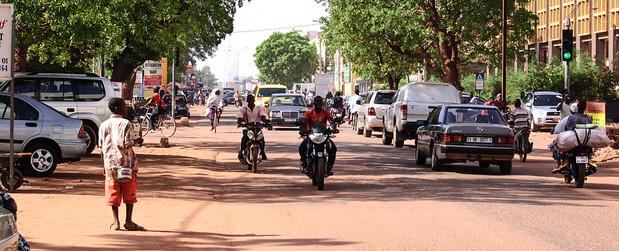
On the streets of Ouagadougou, Burkina Faso. Photograph by
Thoralf Gutierrez.
In late October 2014, the Burkinabé people took to the street to protest former President Blaise Compaoré’s attempt to amend the constitution and extend his 27 years in office. The world stood still, Africa stood proud, and the Burkinabé people’s will prevailed by virtue of it being greater than the arrogance of those in power.
Africans across the continent echoed their calls as Compaoré was forced to resign and escape into exile. The people’s protest was, for many, the “˜good coup’ that got a tyrannical government out of power, giving way to a new beginning.
Barely a year later on 16 September 2015, however, just 25 days ahead of the scheduled 11 October elections, the Presidential Security Regiment (RSP) struck a blow against that fresh start, taking hostage the President of the Transition, the Prime Minister, and two ministers.
The immediate reaction of many was to think it was another hoax on the part of the RSP, it being the elite guard’s fourth attempt to hold the transitional government to ransom and maintain their hegemony. In February 2015, tensions nearly boiled over as the RSP called for the resignation of transitional Prime Minister, Colonel Isaac Zida (who happens to be a former senior member of the elite force himself) over his alleged noncompliance with previous agreements regarding the RSP’s high status and special privileges within the Burkinabé army, a legacy inherited from the Compaoré regime.
It may also be recalled that before that, in December 2014, the RSP led by General Diendéré Gilbert had made a series of demands of the government, including the payment of year-end bonuses and the non-dissolution of the Regiment. Prime Minister Zida was said to be in favor of plans to incorporate the RSP into the regular army. However, with the intervention of the Moro Naba − the Emperor of the Mossi, the largest ethnic group in Burkina, and one of the most influential monarchs in West Africa − a resolution was reached.
As the elections having been inching nearer recently, many have expressed fears regarding the RSP and the probable inability of the transitional government to honour an agreement over the Regiment’s special pay. Many Burkinabés also asked whether, given dwindling resources and financial challenges, the government should prioritise paying an elite force created to dance to the whims and caprices of former President Compaoré anyway?
This possibility of non-payment may have been one factor in the RSP’s coup, but perhaps more important in driving the elite guard’s actions were a series of recent setbacks and concerns over its survival.
One of those setbacks was that former members of the Compaoré regime and political parties who supported the former president’s attempt to elongate his reign were banned from the forthcoming elections. Even the regional ECOWAS Court of Justice’s judgment ordering that the former ruling party, the Congress for Democracy and Progress (CDP), and its political allies be allowed to participate in the elections was not respected in the country. And in late August, Burkina’s Constitutional Council banned more than 40 candidates from both the legislative and presidential elections on the grounds that they backed an “anti-constitutional change damaging to the principle of democratic transition.” Meanwhile, Compaoré was charged with treasonable felony over his bid to change the constitution and charges were brought against his accomplices for assault, murder and embezzlement.
Furthermore, on 14 September, the National Reconciliation and Reform Commission (CRNR) submitted a report to Prime Minister Zida recommending the 1,200-strong RSP be disbanded. This was the final straw. The Compaorists appeared to be losing on all fronts and the recommendation to scrap the elite forces would likely be implemented after the elections. Having ruled Burkina Faso for nearly three decades, the commanders seem to have decided that they could not afford to lose power and go into political and social oblivion.
What next?
Presently, things are quite hazy. The putschists have announced the formation of a new governing body − the National Council for Democracy − headed by General Gilbert Diendéré, former President Compaoré’s chief of staff and right-hand man. They have promised to conduct elections at a later date to be determined, and have just announced the release of President Michel Kafondo and two ministers, though Zida remains under house arrest.
At the same time, however, the head of the National Transitional Council, Chérif Sy, has declared himself the be the legitimate “Interim President of Burkina Faso” while the transitional president and PM are being held.
The situation is far from settled. Having enjoyed power for so long, being out of power for less than a year seems like a lifetime without water for Compaoré’s allies, and it remains to be seen if the RSP will willingly cede power, if they will fight their own people to keep it, or if there is any possibility of a coalition of interests emerging. There are already reports that the RSP has met with the Moro Naba to explain its position, though there are also rumours that the elite forces have invaded the Moro Naba palace to seek out Chérif Sy.
Meanwhile, Burkinabé demonstrators have taken to the streets to protest the military coup, with the Balai Citoyen, the grassroots movement so central to the popular revolution in 2014, calling for popular resistance. The Presidential Guard have responded with gunfire, reportedly killing at least 10 people in the capital Ouagadougou.
Burkina Faso is again striving to be true to its name, which means “the land of upright people” and which was bestowed upon it by its beloved revolutionary leader Thomas Sankara in 1984. The present wrangling in the poor and small but dignified West African nation should once again teach African leaders that governance goes beyond rhetoric, and that Africa doesn’t want strong men but strong institutions.
A small clique of strongmen holding a nation of millions to ransom should not be tolerated in Africa, and the Burkinabé people are showing − once again − that it will not be tolerated. Whether they will have the capacity to sweep the old guard out of power through their sheer bravery, numbers and determination a second time remains to be seen, but the country once again finds itself in the throes of a battle of the Old Guard vs. the People of Burkina Faso.
Idayat Hassan is a 2015 Yale World Fellow and Director, Centre for Democracy and Development, Abuja, Nigeria.