What Lagos planned for Precious Seeds
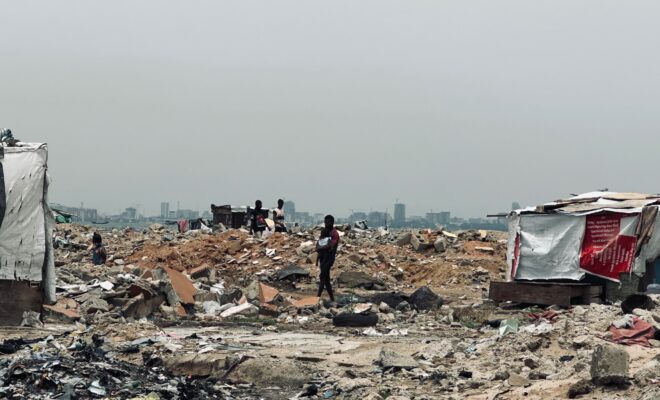
In December 2025, Lagos State bulldozers tore down Precious Seeds, a waterfront settlement in Oworonshoki. Esther Udoh had been driven out of the same site once before, by a fire in 2010. She returned in 2013 and built again: small payments for land, then materials, then walls, then a roof, until what she had built was worth perhaps a hundred million naira. The state took it down. She is now in Agbado, rebuilding. Five months after the demolition, at the Joint Closing of the Assemblies at the World Urban Forum in Baku on 18 May 2026, Melanie Cherba of Slum Dwellers International stood up and named what had happened to her.
A declaration and a demolition
Cherba, speaking for the Grassroots and Civil Society Assembly, called for an end to forced evictions: for laws that protect communities, secure tenure, and genuine alternatives where displacement cannot be avoided. Goldson Rezva, Deputy Chief of Staff of the State Committee of Urban Planning and Architecture, had opened the session by reporting the Women’s Assembly’s position: there can be no safe and resilient cities without gender equality, and housing and land policy must be not merely gender-responsive but gender-transformative. Mate Rodriguez, from the Women’s Assembly, called for strengthening women’s leadership, because without it livelihoods cannot improve (UN Web TV, 18 May 2026). Distilled, the closing said two things. No more evictions. Women’s leadership.
Both describe Esther and the women of Precious Seeds. The assembly named them as the leadership without which the housing agenda fails. Five months earlier, Lagos State had named the same women as people whose homes could be flattened on a December morning. Both descriptions are accurate. The question is which one constitutes policy.
The Baku Call to Action, the WUF13 outcome document says what the assembly said. Its eighth call is titled simply: Stop forced evictions! It calls them gross violations of human rights and demands legal safeguards, monitoring, and accountability for the global pattern of displacement. The document is also explicit about its limits: its own disclaimer states it is not an intergovernmental agreement and binds no Member State. Nigeria is bound by none of it. Lagos State even less.
The demolition of Precious Seeds was not a failure of urban planning. It was urban planning. Precious Seeds sits within Oworonshoki, where the current wave of waterfront clearances began in 2023, the start of what advocacy groups call the worst series of mass forced evictions since military rule (Peoples Dispatch). The demolitions were challenged from the beginning; a coalition of organisations petitioned against them in August 2023. They continued. The cleared land had a destination on the record: a commercial jetty and a private gated development, The Elite Villa. By December 2025 the campaign had reached Precious Seeds.
The pattern is older than this round. Between 1973 and 2024, Lagos carried out an estimated ninety-one eviction operations. Makoko was razed in 2005 and 2012, each wave stopped only by protest. Otodo-Gbame was cleared in 2016 and 2017, leaving more than thirty thousand homeless; enforcement agents fired tear gas, and residents who fled into the lagoon were reported drowned, after court orders meant to protect them. By January 2026 the bulldozers were back in Makoko. A lawyer for Makoko since 2005 calls it a “playbook”: an area is declared unsafe, cleared, then rebuilt with development priced beyond the people removed.
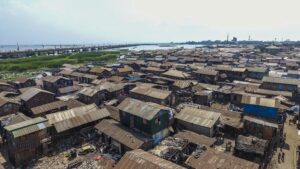
Makoko, Lagos. The waterfront settlement has faced repeated demolition waves since 2005
The instrument in every case is infrastructure. Services are withheld or never installed. The settlement is declared a public hazard. The cleared land, almost always waterfront, almost always valuable, becomes available for sale or development.
Women are the infrastructure
Forced eviction falls on men too. It does not fall evenly. The everyday infrastructure that makes a waterfront settlement survivable (water fetched and stored, sanitation managed, the paths walked after dark) is built and maintained largely by women. Where the state provides nothing, women are the infrastructure. So when a settlement is cleared, what is destroyed is not only housing but the systems women built in the state’s absence and must build again, on the next contested ground. The eviction is general. Its weight is gendered.
None of this is hidden. It is published as policy, announced as planning, executed on schedule. Twelve years of fieldwork in Lagos informal settlements, including a published study of women’s water labour, has made the pattern visible. The women are not collateral. They are the targeted population.
What was destroyed at Precious Seeds had taken two years to build, and the women built it as a body: they organised themselves into the Oworo Reality Women Group, and every project ran through it. With FABULOUS URBAN, the group installed waterless dry-diversion toilets, separating urine from faeces and drying both into fertiliser for local farmers, which also shortened the night walks that exposed women to sexual violence. A mobile clinic served the elderly and the pregnant. A community garden fed the settlement. A building code, written to the conditions of waterfront life, was the closest thing Precious Seeds had to a planning instrument. Lagos State offered no equivalent. The bulldozers came anyway. Amope Oseni, who was on the site that morning, describes officials arriving before dawn; bulldozers first, then fire. What she saved was her life.
This work was not charity; the women were not waiting to be planned for. They were building the instrument the state had withheld, which made what they were doing, not what was being done to them, the political content of the settlement.
Five months on, the Oworo Women Reality Group has not disappeared, which is what planning of this kind assumes. Field research in May 2026 traced where its members had gone. Several are widows, scattered across three states: Lagos, Ogun, and Oyo. A number still hold the demolished site under tarp. Where Lagos State has a compensation procedure, it does not pay: women report submitting paperwork and affidavits and receiving nothing; others report no procedure at all. For those still trading, the food businesses that fed them now earn under a quarter of what they did before. And the group is building again, working with FABULOUS URBAN on Dignity in Shelter, a demountable, reusable housing system for communities evicted, and evicted again. The demolition did not end their work. It scattered the site of it.
Cities don’t fail women by accident. They fail women by design. The Baku Call to Action names the violation. It does not bind the state. The mechanism producing evictions (services withheld, land cleared, women removed from valuable ground) remains unnamed in any document with force.
Melanie Cherba named the evictions. Mate Rodriguez named the leadership. Esther Udoh named herself: “I’m not this kind of person that depends on people.” The Baku Call to Action describes her, and refuses to bind the state that took her home down. The question now is whether Lagos State, and the institutions that publish declarations to which no government is operationally signatory, will name the policy. Or whether, four years from now, at WUF14, another woman will stand in another room and say the same thing about another community that did not need to be demolished.