
What Happens After Dandora? Kenya’s Green Transition Faces Its Hardest Test
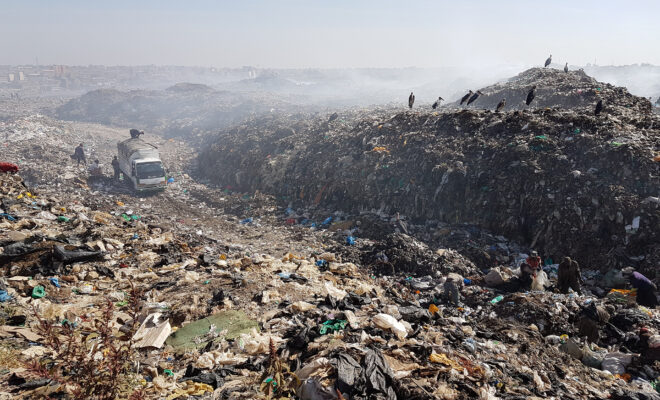
For decades, thousands of Nairobi’s poorest residents have quietly carried out one of the city’s most important environmental services. Every day, informal waste pickers at Dandora sort, salvage and recover plastic, metal, paper, glass and electronic waste that would otherwise remain buried beneath one of Africa’s largest and oldest dumpsites. In doing so, they help sustain Nairobi’s recycling economy. Yet despite performing work that cities increasingly celebrate as part of the circular economy, they have rarely been recognised as environmental workers.
Kenya is now preparing to close Dandora. From an environmental perspective, few would question the decision. Officially declared full in 2001, the landfill still receives more than 2,000 tonnes of waste every day and has become one of the clearest symbols of Nairobi’s environmental crisis. National and county authorities have revived plans to replace it with a new waste management facility in Ruai. The environmental case for closing Dandora is compelling. The social one is far less straightforward. Public debate has focused overwhelmingly on pollution, public health and urban regeneration, while paying much less attention to the thousands of people whose livelihoods have become intertwined with the landfill. The real challenge is therefore not simply how to close Dandora, but how to transform the informal environmental economy that has grown around it without destroying the livelihoods it sustains.
The workers the city forgot to count
Across Africa, informal waste pickers recover millions of tonnes of recyclable materials every year. They reduce landfill volumes, supply industries with valuable raw materials and provide an essential environmental service. Yet they remain largely excluded from official waste management systems, lacking legal recognition, social protection and a meaningful role in environmental planning.
Every day, waste pickers climb mountains of freshly unloaded refuse searching for plastic, metals, paper and discarded electronics. Women make up a substantial proportion of this workforce. Most earn between 300 and 500 Kenyan shillings a day, little more than two euros. Waste pickers’ organisations report that conditions have become increasingly difficult as competition has intensified, valuable recyclable materials have become scarcer and the cost of living has continued to rise.
An environmental crisis that has always been human
Their work also exposes them to serious health risks. Electrical cables are burned to recover copper. Electronic waste containing lead, mercury and other hazardous substances is dismantled by hand. Numerous studies have documented high levels of contamination affecting soil, air and water around Dandora, with consequences extending well beyond the landfill itself to neighbouring communities such as Korogocho. “Tightness in the chest and persistent coughing are normal here,” one waste picker told me during fieldwork. “But if we don’t work, we don’t eat.”
Few sentences capture Dandora’s central paradox more clearly. The landfill is simultaneously an environmental disaster and a source of livelihood for thousands of families. Peter Warui, a community organiser in Dandora, offered a different perspective. “People think this is only rubbish,” he told me during fieldwork. Then he added in Swahili: “lakini kwetu sisi ni kazi” (but for us it is work). As he put it, “there is no waste in Boma,” using the name many workers give to the dumpsite. What appears to outsiders as discarded material immediately acquires value, entering a chain of sorting, storage, transport and resale that connects waste pickers, traders and recycling industries across Nairobi.
That contradiction became impossible to ignore in February this year, when Kenya’s Environment and Land Court ruled that more than 1,000 waste pickers had been exposed to hazardous working conditions and prolonged pollution, awardingcompensation to those affected. The judgment recognised something that had remained largely invisible for decades: Dandora’s environmental crisis has always been a human one as well.
A transformation already under way
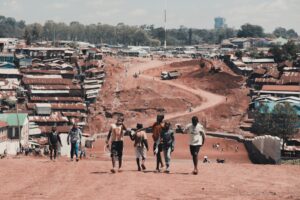
Around Dandora, that transformation has already begun. Residents of neighbouring Korogocho describe a landscape that is visibly changing: the deepest section of the quarry has been filled, construction has started on a new access road linking surrounding neighbourhoods, and several homes have reportedly been demolished without prior notice. For many residents, these are not isolated construction projects. They are the first visible signs of a much broader urban reconfiguration whose social consequences remain uncertain.
If Dandora closes, the livelihoods and networks that have developed around it will also need to be reconfigured. Understanding that challenge means looking beyond the landfill itself. Dandora did not emerge simply because Nairobi lacked somewhere to dispose of its waste. It is the product of decades of rapid urban growth, chronic underinvestment in waste management, fragmented institutional responsibilities and repeated failures to develop viable alternatives. The landfill is therefore not simply an environmental problem waiting to be removed. It is also the outcome of long-term political choices.
Redesigning a system, not just relocating a dump
Around the dumpsite, an entire urban economy has developed. Materials discarded by households and businesses immediately enter chains of sorting, storage, transport and resale linking waste pickers, traders and recycling industries across Nairobi. Access to valuable materials is often organised through informal agreements, territorial control and networks of intermediaries rather than formal regulation. Closing the landfill may relocate waste, but it will not automatically dismantle the social and economic relationships that have developed around it over decades.
The challenge facing Nairobi is therefore not simply to replace one landfill with another facility. It is to redesign an entire waste management system while recognising the workers, knowledge and economic relationships that already exist within it. Long before Nairobi adopted the language of the circular economy, Dandora’s waste pickers were already putting it into practice. Their work has reduced landfill volumes, supplied recycling industries with raw materials and generated environmental value without formal recognition.
Closing Dandora is necessary. Few people who have witnessed its environmental and health impacts would argue otherwise. But a landfill is easier to close than the economy that has grown around it. Kenya’s green transition will ultimately be judged not only by cleaner landscapes, but by whether the workers who have kept Nairobi’s recycling economy alive are allowed to remain part of it.