
The CFA Franc Is Not a Currency. It Is a Constitutional Constraint
The debate about the CFA franc keeps happening on the wrong terrain.
My mother used to sell food in front of our house in Biyem-assi. Not because she enjoyed it, or because it was the natural extension of some entrepreneurial ambition. She did it because the structural adjustment programmes of the 1990s had done their work on my father’s salary at the Ministry of Public Service, and the arithmetic of feeding four children no longer added up without a second income. She was resourceful, and dignified, and she never complained in front of us. But I was old enough to understand what the table in front of our house meant, even if I was too young to name the forces that had put it there.
In January 1994, the CFA franc was devalued by fifty per cent overnight. My father had parked his Peugeot 504 already; the price of fuel had become, on a civil servant’s salary already reduced by structural adjustment, a calculation that did not work. The devaluation halved the purchasing power of every franc he had managed to save. It was not a crisis that arrived gradually, giving people time to adjust. It arrived by decree, in the language of macroeconomic necessity, decided by men in Paris and Washington who had not been elected by anyone in Yaoundé and would not live with the consequences of what they had decided.
I was two years old. I grew up in the world that devaluation made.
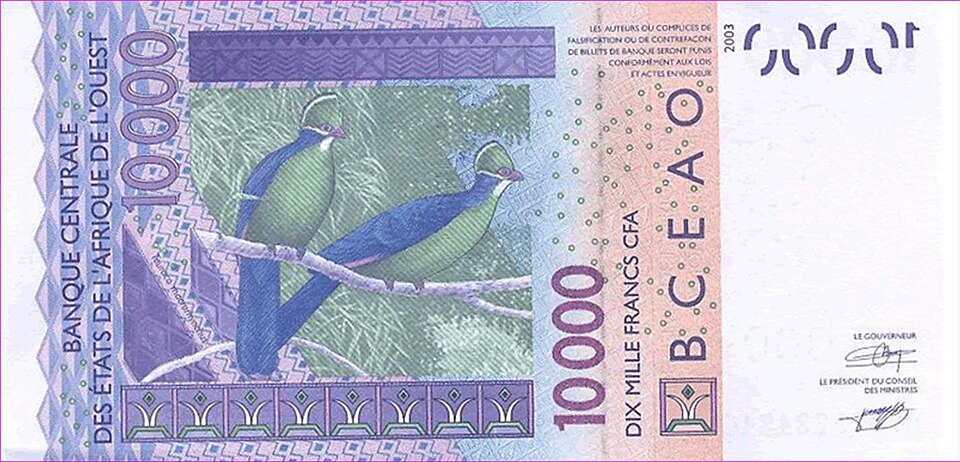
The Franc CFA is an enduring institution linking France to its former colonies.
Most debate about the CFA franc treats it as an economic question: does the franc’s peg to the euro provide the monetary stability that benefits its fourteen member states, or does it lock those economies into an exchange rate calibrated for European monetary conditions rather than African developmental realities? This is a real question with real answers. But it is the second question. The first is constitutional: by what right does the monetary policy of fourteen formally sovereign African nations remain anchored to decisions made in Paris?
That question makes people uncomfortable. In Paris, for obvious reasons. Also in Yaoundé, Abidjan, and Dakar, where a certain class of political and economic leadership has invested, across decades, in not asking it. That reluctance is itself information.
The CFA franc was created in 1945, during the final years of formal French colonialism, as a mechanism for maintaining French economic influence over its African territories as the political winds shifted toward independence. The arrangement was not hidden; it was structural. France guaranteed convertibility. Member states deposited a portion of their foreign exchange reserves in an operations account held at the French Treasury. French representatives sat on the governing boards of the two central banks that managed the currency. The exchange rate was fixed, first to the French franc, then to the euro.
In 2019, France announced reforms: French representatives would leave the central bank boards, the name would change for the West African zone, the reserve deposit obligation would end. These were real changes in the sense that they removed some of the arrangement’s most visibly colonial features. They were not monetary sovereignty. The peg remains. The convertibility guarantee remains. The core constraint on member states’ ability to use monetary policy as a developmental instrument remains in place.
Joseph Tchuindjang Pouemi understood this in 1980. His book Monnaie, Servitude et Liberté — which I first read as a teenager in Yaoundé, bought from a street vendor near the cathedral with carefully accumulated savings — made an argument that has not been refuted in the forty-five years since: monetary policy is not a technical question. It is a political one. Every choice about an exchange rate, every decision about reserve requirements, every condition attached to credit — these are choices about whose interests are protected and whose development is enabled or constrained.
The CFA arrangement was not designed to promote African development. It was designed to serve French monetary stability and preserve French commercial access to former colonial territories after independence made direct administration impossible. That it has also, in some periods, provided real benefits such as inflation control and reduced exchange rate uncertainty within the franc zone does not change what the architecture was built to do, or whose fundamental interests it continues to serve.
Pouemi put it plainly: a currency that belongs to someone else is sovereignty that belongs to no one.
So why has no one left?
Here the honest writer has to stop and answer a question that the nationalist version of this argument prefers to skip. If the constraint is so plain, and Pouemi named it forty-five years ago, why has no member state walked out in four decades? Guinea left in 1958. Mali left, then returned. Mauritania and Madagascar left long ago. The door, formally, is open. So why does almost everyone stay?
The lazy answer is that France tricks them, or coerces them, or pulls strings behind the scenes. I want to be careful here, because that answer is both comforting and wrong, and its wrongness matters. It is comforting because it locates all agency in Paris and none in Yaoundé or Abidjan or Dakar. It is wrong for the same reason. The arrangement does not survive because Africans are being deceived. It survives because it serves the people who are empowered to decide its fate.
Convertibility is the key. A guaranteed, fixed rate window into the euro is enormously valuable. Not to the food seller in Biyem-assi, but to the political and commercial class that holds savings, signs import contracts, and may one day wish to move wealth abroad without exchange rate risk. A national currency that floats, and might depreciate, removes that guarantee. So the constituency with the most political power is precisely the constituency with the most to lose from monetary independence. This is not a conspiracy. It is an alignment of interests, and it is more durable than any conspiracy, because you cannot dissolve it simply by exposing it.
Set against that certain benefit is an uncertain alternative. The peg delivers things a finance minister can point to: low inflation, price stability, a number that does not move. Building a credible independent central bank delivers nothing for years, and carries the real risk of doing it badly. There is no shortage of African currencies mismanaged into ruin, and every leader weighing exit knows it. The choice is rarely between sovereignty and servitude in the abstract. It is between a flawed certainty and a difficult institutional gamble that takes years to pay off. Most leaders, most of the time, choose the certainty, and they are not irrational to do so.
There is also a structural lock. You cannot quietly leave a shared monetary union the way you cancel a subscription. Exit requires either coordinated departure by the whole bloc or a costly, destabilising unilateral rupture. A single country that leaves forfeits the common market in the act of leaving. This is why genuine exit has only ever become real policy at the edges of the normal political process, and why it took soldiers, not elected governments, to put it on the table.
What the Sahel changed
Which brings us to the present. Since 2024, the juntas of Mali, Burkina Faso, and Niger, now bound together as the Alliance of Sahel States, have made exit from the franc zone explicit policy in a way no elected government dared. They have torn up military agreements with France, expelled French troops, left ECOWAS, and in December 2025 created a confederal investment and development bank to prepare the ground for a currency of their own, provisionally called the sira.
What this has and has not achieved matters, because the rhetoric runs far ahead of the reality. As of 2026, the three states still use the West African CFA franc, still pegged to the euro at the unchanged rate of 655.957. They remain inside the West African monetary union even after leaving ECOWAS, because roughly sixty per cent of the confederation’s economic activity depends on cross-border trade that the common market enables. The new currency is announced, not born. Observers expect the transition to take years, if it survives at all. The Sahel has proven that exit is sayable. It has not yet proven that it is survivable.
But the more interesting fact is who said it. Exit became real policy only when actors outside the elite bargain forced the question that elected leaders had spent forty years declining to ask. Military regimes, claiming with whatever justification to speak for populations the arrangement never served. That is the answer to why no one left. The people empowered to decide were the people the system already served. The question had to come from somewhere else.
Is it still about France?
A fair challenge to all of this: does the franc zone even matter to France in 2026? The honest answer is that it matters far less than it did in 1960, and that “importance” is the wrong measure anyway. The zone is not a major market for French exports, and the eurozone’s share of West African trade has been falling for years. In 2024, Europe took only about a fifth of the West African union’s exports, with the Netherlands rather than France the leading destination.
But the guarantee is cheap for France to maintain and useful out of proportion to its cost. Printing CFA notes is a significant share of the Banque de France’s printing activity. The peg keeps a stable, low-inflation zone open to French firms. And it preserves a seat at the table, monetary influence over a region where French standing is otherwise collapsing, base by base and embassy by embassy. So the question is not whether the franc zone is important to France. It is that the arrangement costs France little and offers it something, while it costs member states their monetary autonomy outright. That asymmetry is the whole point. Trivial to keep, awkward to be seen abandoning, expensive only for the Africans living inside it. France is not clinging to the franc zone. It is simply not paying enough to want to let it go.
The argument, restated
The table in front of our house in Biyem-assi. My father’s parked car. The devaluation that arrived by decree in January 1994. These were not private misfortunes. They were the downstream consequences of a monetary architecture designed, at its origin, with other priorities than the wellbeing of the people living within it.
The argument for African monetary sovereignty is not primarily the argument for a weaker currency , a point critics of this debate deliberately conflate with the actual position. It is the argument for a currency that serves the developmental needs of the economies it governs, rather than the monetary preferences of an external power.
A country with genuine monetary sovereignty can respond to a commodity price shock by adjusting its exchange rate rather than absorbing the shock through reduced employment. It can set interest rates suited to domestic credit conditions rather than conditions in Frankfurt. It can manage reserves in ways that promote productive domestic lending. None of these tools guarantee good outcomes; a country that mismanages its own currency can do serious damage to itself, and there is no shortage of examples. Monetary sovereignty is necessary but not sufficient for development.
But a country that cannot manage its monetary policy at all is not sovereign in any economically meaningful sense, whatever its constitution says. Fourteen African nations are in that position.
The path toward genuine monetary autonomy is not simple dissolution of the franc zone; currencies are institutions, and institutions require time and capacity to build responsibly. The Sahel may yet demonstrate that or demonstrate the opposite. What it requires, first, is honesty: that the current arrangement was not designed for African development; that the 2019 reforms were significant but insufficient; that no one stayed because they were tricked, but because the system rewarded the people with the power to leave; and that the conversation about building genuinely African monetary institutions governed by African central banks, calibrated to African developmental conditions, accountable to African populations should be treated as a political priority rather than an academic deferral.
Pouemi made that argument in 1980. It is 2026. The peg endures.
My mother’s table is no longer in front of the house. But the architecture that put it there has not changed in any essential way. At some point, waiting for conditions to become more favourable is simply a way of not deciding.