South Africa’s migration debate is missing the bigger picture
South Africa’s migration debate is overwhelmingly focused on what happens when migrants arrive. Politicians argue about deportations and documentation. Activists focus on xenophobia and human rights. Journalists report on violence and vigilantism.
The question no one asks
Far less attention is paid to a simpler question: across Africa, why are so many people leaving home for South Africa in the first place?
President Cyril Ramaphosa touched on it in his 7 June national address on migration when he observed that South Africa “cannot address migration challenges alone”. In doing so, he acknowledged something that is often missing from public debate: migration is not simply a border management problem, a law enforcement problem or a political problem. It is also a regional problem.
Migration itself is neither unusual nor inherently negative. People have moved across borders in search of safety, opportunity and prosperity throughout history. But across Africa, most people do not leave their homes, families and communities lightly. They move largely because they have no alternative. And as the region’s most industrialised economy – and arguably its most robust democracy – South Africa inevitably attracts migrants seeking opportunities that are unavailable elsewhere on the continent.
That observation matters because discussions about migration frequently focus only on what South Africa should do differently.
South Africa’s share of responsibility

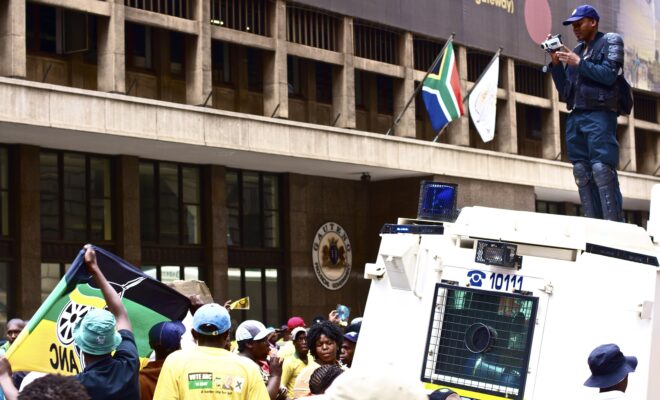
Protest in Johannesburg (Photo: Andy Diesel / Pexels)
Certainly, the ANC-led government bears significant responsibility. For more than two decades, it has treated repeated outbreaks of xenophobic violence as temporary crises to be managed rather than symptoms of a deeper structural problem requiring sustained political attention, even as these episodes exposed deep public frustrations over unemployment, crime and poor service delivery.
It is also true that politicians across the political spectrum in South Africa have exploited these frustrations for political gain, particularly over the past decade. Those who have weaponised anti-immigration rhetoric as an easy route to popularity often appear indifferent to the very real and sometimes deadly consequences of their words.
But there is an uncomfortable truth that many governments elsewhere in Africa prefer not to acknowledge. Economic stagnation, political instability, weak governance and limited opportunities remain acute across much of the continent.Zimbabwe’s economic collapse drove millions of citizens to seek opportunities elsewhere over the past two decades, while persistent poverty and limited employment opportunities continue to encourage migration from countries such as Malawi and Mozambique.
A burden South Africa cannot carry alone
South Africa should not be expected to solve a challenge rooted in broader regional dynamics. Nor is it capable of doing so. South Africa itself faces enormous challenges. Unemployment exceeds 30% – and rises above 40% among young people – while many public services are under significant strain. Much of the spatial inequality designed by the apartheid government remains untouched more than three decades after the dawn of the democratic era.
These challenges are the product of historical imbalances, domestic policy choices and governance failures, not migration. But it would be equally wrong to suggest that migration places no pressure on public services, labour markets or local communities. When systems are already under strain, additional demand can intensify existing frustrations.
Coverage of migration often reflects this imbalance. Journalists frequently ask migrants why they fear xenophobic violence in South Africa, but far less attention is paid to why they left home in the first place. The answer is often found not in Johannesburg or Durban, but in the economic and political realities of Harare, Lilongwe, Maputo and elsewhere. Focusing only on conditions in South Africa risks obscuring the forces that make migration appear attractive despite the deep risks involved – which in South Africa sometimes include death at the hands of vigilantes. It also risks deepening perceptions that government is more responsive to the needs of migrants than to those of struggling citizens, whether that perception is justified or not.
Governments across the region often reinforce this tendency. They are quick to condemn xenophobic violence in South Africa, and rightly so. But far less attention is paid to the political and economic conditions that compel so many of their citizens to leave home in the first place. It is easier to criticise South Africa’s response to migration than to confront the governance failures and economic stagnation that continue to drive migration across much of the continent.
Why the silence holds
South Africa is unlikely to challenge this narrative directly. No ANC president will want to publicly criticise neighbouring governments for contributing to migration pressures in South Africa. South Africans will recall how former president Thabo Mbeki maintained his policy of quiet diplomacy towards Zimbabwe in the 2000s, even as political repression and economic collapse under Robert Mugabe drove large numbers of Zimbabweans into South Africa.
Still, Ramaphosa’s remarks briefly pointed in that direction. South Africa’s migration challenge is inseparable from the wider condition of the region around it. Until that reality is confronted more directly – by South Africa and its neighbours alike – migration will remain a source of political tension.