
Why Global Health Research Needs More African Leadership

Adesina and colleagues through their published article titled, ‘The COVID-19 Pandemic response and the new era of austerity in Africa’ discussed how the economic backslide that swept the African continent since the COVID-19 lockdown was a result of a misaligned response. According to them, the pandemic response policies were predominantly designed for high income countries and instead imposed in under-developed and developing African contexts. In their paper, Adesina et al draw on evidence from Angola in the Southern part of Africa, Nigeria from the West and Uganda in the East. An unfortunate reality they discuss highlights how in many African countries, the African traditional models of healthcare were dismissed in favour of western biomedical measures. They particularly argue that restrictions such as social distancing in many African contexts where families share the same food containers, beds and use communal sanitary facilities were just not suitable. According to the authors, majority of evidence from the global north did not take this into consideration, with many academics producing theoretical frameworks in COVID-19 research which promoted agency and resilience and not critically analysing what was actually happening to the ‘African poor’. Furthermore, with Africa reporting less deaths than the developed world, the pandemic response also became the main driver of what the authors termed the new era of austerity and neo colonialism. This was mainly through the vaccine procurement and debt dependency, with the International Monetary Fund (IMF) lending tied to conditions that will constrain African governments for years to come.
Adesina and colleagues make a powerful argument inspiring this blog’s discussion on what it would look like if African researchers take more leadership in global health research, a subject not adequately addressed in their article. To elaborate on this, we share our experience spanning a 15-year-old partnership between Makerere University School of Public Health (MakSPH) in Uganda and Nottingham Trent University (NTU) in the United Kingdom. As we discuss in a review here, north – south collaborations carry structural inequities that do not disappear simply because partners have good working relationships. However, despite these inequities, our partnership has persevered while impact in Uganda is spearheaded by MakSPH working in collaboration with NTU.
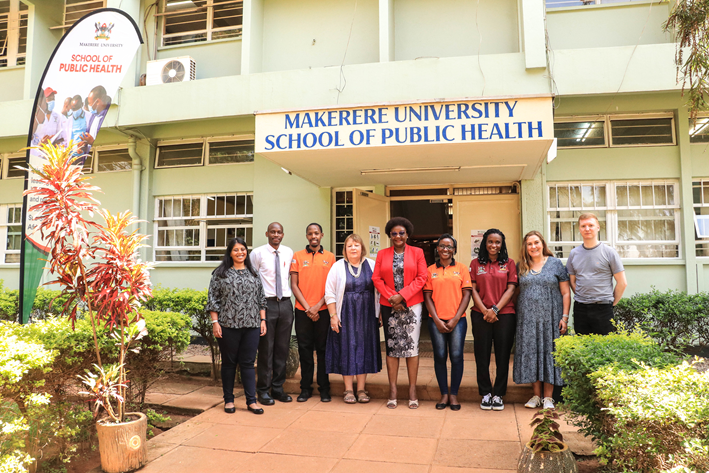
In answering the question, ‘Why does global health research need more African leadership?’ we share a lived experience! MakSPH has led majority of the projects in this partnership, not superficially but genuinely right from project conceptualisation, proposal writing, implementation, and shaping the research agenda. An example is our most recent seven-year project on antimicrobial stewardship funded by the Fleming Fund and delivered across eight health facilities in Central Uganda. Indeed, the MakSPH team lead the design and implementation of the project, working closely with collaborators from both Uganda and the UK. The project utilised a hub-and spoke model where Entebbe Regional Referral Hospital mentored several healthcare facilities across three districts. This represents a south-to-south knowledge transfer which necessitated local leadership for successful implementation. Even when northern partners supported in-country activities including training of health practitioners, this was done in close collaboration with the Ugandan team. The model also developed antimicrobial stewardship committees at each facility that have committed to sustaining the gains even after the project ended. Therefore, bearing in mind the fact that sustainability is where most externally funded research projects typically fall apart, our partnership has been deliberate in growing local and institutional ownership of interventions implemented.
Despite many years of successfully delivering on several projects, some limitations persist and require active effort to address. These include funding gaps, visa delays/denials for African teams, unequal access to publishing and academic platforms, and the persistent tendency for northern institutions and funding bodies to hold grant ownership while southern partners only hold implementation responsibility. To elaborate, one of the key principles of our partnership is bi-directional learning which typically involves travel from Uganda to UK and vice versa for academic and learning visits, as well as co-organizing conferences, workshops and other events. However, even with 15 years of successful collaboration, we have had some individuals denied visas to the UK. Indeed, it has sometimes taken up to 3 attempts for some members of the team to acquire visas to travel for collaborative activities at NTU. Nonetheless, with proven impact over the years, we have been able to obtain institutional support from both organisations which has greatly helped in such situations. In addition, we more recently also use virtual meeting platforms such as Zoom and Teams to have continuous engagements even in the absence of international travel.
The MakSPH-NTU partnership has also addressed some of the structural problems highlighted by Adesina et al. particularly regarding knowledge production. This has been done for example through securing waivers of article processing charges so that Ugandan researchers publish in open access journals as first authors, as well as building bi-directional mobility of staff and students in most projects. Our project outputs are continuously beneficial to the communities we serve which the health system in the Ugandan setting can easily build on. In addition, we have recently implemented a project on equitable partnerships funded by the British Academy in which MakSPH was the grant holder, with funds transferred from the Uganda to the UK partner. This was a major shift in our collaborative efforts as many times project funds move from high income to low income settings.
Our partnership has been successful as the Ugandan team brings expertise that is unique to the local context. This includes contextual knowledge, community trust built over years, and the ability to navigate the local health system in ways that produce research which is not only academically rigorous but also positively improves communities. Therefore, with our partnership’s example we retaliate that even in North – South global research partnerships, African researchers should take lead in the research because they understand the contexts, have been trained there, and have spent years building relationships with communities, the health system and policy environments. The MakSPH-NTU partnership demonstrates that north-south collaboration can indeed work well when built on equity, mutual benefits and willingness to follow African leadership and not necessarily accommodating it.
In conclusion, we implore the global health research community to examine why such examples are less in reality. Funding bodies which locate grants in northern institutions and subcontract African partners, journals that structurally disadvantage researchers from low-incomes countries, and advisory structures that treat African expertise as local knowledge rather than scientific leadership all reproduce the epistemic issues which Adesina et al. point out as the main causes of the COVID-19 response policy failure. Our partnership has spent 15 years showing that indeed there is vast expertise and capacity in Africa. What remains is for the powers that control global health research funding and governance to decide whether they will make changes or whether they would prefer to have African researchers to document the consequences of decisions made without them as witnessed in the COVID-19 response.