
How Russia Lost the Ability to Leave the Central African Republic
When armed groups attacked the border post of Am-Dafok in northeastern CAR on 30 June 2026, most analysts asked the familiar question: who was behind the attack, and how resilient is Russia’s presence? The right question is different. Why can Russia not simply leave the Central African Republic — even if it wanted to? The answer changes how we understand the nature of external military presence in post-patronage Africa.
Not Wagner, Not Africa Corps: A System.
The debate over whether the transition from Wagner to Africa Corps is complete misses the point. The rebranding is real. The architecture did not change.
Russia’s presence in CAR has long ceased to be an instrument that Moscow manages and can withdraw at will. It has become a self-reproducing system with its own operational logic — one that no longer requires continuous decisions from the centre to keep functioning.
Three interdependent circuits make up this architecture. The security circuit protects the regime, trains the national army, and accompanies military operations. The rent circuit controls mining concessions, manages export flows, and generates the revenue that finances the other two. The information circuit provides narrative cover and manages external perception. None of the three exists independently: the security circuit finances itself through the rent circuit; the information circuit protects both. Remove one element and the others cease to function. Which is precisely why removing any of them is so difficult.
The self-financing character of this system is not a side effect — it is the condition of its effectiveness. The architecture does not need budgetary support from Moscow. It feeds itself. That is what makes it genuinely autonomous.
The Mechanism of Delegation Without Return
The Russian Wagner Group first deployed to CAR in 2018, initially with the stated aim of training the national armed forces and providing security assistance to the Touadéra government. Over the following years, its role expanded significantly — from military training to regime protection, resource extraction, and information operations. Following the death of Wagner’s founder Yevgeny Prigozhin in August 2023, the group began a gradual transition toward Africa Corps, a structure under more direct Russian Ministry of Defence oversight. By 2025, Africa Corps had taken over Wagner’s formal role in several Sahel countries. In CAR, however, the transition remains incomplete — the operational networks, personal ties, and rent positions built over seven years have proved resistant to administrative reorganisation.
Every external military presence begins as a service: one state provides, another receives. The underlying assumption is that this service can be expanded, reduced, or withdrawn according to political decisions.
In CAR, something more complicated has happened. As the delegated security function embeds itself within the recipient state’s governance structures, the service detaches from its external provider. The state comes to depend not on the partner, but on the function — a function that no one else performs.
This process unfolds in three stages. First, functional substitution: the external circuit takes on what the state cannot do alone — protecting the head of state, accompanying the army, controlling the extractive periphery. Second, institutional embedding: local financial interests form around the circuit, personal networks reorganise, administrative routines adapt. Third, autonomy accumulation: as stabilisation succeeds, the circuit develops horizontal connections that no longer depend on its original sponsor.
At this point, a paradox emerges. Control weakens for both sides simultaneously. The recipient state cannot remove the delegated function without dismantling the scaffolding on which its own governance rests. The external actor cannot recentralise what has already developed its own institutional life. The system remains functional precisely to the extent that it cannot be centralised.
This is what delegation without return means. Not that exit is impossible — but that its cost rises with every year of successful operation.
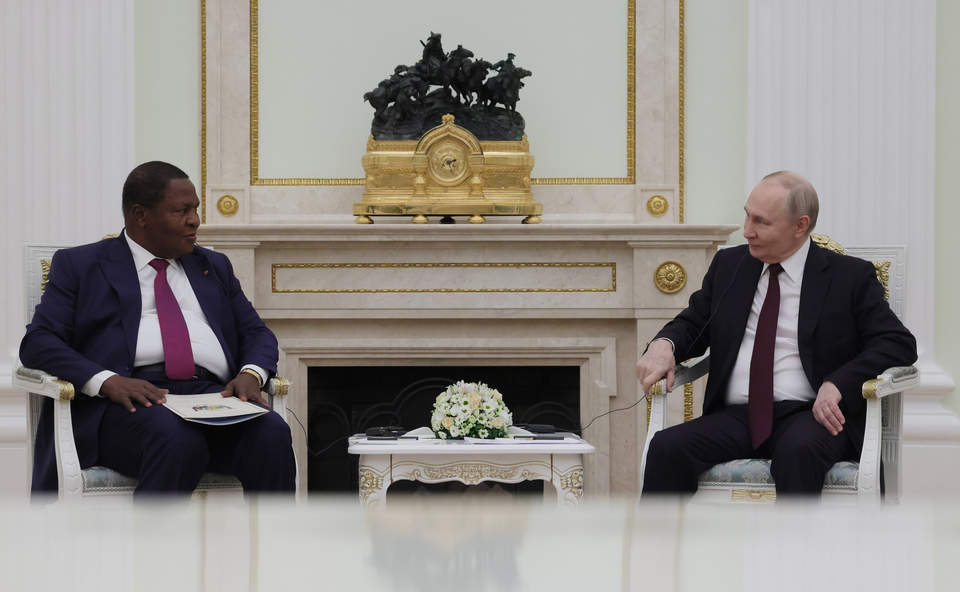
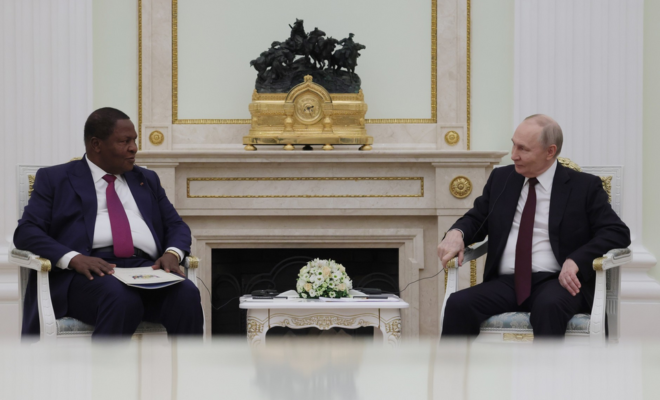
Central African president Faustin Touadera and Russian president Vladimir Putin in Moscow on March 5, 2026
The Stabilisation Trap
The more effective the external stabilisation, the deeper the trap.
President Touadéra is not blocking the transition to direct management through Africa Corps out of anti-Russian sentiment. He fears irreversibility. Full centralisation under direct Russian military command would mean the end of the architecture that keeps his regime in place — an architecture built on distributed autonomy, not vertical hierarchy. So he pursues additional partners: not to replace Russia, but to preserve room for manoeuvre within a system he does not control.
This diversification does not release him from the trap. It expands its perimeter. Each new security partner reproduces the same logic: delegation of functions in exchange for access to resources. A new layer of delegated relationships, new local interests, new informal networks.
The result is a structural deadlock with asymmetric costs. For Bangui, exit means the simultaneous collapse of security and rent. For Moscow, direct management destroys the self-financing mechanism that makes the presence sustainable. Both parties bear the costs of continuation — which are lower than the costs of exit. The system reproduces itself regardless of the political will of either side.
The Third Force
There is a variable that most analysts of external military presence overlook systematically: local armed formations.
Their loyalty is situational. Their drive to participate in the control of rent flows is permanent.
An expeditionary corps — and even more so a private military company — inevitably becomes a buffer between these formations and the state. In the short term, this is convenient: the state delegates management of local armed actors to an intermediary, avoiding direct engagement. But gradually the buffer becomes a wall. The state loses its understanding of the real balance of forces on the ground. The formations accumulate autonomy — autonomy that the system itself finances through their access to rent flows along corridors and at resource nodes.
This is not a side effect of the architecture. It is its structural consequence. The system does not only reproduce security and rent. It reproduces new carriers of security and rent — actors with their own agenda, whose loyalty can no longer be taken for granted.
Am-Dafok
On 30 June 2026, armed formations attacked the border post of Am-Dafok in Vakaga Prefecture — a node on the live corridor connecting CAR to Sudan’s ongoing war. The attack tested the architecture’s peripheral resilience. The core held.
But the incursion revealed what this article has been arguing: at the periphery, where rent flows intersect with transborder corridors, the architecture of delegated control produces actors it does not control. The attack came from exactly where the model predicted the greatest vulnerability — not at the centre, where Russian presence is densest, but at the edge, where delegated autonomy accumulates fastest.
The attack was attributed by MINUSCA — the UN peacekeeping mission in CAR — to a coalition including elements of the FPRC (Front Populaire pour la Renaissance de la Centrafrique) led by Noureddine Adam, and the MDRPC (Mouvement pour la Défense de la République et la Protection des Civils) under Arba Hakouma, alongside unidentified armed elements. The full composition of the coalition, and the role of armed groups that crossed from Sudan, remains under investigation.
Who attacked, and why, is a subject for a separate analysis. What matters here is simpler: the event occurred where the mechanism said it would.
That is not coincidence. That is the system working as designed — and producing consequences no one designed.