
Two Presidents, No Government: Why Tigray’s War Is Coming Back
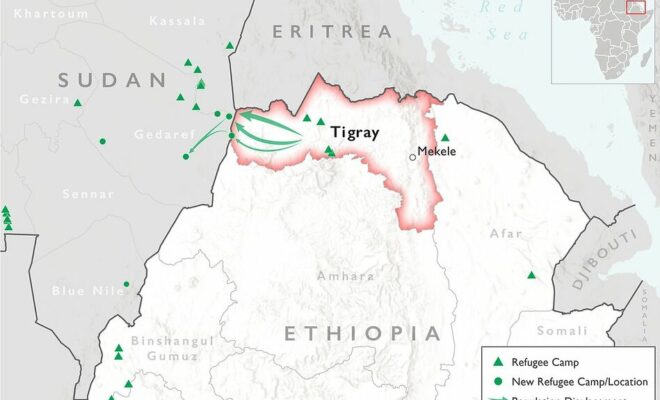
In Mekelle, the capital of Ethiopia’s northern Tigray region, two men call themselves president. One is Lieutenant General Tadesse Worede, appointed with Addis Ababa’s approval to run the region until elections could be held. The other is Debretsion Gebremichael, chairman of the party that governed Tigray for decades and led it through a war (2020-2022) that killed an estimated 600,000 people and displaced two to three million. On 5 May, a regional council that had not met in more than three years reunited and elected him. Addis Ababa treats that council as an illegal body: it was abolished under the 2022 peace agreement, and the vote that created it was declared unconstitutional at the time. The situation nonetheless stands: neither president accepts the other, both sit in the same city, and both have access to men and guns.
How Tigray arrived here?
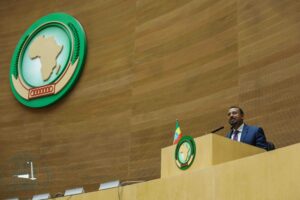
The Tigray People’s Liberation Front dominated the coalition that ruled Ethiopia for nearly three decades, representing the principal component among four ethnic parties. However, in 2018, after years of mass protests led from the Oromo and Amhara regions, the coalition chose a new chairman, and so a new prime minister, from outside the TPLF: Abiy Ahmed, from the Oromo party. Debretsion himself had stood for that post and took two votes on a committee of 180. For the TPLF it was not a reshuffle, but rather an eviction from the centre it had run since 1991. When Abiy dissolved the coalition into a single national party the following year, the TPLF labelled the move illegal and refused to join, moving its people and its money back to Mekelle. In September 2020, with national elections postponed, Tigray held its own regional vote regardless. Two months later the war began: federal troops, Amhara militias and the Eritrean army against Tigray’s forces. It lasted two years, ending in November 2022 with a deal signed in Pretoria, under African Union mediation. Tigray’s fighters would give up their heavy weapons, and its elected institutions would stand aside for an administration chosen by Addis Ababa. Elections were supposed to follow, but they never came.
It is tempting to read what has happened since as the failure of that agreement, and to understand the reasons, but this would assume that the deal created something that has now broken. It didn’t. Pretoria stopped the mass killing of civilians but did not settle anything else. What it left behind is today’s Tigray: two claims to authority, neither of which can govern. Debretsion has a mandate and no legality. Tadesse has legality and no mandate. Neither man can rule six million people by consent, which means that the only means left to either of them is force, and both are reaching for it. This is why the war is coming back.
Two claims, neither complete
Take either claim on its own terms and it falls apart. Debretsion’s rests on the regional election of September 2020, the vote Tigray held in defiance of Addis Ababa and which helped start the war. It is a real mandate, and it is six years old, delivered by a population that has since been through a conflict that killed hundreds of thousands of them. It is also worth noting that, from a legal perspective, the electoral board struck the TPLF off the register of political parties last year, so the party now governing Tigray is not a legally recognised party, nor is the council that elected its president legally a council.
Tadesse’s claim is the reverse: impeccable in law, empty of consent. He was appointed, not elected, taking over the administration from Getachew Reda in 2025. When his term ran out, Addis Ababa extended it by a year without consulting anyone in the region. No Tigrayan has ever voted for him, and under Pretoria none was ever meant to: the agreement handed the federal government the power to appoint.
Compare the two claims side by side and the practical questions have no good answers.
Who pays the civil servants, now that Addis Ababa has frozen the budget and salaries are going unpaid? Whose signature counts in Mekelle’s offices? Whose orders do the police follow in the towns? Which president do the courts answer to? No reporting can answer these questions, and that is exactly the problem.
This is where the crisis stops being about titles and turns into a war. Administration is the entire contest, because neither man can administer without power, and neither can hold power unless the administered recognise his claim. There is no political way out of that circle, and so both are looking for one outside politics.
The more immediate danger in Tigray is not Mekelle against Addis Ababa but Tigrayan against Tigrayan. Tadesse Worede is no mere administrator: he commanded Tigray’s army through the war, and he has refused to hand over powerwhile keeping the connections to call up troops of his own. ACLED’s analysts think the likeliest first scenario is fighting between Tigrayan factions, with commanders forced to choose between the party that claims the 2020 vote and the general who holds the recognised office. The TPLF understood this before it moved: it secured the backing of senior commanders in April, then reconvened the council in May, counting the guns before counting the votes.
What rule without consent looks like
Both ‘governments’ are already treating the people they claim as a resource to be conscripted. On 4 June the local rights organisation Human Rights First Ethiopia documented forced recruitment and mass round-ups, known as afesa, across the north-west, centre and east of the region: old soldiers ordered back to their units, families who lost nobody in the last war told to give a son to the next one, young men taken from markets, gold mines and church gatherings. Some are sleeping in fields and moving between relatives’ houses to stay out of reach, others have fled to Addis Ababa. Human Rights Watch has since reported the abduction of children as young as 15 in night-time house-to-house searches. In June the council turned it into law, passing a mobilisation proclamation that makes service compulsory and punishes evasion, desertion or criticism of the campaign with up to 25 years in prison, or death.
The party’s whole authority rests on the votes of 2020, and it is now press-ganging the people who cast them, with the death penalty available for anyone who objects out loud. A mandate that was still alive would not need any of this, because the volunteers would come; instead they are hiding in fields and slipping away to the capital of the government they are supposedly being raised to fight. The TPLF’s own vice-president, Amanuel Assefa, told AFP that recruitment is normally ‘only based on consent’, with exceptions permitted because every Tigrayan must defend the territory against an existential threat. That is the argument of a party that has run out of willing subjects.
Addis Ababa’s coercion is quieter, but it is the same admission. Unable to make Tigray accept a president nobody chose, the federal government has frozen the region’s budget and restricted its fuel: a war on salaries and generators. It has also removed the only lawful route out of the impasse, since a deregistered party cannot contest an election. In January, federal and Tigrayan forces fought their first large clashes since the war ended, and by February the federal army was moving tanks into Welkait, in the disputed west.
Nothing at home, so look abroad
An authority that cannot draw support from its own population has to buy it elsewhere, and both are shopping. Eritrea sent its army into Tigray in 2020 to help destroy the TPLF, but now it is lining up with the Sudanese army to back a Tigrayan push into the disputed west. In mid-May, people linked to Asmara, Port Sudan, Amhara nationalists and other armed Ethiopian opposition groups met openly in Sudan under a single banner, the first public alliance of states and insurgents aimed at Addis Ababa. Abiy Ahmed, for his part, stands accused of arming Sudan’s Rapid Support Forces against Khartoum.
Every government in the neighbourhood is now funding its neighbour’s rebels, and the enemies of 2020 have traded places, which tells you these alignments were never about anything but leverage. ACLED’s analysts had long warned that a Tigrayan move on Western Tigray, the question Pretoria refused to answer, was the red line most likely to bring on a full battle and pull in Eritrea, Sudan and the Amhara Fano, the region’s ethno-nationalist militia, at once. In recent days, that line has been crossed. Fighting broke out in Shererina, in the contested west, the same ground Amhara nationalists have held since the last war, and it ran for the better part of two days with heavy artillery and drones. The Tigrayan unit reported at the centre of it, known as Army 70, is one whose fighters had fled to Sudan during the war and then fought alongside the Sudanese army: the outside sponsorship is no longer a matter of meetings and banners but of men recrossing a border to do the fighting.
Who fired first is contested, and the confusion is itself part of the story. Tigray’s government says federal forces opened the assault at dawn; a federal minister, himself a Tigrayan, confirmed the clashes but blamed Debretsion’s forces for starting them; Addis Ababa’s army has said nothing, and reporters on the ground cannot independently verify either account. The question of who pulled the trigger, at this point, stops mattering, because what matters is that the trigger was pulled.
The fair objection to all this is that the two coercions are not equivalent, and they are not. Addis Ababa holds the state, the recognition and the money; Tigray holds a ruined region and its grief. Freezing a budget is not abducting a fifteen-year-old. But the structure is the same, and the structure is what matters, because it explains why every deadline slips towards violence. Neither president can be voted out, since there is no vote. Neither can be argued down, since neither is making an argument. What is left is the thing that settled it last time. The council that reconvened in Mekelle on 5 May did not come back from the dead; it had never gone. Nor had the war, which was only suspended, and now it is the only institution that still works.
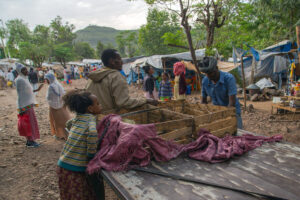
Six million people will pay the bill. Nearly every family in Tigray buried someone the last time this argument was settled by force, and the region has not been rebuilt, its displaced have not gone home, and its dead have not been counted. Those people chose neither president. Nobody asked them whether the mandate of 2020 should be revived in their name, or whether a caretaker should be imposed on them from Addis Ababa. In the first days of August, as the guns opened in the west, they answered in the only way left to them: on foot, towards the Sudanese border, wounded among them, walking back into the country many of them had last fled as refugees. In the argument between the two men who claim to govern them, there was never a place for their answer.
‘They kept their comfort while forgetting the martyrs’, one man who fled the recruiters told AFP this summer, saying what many in Tigray now believe: that whatever comes next will serve the few at the top. ‘The war should not happen,’ he said; it has to be solved politically, and firing bullets solves nothing. He is right, and that is the whole problem, because there is no politics left in Tigray to solve it with.