After the Ballot: What Democracy Must Mean for Somalia
Somali political life is intensely debated across towns, households, media platforms and diaspora communities. Yet this energy does not consistently produce the power to compel answers, reverse failed policies or remove officials whose conduct has become unacceptable. The distance between participation and political consequence remains one of Somalia’s central democratic problems.
Direct local elections in Puntland and Mogadishu have provided recent precedents, and Somalia is again moving towards direct national elections. The framework for federal elections, however, has yet to be settled between the government and opposition. The debate should not stop at how votes will be cast. It must also ask what power citizens retain after they have cast them.
Somalia’s First Republic combined universal suffrage and competitive elections with legal opposition, constitutionally protected civil freedoms and a government required to retain the National Assembly’s confidence.
The 1969 election produced substantial turnover. 77 of the National Assembly’s 123 sitting members were not returned, including eight members of the outgoing cabinet. The Somali Youth League (SYL), the governing party at the time, won 73 seats, while parties outside it secured 50. Political scientist Ahmed I. Samatar records that, when the new Assembly first met, all but one of the newly elected non-SYL deputies crossed to the governing party.
The formal result stood. Inside Parliament, most of the opposition strength it had created was gone. That is political attenuation: the balance created by voters remained on paper while losing much of its force inside Parliament. In this case, the attenuation occurred between the election and the new Parliament.
The same election also exposed pressure on the institution meant to keep the contest fair. The government asked police commander Mohamed Abshir Muse to place police personnel and vehicles at the disposal of the governing SYL in electorally important areas. Abshir had defended the force’s political neutrality. He refused and submitted his resignation. A temporary compromise placed him on leave until after the election. Tom J. Farer records that, during his absence, a northern commander known for integrity and political neutrality was recalled to Mogadishu, while more compliant officers were reportedly assigned to important electoral districts. Abshir’s resignation was then accepted.
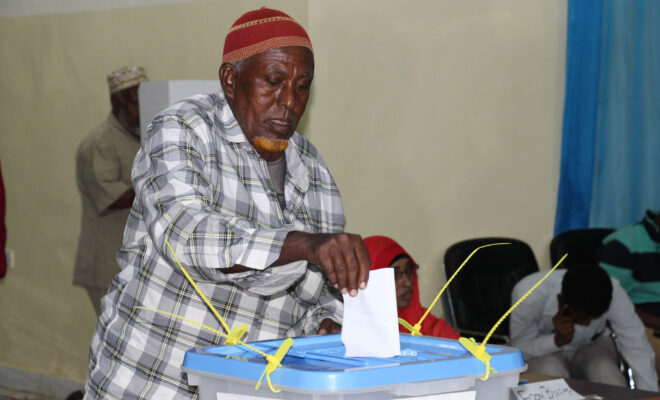
A delegate casts his vote during the electoral process to choose members of the Lower House of the Somali federal Parliament in Baidoa, Somalia on November 25, 2016. UN Photo/ Sabir Olad
The police were responsible for protecting the election — the government asked them to help it win instead. The episode showed how vulnerable institutional neutrality became when it obstructed those already in power.
Somalia’s current political order was shaped by successive ruptures: colonial division, the discrediting of civilian government, military rule, state collapse and fragmented reconstruction. By 1969, civilian government had lost so much public confidence that the military takeover was widely welcomed. After the state collapsed, political reconstruction relied on a different settlement.
Somalia’s 4.5 formula, a clan based power-sharing system, allocates equal shares of political representation to four major clan families and a collective half-share to minority groups. It helped restore representation, but also established guaranteed shares and gatekeeping roles for elders and political brokers that have proved difficult to dislodge. The arrangement continued to shape political choices as the surrounding context changed. That persistence is a form of political hysteresis. Research by the Somali Dialogue Platform and Somali Public Agenda describes both its contribution to inclusion and its concentration of political selection among a relatively small group of intermediaries.
Direct elections would return the choice of national representatives to citizens, but they would not automatically remove the political arrangements built around the present system. Candidate selection, party formation and coalition bargaining would still determine how much influence citizens retain after voting. Whether representatives remain visible to those who elected them, whether government answers Parliament and whether political decisions are actually carried out would remain separate questions.
The problem also appears after Parliament has acted. In 2017, the House of the People endorsed committee findings on the Qalbi Dhagax case: the Somali government’s transfer to Ethiopia of Abdikarim Sheikh Muse, known as Qalbi Dhagax. He was a commander in the Ogaden National Liberation Front (ONLF), then an armed movement seeking self-determination for Ethiopia’s Somali Region. The vote was 152 to six, with three abstentions. The committee said the transfer had bypassed lawful process and rejected the government’s designation of the ONLF as a terrorist organisation. The surviving public record shows no timely, attributable executive answer during the remainder of that administration.

The state Minister for Interior, Farhan Ali Mohamed, awards a certificate to a graduating officer at the end of training of trainers course on elections security and crowd control in Mogadishu
In 2022, a later Cabinet reversed the ONLF designation and declared the transfer illegal. That partly restored Parliament’s earlier judgement, but the available evidence does not show that the 2017 vote caused the reversal. Citizens could see the parliamentary decision and the later policy change, but not a functioning route connecting them.
The issue was not that the executive had to agree with Parliament. Democratic institutions can disagree. The problem was the absence of a timely, attributable response showing whether Parliament’s judgement had been accepted, rejected or acted upon.
The vote determines who enters office. It does not by itself determine what happens afterwards.
These cases reveal different points at which democratic transmission can weaken. Electoral authority can be attenuated inside Parliament, the neutrality of the electoral channel can be damaged, inherited political arrangements can persist after the conditions that produced them have changed, and parliamentary judgement can meet executive non-response. These are distinct failures.
The coming transition should therefore be judged by more than access to a direct vote. Its democratic significance will depend on whether the authority citizens allocate survives beyond election day: whether representatives remain answerable, Parliament retains force, neutral institutions resist capture and formal decisions produce attributable responses. The ballot should open that process, not end it.