Why Sanctions Are Not Stifling Sudan’s War Economy and What We Can Do About It
Since the outbreak of the brutal civil war in Sudan in April 2023, the US, British, and Canadian governments, along with the European Union and United Nations, have imposed targeted sanctions on some 32 individuals and 20 companies tied to the bloodshed to restrict their access to assets, international finance, and travel. Three and a half years into the fighting, more than two-thirds of Sudan’s population requires humanitarian aid and almost 14 million people have been forcibly displaced, and the need for effective policy responses has never been more urgent.
These sanctions have had some impact. For example, China, citing international sanctions, refused to authorise the sale of its air defence systems by Pakistan to Sudan in August 2025. Turkey refused a deal to sell drones to the Rapid Support Forces (RSF) because the group was unable to provide an end-user licence. Succumbing to pressure, the UAE has distanced itself from some shell companies previously operating as covers for the RSF from its soil.
More often, however, it has been easy for sanctioned entities to obfuscate and manoeuvre around sanctions, sometimes in the very capitals that have issued them.
Earlier this year, a business forum convened in London to mobilise capital to rebuild Sudan’s economy showed how those profiting from the conflict continue to evade sanctions. One of the event’s sponsors, the Export Development Group (EDG), presented itself as a leading player in Sudan’s future reconstruction.
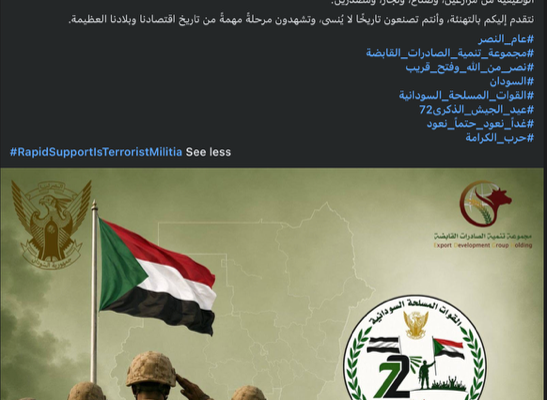
A new report by the Sudan Transparency and Policy Tracker (SPTP) argues that the company is, in fact, a subsidiary of the Defense Industries Systems (DIS), the military conglomerate that operates a web of businesses that finance the Sudan Armed Forces’ (SAF) war machine, which the UK government designated in June 2023. Operating in London and on its website, it obfuscates that connection, scrubbing any reference to its affiliation to its parent company from its website, with the imputed goal of distancing itself from the sanctions. At the same time, it continues to reference it in social media posts intended for domestic audiences.
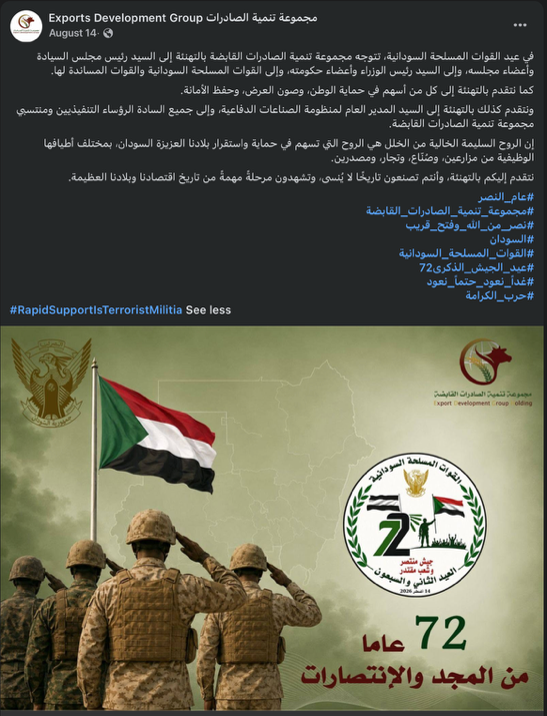
The Exports Development Group presents a different image in content for domestic audiences compared to its international profile.
Research published by STPT has identified the primary challenge in employing sanctions effectively. The designations issued to date have been drawn narrowly and enforced loosely, targeting specific individuals and companies, with targets adapting faster than the governments that target them.
A prime case is that of Zadna International, a DIS subsidiary sanctioned by the UK, US, and EU between June 2023 and January 2024. Despite this, the report argues that the company has become the primary beneficiary of massive contracts across areas controlled by the Sudanese Army and a conduit for war profiteering. In December 2025, the company was awarded an approximately $7 million contract to resurface a 12-mile road in Gezira state, a cost ten times higher than an estimate for the same work in a 2022 agreement, according to the STPT report.
In the same month, White Nile state reportedly named Zadna as the primary partner for all of its 2026 development projects. The company’s director described the strategy as ‘financial engineering,’ shifting its externally-sanctioned operations domestically. Such ‘financial engineering’ involves structuring joint-venture trade partnerships in friendly countries—such as Egypt—and using commodity swaps to bypass international currency transactions, a mechanism detailed in a recent STPT report and investigated by The New Arab.
Red Rock Mining Company, another DIS affiliate company sanctioned by the UK and EU, highlighted its operations in Tanzania, Ethiopia, the UAE, and the Netherlands, an EU member state, on LinkedIn in November 2025.
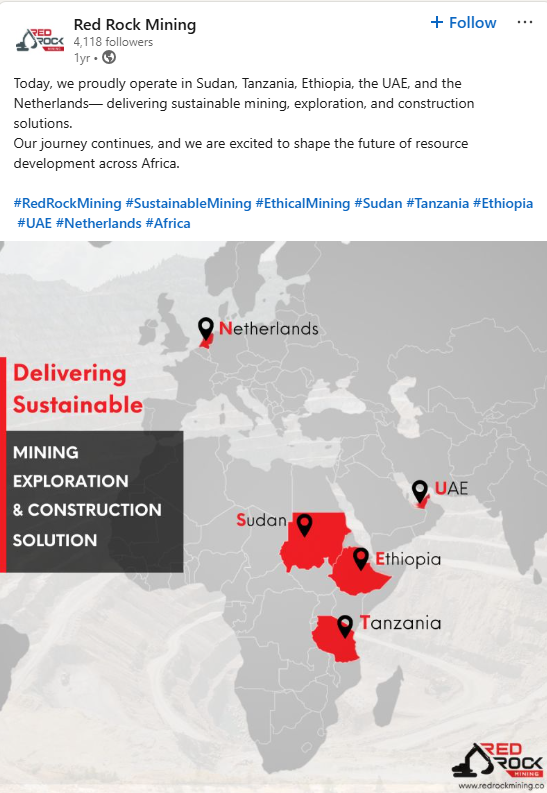
LinkedIn post by Red Rock Mining.
Merghani Idriss, the head of DIS, is still alleged to lead major weapons procurements for the army, despite being sanctioned by Canada, the US, and the EU, reportedly leading a delegation to Pakistan to sign a $230 million arms package, widely reported to have been financed by Saudi Arabia.
The DIS, two years into the conflict, showcased its domestically manufactured drones and precision weapons at a Turkish defence fair.
Similarly, SAF’s main rival, the RSF, have employed similar tactics and adapted to sanction regimes. One of its primary vehicles, Al-Junaid company, has managed to process and export millions worth of gold via neighbouring countries and onwards to the UAE, according to reporting by the New York Times.
Kenya, one of the key conduits for RSF operations, saw its gold exports to the UAE spike by almost 30 percent in the first nine months of 2025, a 13-ton increase from 2024 attributed to laundering and not domestic production.
This is not to say that sanctions do not work entirely or that they should be abandoned, but rather a call for using them more effectively. Evidence shows they have worked in isolated examples.
The difference between the cases that worked from the cases that failed is whether the corporate structure was hidden in the first place.
At the same time, the decades of sanctions imposed during the Bashir era that were fully removed by 2020, continue to have an impact. Overcompliance by banks and companies continues to impede banking and commercial transactions, making it difficult for humanitarian and human rights actors to move funds and access corporate services.
The recent exposure of the SAF’s use of chemical weapons has renewed attention to the need to address weapons supply chains. Despite an arms embargo being in place for Darfur since the start of the conflict both SAF and the RSF have managed to move weapons there that have targeted Sudanese civilians. Both are channelling the country’s natural resources towards arms purchases, including said chemical weapons.
Fixing sanctions evasion requires five elements.
First, more attention needs to be paid to subsidiaries and the joint ventures established to obfuscate sanctions. Under US law, any company more than 50 percent owned by a designated entity, such as the Export Development Group, is included in the designation. The UK adopts a similar standard. However, too little attention is paid to ensuring that there is awareness of these connections and subsidiaries, which impedes enforcement. Explicitly naming subsidiaries more quickly could address this.
Second, expand that scope of the current and future targeted sanctions to network sanctions by targeting the entire supporting ecosystem around those primary bad actors, the commanders of the warring parties and their top revenue earning companies. This would require identifying and sanctioning foreign shell companies, front organisations, procurement agents, financial facilitators, and logistics providers that enable the primary target to evade restrictions or maintain operations.
Third, the UN arms embargo on Darfur should be expanded to cover all of Sudan, a call made in August by the US Government.
Fourth, sanctioning entities should directly engage third-country jurisdictions, including neighbouring countries such as Egypt, Kenya, and the UAE to ensure the logistics hubs facilitating evasion are eliminated, with clear due diligence and secondary measures as warranted.
Fifth, guidance that unwinds overcompliance by banks in areas that are not targeted by sanctions and which hinders humanitarian, legitimate businesses, and individual transfers should be issued to facilitate access to millions in need of aid.
Sanctions can work only if a concerted strategy is put in place to ensure that sanctioned entities cannot continue to operate via subsidiaries in the very capitals that issued them.