
Nigeria’s Accountability Crisis Is Fueling Every Other Political Crisis

On March 23, 2026, a Federal High Court in Abuja handed down a 72 year sentence, to be served as eight years concurrently, to Chukwunyere Nwabuoku, the former acting Accountant General of the Federation, for laundering funds while he ran finance for the Ministry of Defence. At first glance, it looks like a rare victory for accountability. It is also, on closer look, proof of how unusual accountability has become. A review of 393 corruption cases involving Nigerian public officials between 2013 and 2026 found that only 144 ever reached a final judgment. Roughly six in ten sit unresolved, some for over a decade, while the accused keep their freedom, their assets, and often their offices.
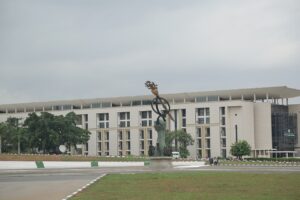
National Assembly Complex, Abuja
Nigeria’s deepest political crisis is not corruption, poverty, or insecurity on their own. It is the near total absence of consequences for the people who cause them. Officials are investigated and never tried. Governors face removal proceedings, only for the process to be overtaken by court rulings or political bargains. Security failures repeat because senior officials rarely face consequences for them. Each of these failures compounds the next, and all of them trace back to one missing ingredient: a cost for getting caught.
Every scandal that dies quietly teaches the next official that the system will absorb the loss. That lesson shapes how public money is spent, how elections are contested, and how much faith citizens place in their own government, right as the country heads toward the 2027 elections.
A culture built over decades
Nigeria’s tolerance for unpunished power did not start with this republic. Decades of military rule normalized the idea that those in charge answer to no one, and the civilian government since 1999 inherited that habit. Weak courts, a politicized Economic and Financial Crimes Commission, legislative godfathers who make and unmake governors, and a public grown tired of outrage have all helped the pattern outlive the dictatorships that produced it.
The 1999 Constitution promises, under Section 14(2)(b), that the security and welfare of the people shall be the primary purpose of government. In practice, that promise competes with a political culture where loyalty to a patron counts for more than performance in office.
What impunity looks like now
The pattern shows up at every level of public life.
In politics, the Dataphyte review found that only 35 of 393 corruption defendants over 14 years were former governors, and cases against elected officials take six to fifteen years to conclude, against two to five years for appointed officials. Former Kaduna governor Nasir El-Rufai still faces a fraud charge running over hundreds of millions of naira, while opposition figures have accused the EFCC of timing such prosecutions for political effect ahead of 2027. In Rivers State, repeated attempts by lawmakers aligned with FCT Minister Nyesom Wike to remove Governor Siminalayi Fubara became less a constitutional process than a political contest. Court orders, presidential intervention, and negotiated settlements repeatedly overtook legislative procedures, leaving institutional accountability secondary to political bargaining.
In public finance, the sums grow larger while accountability grows weaker. The Auditor General’s 2021 report flagged the NNPC for N514 billion in unauthorised deductions and undocumented spending, and the Senate has separately been pressing NNPCL to explain N210 trillion in discrepancies across its 2017 to 2023 financial statements. BudgIT’s review of the 2025 budget found that lawmakers inserted 11,122 projects worth N6.93 trillion, many with no clear link to national priorities. None of these revelations has resulted in clear political consequences for those responsible.
In security, the human cost is measured in bodies, not just balance sheets. SBM Intelligence’s tracking of kidnapping for ransom recorded 4,722 people abducted in 997 incidents between July 2024 and June 2025, with 762 deaths and N2.57 billion paid out against ransom demands of N48 billion. Public perception data from Afrobarometer and other polls show that most Nigerians rate the police and security forces poorly in addressing crime and banditry. This judgment is reinforced by the rarity of meaningful investigations, prosecutions, or reforms following major security failures or reported abuses by state actors.
The cost of a system without consequences
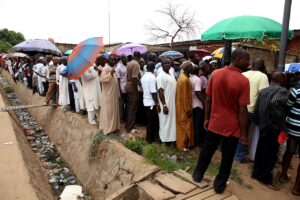
Voters waiting at a polling station in Kubwa, Abuja
None of this stays contained to the officials involved. Every unresolved case tells the judiciary and the public that the law bends around power. Every recycled politician tells voters that scandal is a career pause, not an end. Every unremitted billion tells citizens their taxes fund someone else’s impunity instead of their own roads and schools. The result is a slow bleed: falling trust in institutions, an economy underperforming its potential, professionals leaving for countries where effort and consequence still track each other, and a public that disengages from politics because engagement rarely changes outcomes.
Nigeria’s challenge is not a shortage of anti corruption laws. It is a shortage of visible consequences.
Why it persists, and the honest counterpoint
Defenders of the current system point to prosecutions, ongoing EFCC cases and reform proposals in the National Assembly as evidence that accountability is advancing. Some of that is true. But a system that convicts appointed officials in a few years while elected ones wait over a decade, or allows politically sensitive cases to drag through prolonged legal battles, struggles to create a consistent expectation of consequences.
Political incentives help explain why. Many of those with the authority to strengthen accountability operate within the same political system that could eventually subject them, their allies or their successors to scrutiny. Courts face their own capacity constraints, while civil society organisations and journalists can expose wrongdoing without having the institutional power to ensure that exposure leads to a final outcome.
Nigeria does not lack proposals for reform. Judicial timelines, anti corruption agency independence, asset declaration enforcement, electoral safeguards and protections for whistleblowers have all featured in public debate. The challenge is turning those proposals into institutions that can act consistently, including when the people involved are politically powerful.
That distinction is important. Accountability is not established by the number of investigations opened, charges filed or agencies created. It is established when cases move from allegation to resolution and when misconduct produces consequences regardless of who is involved. Nigeria’s corruption, insecurity and governance problems may look like separate crises, but they share a common weakness. When institutions struggle to impose consequences, failures become easier to repeat.
That is why the accountability crisis deserves attention beyond individual corruption cases. It is part of the machinery through which Nigeria governs itself, and its weakness has consequences far beyond the courtroom.