Eritrea’s Coming Crisis? How the Lifting of US Sanctions Might Spell Trouble for Africa’s Most Opaque State
On 19 September 2026, the United States lifted its sanctions on Eritrea, one of Africa’s most enigmatic and repressive states. These sanctions were imposed by the Biden administration in 2021 for Eritrea’s role in Ethiopia’s devastating Tigray War (2020-22). Opinions vary as to the possible meanings of their removal: is it morally permissible on the part of the US? Will Eritrea’s inhabitants be uplifted by their departure? Is this a portent of a new US-defined political order in the Horn of Africa? Though these are important questions, the greatest impact – and a paradoxically destabilising one – may instead be felt around Eritrea’s octogenarian autocrat, Isaias Afwerki, as predatory officials search for new political openings. The lifting of these sanctions may yet help to push Eritrea into an era of uncertainty.
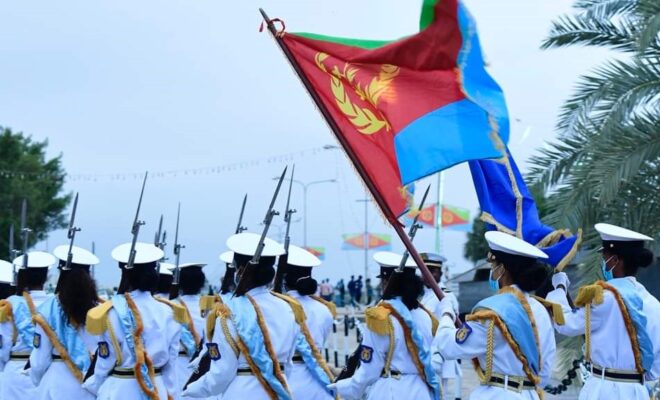
Eritrean navy
The departure of the sanctions is both controversial and long-awaited. Human rights groups have decried the decision, citing now-notorious accounts of forced labour, torture and media suppression that have made the People’s Front for Democracy and Justice (PFDJ), Eritrea’s ruling party, a byword for authoritarian governance in Africa. The development was, nevertheless, expected. It comes four months after Reuters reported on an internal US government document outlining plans to lift the sanctions. Eritrea, which denounced the sanctions as ‘illicit and immoral’, has welcomed their departure, arguing that they had ‘caused incalculable damage to the country’. Sanctions, the PFDJ argued, had long acted as a ‘constraint on the country’s development trajectory’.
Observers of Eritrea’s political economy will, however, likely recognise that the lifting of these sanctions will contribute little in the way of relieving Eritrea’s impoverished population. The departing US sanctions targeted the PFDJ’s key financial and military apparatus, as well as two major officials – its security boss, Abraha Kassa, and its economic chief, Hagos Gebrehiwet. (The Eritrean Defence Force’s chief of staff, Filipos Woldeyohannes, remains designated under a separate sanctions.) It is these elements that stand to benefit from the removal of US sanctions, much less the country’s wider inhabitants. In fact, poverty and repression are necessary parts of the PFDJ’s political strategy: to control political expression, transnational capital flows, and the mobility of permanently enrolled national service conscripts. Turning to precedent, recall that following the removal of near decade-long UN sanctions in November 2018, the PFDJ remained isolated, introverted and implacably self-sufficient. The power to transform Eritrea remains in the hands of the party, not the US.
Meanwhile, other reports speculate that the removal of US sanctions portends a US-Eritrean partnership against Yemen’s Houthis. The latter have, in recent weeks, captured swathes of territory in southern Yemen, culminating in their seizure of the Bab el-Mendeb’s Perim Island, to the ire of their Saudi opponents. Eritrea’s Hagos Ghebrehiwet met with Saudi officials on 15 September, the most recent in the countries’ long liaison. The Houthis’ (un)timely capture of Perim, being fifty miles from Eritrea’s Asseb Port, raises Eritrea’s international bargaining strength, thirsty as it is for oil amid the Hormuz crisis. Yet while the Saudis may appreciate a sanction-free engagement with Eritrea, the US is unlikely to sideline its powerful Ethiopian ally. In truth, the ‘removal’ of these five-year-old sanctions signifies their expiration without renewal, rather than a forthcoming regional reorientation. Indeed, the United States, showing little favouritism to Eritrea, has simultaneously allowed its arms embargo on Ethiopia to expire and agreed to strengthen their security ties.
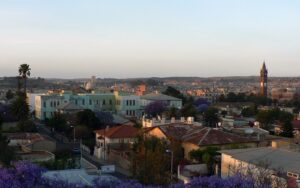
Asmara
The most radical effect of the removal of US sanctions may, in fact, be found in the PFDJ’s own esoteric high command. Eritrea’s opaque state is underpinned by a political system only as secure as its dogged autocrat, Isaias Afwerki, is strong: one not unsettled by sanctions but, through the concentration of scarce political resources in one man, stabilised by them.
In his 2015 book, The Real Politics of the Horn of Africa, the anthropologist Alex de Waal described a quiet transformation occurring within the PFDJ that threatened to dismantle it from the inside. Isaias had led Eritrea to independence from Ethiopia in 1993, but his rule became increasingly personalistic, particularly following the border war between the two countries (1998-2000). Internal opponents were crushed during the now-infamous G-15 purge, while the party’s steely revolutionary bureaucracy mutated into a clientelist model that placed Isaias as its central patron.
But monopolising political power proved costly: loyalty had to be bought, and post-war Eritrea was desperately poor. Isaias devised a strategy. He would rule through fear: both of himself and of a looming Ethiopian spectre. Crucially, he would attempt to keep the party and the mushrooming military distinct: party officials could control finance but not force, while military commanders could wield force but not finance. This kept the price of loyalty cheap: who, if anyone, could challenge him?
But where would Isaias find the money? After Eritrea’s war with Ethiopia, the PFDJ sustained its enormous 600 USD military budget (over 20% of its total expenditure) on the proceeds of mineral extraction: gold, silver, copper, zinc, and potash. Foreign mining firms provided much of the necessary capital for these ventures. This budget, in turn, was used to monitor and direct labour conscripts, uphold Eritrea’s regional stature, and, increasingly, to monopolise the regime’s allocation of rents – assets distributed to powerful PFDJ barons under Isaias.
When military officials demanded a financial stake, however, cracks began to show: in the clandestine dealings of generals who benefitted from trafficking refugees abroad, in the major mutiny of a brigadier general in 2013, or in the missing finances of Eritrea’s mining sector, whose exploitation Isaias haphazardly awarded to powerful army commanders. Amid these difficulties, successive waves of sanctions were introduced – first imposed by the UN (2009-18) and then the US (2021–26). These limited Eritrea’s international dealings, hermetically sealing the country. Of course, this likely suited Isaias. In losing their access to the outside world, Eritrean officials would have to rely on the president’s patronage. The price of loyalty decreased.
So when UN sanctions were finally lifted in 2018 and Eritrea normalised its relations with Ethiopia, Isaias, perhaps inadvertently, lost two fundamental political props. The first was the party’s security rationale, which justified Eritrea’s militarised economy against the Ethiopian threat. The second was the opening of new channels for foreign rents which, if left uncontrolled, could threaten Isaias’ resource monopoly by allowing powerful PFDJ officials to cultivate their own external sources of income. Indeed, Eritrea’s subsequent engagement in Ethiopia’s Tigray War might be viewed as an attempt to placate those very officials by setting their ambitions loose on the mineral wealth of Tigray; ‘war prizes’, as ventured Charlotte Touati, the author of Eritrea’s Gold Rush.
It was during this very war that sanctions returned, this time imposed by the US. These targeted individual PFDJ officials: the military chief of staff, security boss and economic chief. Five years later, in 2026, the atmosphere surrounding their removal seems different. Military officials possess a considerable financial stake. Amid the Hormuz closure, Eritrea is starved for fuel and has recently announced a currency recall. Civil conflict has escalated in Ethiopia, with its government accusing Eritrea of supporting Ethiopian rebel groups. Talk of an invasion is in the air and Eritrean opposition is mobilising abroad. Meanwhile, little is known about Isaias’ succession plans, and no successor has been publicly announced. The President is now eighty years old and upon his inevitable death (assuming that Ethiopia does not get there first) there can be little doubt that the PFDJ’s high-ranking officials will zealously protect their own respective positions.
Eritrea is no Sudan, its civil war-ravaged neighbour, but its recent history offers a useful warning. By the 2010s, Sudan had suffered consecutive economic traumas and sacrificed many of its assets to Gulf investors. Diminutive in state capacity, its erstwhile ruler, Omar al-Bashir, played two parallel military authorities off against one another: the Sudanese Armed Forces under General Abdel Fattah al-Burhan and the Rapid Support Forces under Muhammad ‘Hemedti’ Dagalo. Al-Bashir prolonged his rule by delegating coercive extraction to these armed factions, until he was ousted in 2019. Eventually, in April 2023, the RSF and SAF went to war amid a struggle over Sudan’s political and economic order, with both sides benefiting from competing external relationships.
Eritrea today shares some of the characteristics that made Sudan vulnerable to elite fragmentation in the 2010s: a stagnant economy, an elderly autocrat, and a militarised, extractive and internationally-linked system of political finance. Whether it will develop the same fractious armed rivalries as its neighbour remains to be seen. The PFDJ’s armed forces do, however, possess a demonstrated capacity for high-level mutiny, alongside access to a geography that facilitates prolonged insurgency – was this not how the PFDJ itself came to power? If the post-sanctions political landscape is not quickly brought under control, as it was in 2018, the lifting of sanctions in 2026 may produce combustible rivalries within the PFDJ, with powerful figures scrambling for advantageous positions. PFDJ officials may begin to cultivate external political allies of their own, an avenue that the lifting of US sanctions opens. The consequences could be significant.