Sudan: Nobody Hands Over a Gun for Nothing
On 6 October, Sudan’s army chief Abdel Fattah al-Burhan said again that there would be no negotiations with the Rapid Support Forces (RSF) of Mohamed Hamdan Dagalo, known as Hemedti, or ‘any other party’, and that the war would go on until victory. A day earlier, Donald Trump’s envoy Massad Boulos had disclosed a meeting with him in Egypt. Washington is pushing a 90-day humanitarian truce and, according to sources cited by Reuters, made Burhan’s visa for the UN General Assembly conditional on it.
In 1996, General Alexander Lebed told the journalist Yevgeny Kiselyov on Russia’s NTV that ‘all wars, even hundred-year wars, end in negotiations and peace all the same’. He then asked whether it was worth piling up mountains of corpses only to sit down and negotiate anyway. In August that year, at Khasavyurt, he signed a truce himself; the peace treaty followed in May 1997. The troops left, the other side kept its weapons, and the question of Chechnya’s status was put off until the end of 2001. Three years later the war was back.
Khasavyurt is remembered as a breather that the enemy exploited. But a breather works for everyone. The second war was triggered by the raid into Dagestan in August 1999. It came from the side that considered itself the winner, and it was led by the field commanders Shamil Basayev and Khattab, not by Maskhadov, whose signature was on the peace. We cannot say which pushes harder back to war: revanchism born of the bitterness of defeat, or the euphoria of victory.
Burhan sees the breather from one side. In his view, the calls for a truce coincided with attempts to let the RSF expand its territory. He is right about one thing: what he is being offered is not a peace plan. The truce proposed by the Quad (the US, Saudi Arabia, the UAE and Egypt) is designed for two and has still not been agreed. But Burhan has no peace plan either. His condition is that the RSF first leave the cities and gather in designated areas of Darfur, and only then comes a truce. That is a plan for victory written up as a precondition.
The principle and its price
The mediators have a principle. The Quad set it down in September 2025: the transition must not be ‘controlled by any warring party’. This autumn Washington went further. On 15 September Boulos said that ‘there is no future for any of the two leaders in the country’, and on 22 September the State Department declared that neither the army nor the RSF, nor their leaders, represent legitimate constitutional governance: ‘they rule through force of arms alone.’ As a principle, this is easy to support. It is harder to picture what it looks like in practice.
Yet it is the army and the RSF that Washington is asking to sign the truce, and in early October Boulos met Burhan. This is not ambivalence. Legitimacy is a question for national reconciliation, and a truce cannot settle it. The Americans want to hand power back to civilians. But those who hold the weapons are not going to give them up for nothing.
That is rational, though rational is not the same as right. Barbara Walter described this logic in 1997: for an armed group, its weapons are the only guarantee that a deal will be honoured, and disarming leaves it defenceless. Civil wars therefore almost never end in a settlement unless a third party guarantees it.
The alternative is to take the guns by force. The Sahel is trying, and it is not going well. In November 2023 Mali’s army, with Wagner, took Kidal; in January 2024 Bamako tore up the 2015 Algiers peace accord; in April 2026 it lost Kidal. On 6 October the army went back in after the Azawad Liberation Front announced a ‘strategic and controlled withdrawal’; the armed groups say there was no fight. Force takes towns. It does not take the guns.
Who holds the guns
In Sudan the guns are not held by only two sides. Fighting alongside the army are the Joint Force of former Darfuri rebels, the movements of Minni Minawi and Gibril Ibrahim, together with the Sudan Shield Forces of Abu Aqla Kikl, who defected from the RSF in 2024, and a host of militias. Fighting alongside the RSF is Abdelaziz al-Hilu’s SPLM-North, with its own command and its own territory. Abdel Wahid al-Nur’s SLM, in the Jebel Marra mountains, has joined neither side. A signature by two generals does not bind them, just as Maskhadov’s signature did not bind Basayev. In July, Ezzat Khairi showed convincingly in these pages that a table for two does not fit this war.
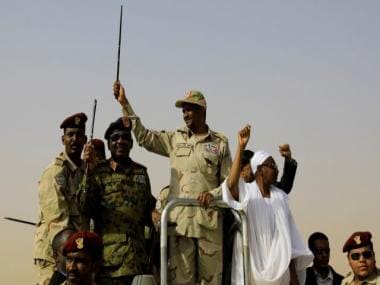
RSF leader Muhammad Hamdan Dagalo (‘Hemedti’)
What it could look like
The table. Everyone with a command, fighters and territory signs, and each speaks for itself. Then neither Burhan nor Hemedti can hide behind their allies’ objections. This is Khairi’s proposal, and it is right. Armed groups left outside will be the first spoilers. That includes the armed groups the Quad wants kept out, those linked to the Muslim Brotherhood.
The first step is the same for everyone. Each side declares its forces and weapons, accepts observers and respects ceasefire lines. Withdrawal and cantonment in agreed areas follow one timetable for all. As with the truce, legitimacy stays out of it: a common timetable simply recognises that all of them are shooting. When one side alone takes that step, it is called capitulation.
The price is stated openly. Weapons are handed over for something: personal security guarantees, ranks and places in a reformed army, a role in securing their own areas, temporary posts. Khairi offers a rule: ‘A seat to disarm is not a share of the state.’ As a principle it is sound. But in Khartoum and in Juba, signatures were bought precisely with a share of the state. If the warring parties are barred from running the transition, the other currencies will have to be paid more generously, and that should be said plainly.
Paying for the guns does not pardon crimes, El Fasher included, where, according to UN investigators, the violence bore ‘the hallmarks of genocide.’ The price goes to formations and fighters; individuals facing charges get none of it. That makes the bargain more expensive, since a commander facing trial has little reason to disarm. But Sudan has tried impunity before. Of the Janjaweed commanders, only one, Ali Kushayb, was brought to court; Hemedti was then too junior to be in the prosecutor’s sights. A few years later he was leading the RSF.
The price is paid on a schedule, and checked. A price promised and never paid buys nothing, as Khartoum and Juba show. In February 2019 in Khartoum, under Omar al-Bashir’s roof, the government of the Central African Republic and all fourteen of the country’s armed groups initialled a peace agreement. For their signatures the leaders got places in government, and their fighters were promised places in the army. The agreement did not bring peace by itself: implementation faltered, and at the end of 2020 a coalition of armed groups marched on Bangui. But at least it started the right way.
Juba went the same way. Hemedti led the government’s negotiators and initialled the agreement in August 2020; Burhan attended the signing in October. Two major movements, al-Hilu’s among them, stayed out. The signatories received three seats on the Sovereignty Council and a quarter of the cabinet. Their fighters were to join the army, starting with a 12,000-strong joint Darfur force, half of it from the movements, within 90 days. Integration was never completed, the movements kept their forces, and today those forces fight for the army. For the RSF itself the text set no terms of integration at all. Whether the country would have one army or two was never settled, and in April 2023 that question became the war.
The guarantors are visible. The war has sponsors, and in any possible deal they will be present invisibly, through the signatories. So they should be made visible: whoever arms a side signs obligations on its behalf. Such guarantees are always conditional; an unconditional guarantor would contradict sovereignty. Two outside powers with a stake already sit at the table as mediators: the UAE, which Burhan accuses of arming the RSF (Abu Dhabi denies it), and Egypt, which openly backs Sudan’s authorities.
A chance
Lebed was right: it will all end in peace. His question about the mountains of corpses has hung over Sudan’s war, now in its fourth year. But there is a second question: what kind of peace it will be. That one is for those preparing the table, since Burhan today rejects any table. A truce is urgently needed, and nothing here argues otherwise. Nobody can predict who will be first to want to break the peace. To keep the war from starting again, those who hold the weapons must, at the very least, sign the document and decide what happens to those weapons next. That is no guarantee; it simply gives peace a chance. Without it, a lasting peace will not come for a long time.