Interview with Dr Antwi-Boasiako Amoah Ahead of COP31
The 31st climate talks (COP31) began in Antalya, Türkiye on 9 November. The African Group of Negotiators (AGN), an alliance of all of the 54 countries from the continent, had submitted three agenda proposals to the UNFCCC for the conference. One concerned a demand to triple adaptation finance, the other related to trade-related climate measures like carbon border taxes and the last one was about financing arrangements under the Green Climate Fund (GCF), a climate fund established under the UNFCCC to assist developing countries in mitigation and adaptation. None of the three proposals made it into the final agenda adopted for COP31. However, the COP31 presidents said negotiation tracks concerned with trade-related climate measures and the GCF will take the respective matters under consideration during negotiations in the following days. If the proposals by AGN were accepted, all three themes would have been negotiated as separate agenda items in their own right.
Nevertheless, the fact that AGN made three submissions shows that the bloc seeks to assert its voice on the global stage.
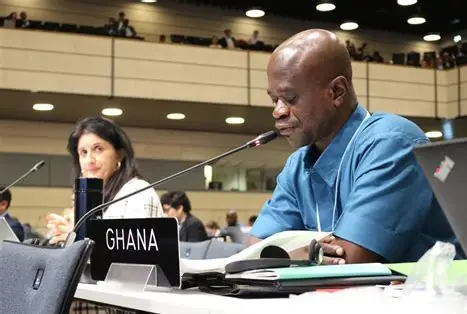
After the agenda was adopted Dr Antwi-Boasiako Amoah, chair of the AGN from Ghana, said in the plenary ‘Africa comes to Antalya with one clear message: implementation depends on means of implementation. Our continent contributes the least to this crisis and is among the most exposed to its impacts.’ It was in this spirit, the chair added, that AGN had proposed three agenda items and also that it participated actively in the negotiations on the agenda and supported the conclusions that were reached.
With COP32 scheduled to be held in Addis Ababa, Ethiopia, African Arguments interviewed Dr Antwi-Boasiako Amoah about AGN’s priorities for COP31 and the outcomes it hopes to secure to build momentum towards the next climate summit:
AA: What are AGN’s priorities for COP31?
Firstly, thank you for the interview. We all need to be speaking to each other in this precious space.
Since the adoption of the Paris Agreement, we have been able to set up a number of structures for implementation. There are methodologies and structures for the implementation of Article 6 [on carbon markets]. Countries have submitted their NDCs [Nationally Determined Contributions] and NAPs [National Adaptation Plans]. Over 80 developing countries have submitted NAPs–this is more than half the number of total developing countries. Even on Article 13 on enhanced transparency framework, we have a solid framework to make sure reporting on climate action is taken care of. So, the groundwork for implementation has been laid. The question now is whether we implement it and how we implement it. Our focus for COP31 and COP32 is to actually bring the issue of implementation to reality. And here, we need to talk about finance, technology and capacity. We are coming to COP31 believing we can make progress on the finance work programme and on the goal to triple adaptation finance. We also come to COP with an understanding that trade-related issues impede our development, especially on climate-related measures [like carbon border taxes]. This COP is mainly about support for implementation. Ambition goes not only with NDC targets and creating awareness but also financial support. Because temperature goals can only be met if developing countries have resources to meet their mitigation targets and other long-term strategies.
AA: AGN was the first group that brought the Global Goal on Adaptation (GGA) to worldwide attention in 2013 with a submission to the UNFCCC that linked global adaptation efforts and costs to temperatures. Then in 2015, GGA was incorporated into the Paris Agreement, as a result of a collective push by the G77+China bloc. Now, more than a decade into this process, do you see progress? What have been the major successes and roadblocks?
When we first submitted the GGA proposal [in 2013], it sounded strange to a lot of stakeholders, especially developed country parties. I remember it very well because I was a part of the process. The initiative and the understanding from our side, as Africa, was to give visibility to adaptation within the global climate negotiations and provide space for the mobilisation of resources to address adaptation activities across countries. I would say that we have seen success because nobody believed GGA would be adopted as part of the Paris Agreement. But now have a whole Article 7 that focuses on adaptation. Through this, we have been able to develop processes and structures to design GGA. However, visibility is not enough. We need implementation. Means of implementation are critical in the whole architecture of the GGA. This is why AGN was pushing for means of implementation as part of adaptation indicators for GGA at COP30 in Belém, Brazil.
But we did not get a good outcome at COP30. We need to implement GGA on the ground. A total of 100 adaptation indicators were proposed at COP30, out of which 59 were adopted. We believe some of the remaining indicators need political guidance before they can be adopted. We will work towards this goal. We have a long way to go as far as means of implementation and mobilisation of resources is concerned. This is why we submitted an agenda proposal on tripling adaptation finance. All three agenda items we have proposed are linked to implementation. They are not theoretical things. If implemented, they will bring money to developing countries to implement climate action.
AA: The Türkiye-Australia co-presidency has established a flagship “35-by-35” global electrification pledge as a key action agenda. It is likely that this agenda will be in the COP31 cover decision. How is AGN engaging with this pledge?
All presidencies have the opportunity to bring onboard their flagship initiative. We have had the cover decision trend since COP26 in Glasgow. For this COP, electrification is not a bad idea and each economy needs electrification. But what kind of electrification are we talking about? As AGN, we have conveyed to the Presidencies that we don’t have a challenge with pursuing the action agenda on electrification. However, having targets is a bit problematic. We do not know where the baseline [with respect to share of electricity in final energy use] and other conditions for these targets come from. And if you check the history of such global targets, you will see that countries which are suffering do not come up. Today, we only see names of countries which are already electrified and benefiting from it. For us in Africa, access to energy is the most important thing and then clean energy under this goal. We have advised the Presidencies to engage more on the electrification agenda so that parties can understand and go along with them because otherwise it is a bit problematic.
AA: A few other developing countries too have expressed similar concerns with the electrification pledge. At present, developed countries have electrified more in terms of final energy use than developing countries, which raises questions about baselines for targets. Earlier this year, various countries came together at Santa Marta in Colombia for the very first conference on transitioning away from fossil fuels. What is AGN’s position on African countries developing a roadmap to transition away from fossil fuels?
Transitioning away from fossil fuels is a decision that was already taken at COP28 in Dubai. So, no party under the UNFCCC would run away from the transition. All of us want temperatures to drop. All of us want climate vulnerabilities associated with high temperatures to be addressed. We have a scientific understanding that there is a relationship between greenhouse gases emissions and global warming and that the fossil fuel sector contributes very significantly to emissions. There are no questions here. The issue before us is how countries are engaged on the roadmap. Colombia started an initiative on the transition. Now I can ask you as a journalist to find out whether Colombia has an interest to really lead this process.A process to transition away from fossil fuels has to bring in all key actors like research and academia, the private sector and the country parties themselves. The engagement process related to the conference [in Colombia] was very selective which does not make it inclusive.
Observers from other countries too have said that the Santa Marta conference was not inclusive because even large developing countries like China, India and South Africa that must be a part of any real global effort towards an energy transition were not invited to attend. Coming to the next question, there is a deadlock at IPCC negotiations concerning the timeline of the next assessment report i.e. AR7. Does AGN have a position on this issue? According to reporting by Third World Network, some African countries support a longer timeline that allows more equitable participation while others prefer a timeline aligned with the second Global Stocktake process.
There is no common AGN position on this, as far as I am aware. My understanding as an individual in this process is that science is very important and scientific evidence should support the major decisions we take as part of this process. However, the IPCC cycle is entirely different from that of UNFCCC. And when it comes to AR7, we cannot manipulate the IPCC process simply because we want the IPCC’s reports to influence the Global Stocktake. The timeline would be too short for countries to meaningfully engage with the conclusions that come from the IPCC reports. We should not rush and do things which might not bring benefits in the long-term. There is also the view that IPCC reports are not only for the Global Stocktake. There are many users and stakeholders of the IPCC reports like students and academia. And there are a lot of scientific reports that are available as inputs to the Global Stocktake like reports by the United Nations Environment Programme on adaptation and overshoot. We also have ground-level information from various countries. If Ghana says it needs $2.3 billion annually to support climate action, then it is coming from Ghana’s own books. This is evidence that can support climate finance. Lessons from the first Global Stocktake will also make the second Global Stocktake more robust. We should not let this issue come between us and divide us. There are a lot of reports that can enhance the outcome of the second Global Stocktake.
AA: Unilateral trade measures like the European Union’s CBAM have been a key concern for many developing country blocs at the UN, including the G77+China group and AGN. Article 3.5 of the UNFCCC also calls on country parties to cooperate on trade and discourages trade discriminations. What do you hope to achieve on this front at COP31?
We see unilateral measures under multilateral processes as divisive and selfish. The UNFCCC is a multilateral process. And if we are going to take measures under this process which bring benefits or punishments to certain countries unilaterally, then it is not in the spirit of consensus under multilateral processes. We are trying to engage with this issue under the theme of ‘Response Measures’ [under article 4.8 of the UN Convention]. We do not support unilateral measures on trade.
AA: Is there a jumpstart the AGN seeks from COP31 that it can take forward to COP32 in Ethiopia? Any specific outcomes which you believe Africa, as a continent, can take forward strongly and meaningfully for further negotiations.
If we are able to get a good decision on climate finance under Article 9.1 [which states that developed countries shall provide financial resources to assist developing countries on mitigation and adaptation], then it will be a good start for discussing implementation at COP32. Ethiopia has not yet come out with a formal document laying out their core areas of interest. But for us in Africa, if we get a good outcome on GGA, climate finance and Just Transition, it will be a good jumpstart for Ethiopia.