Kenya: MRC pre-election rallies likely to turn violent – By Exclusive Analysis Ltd.
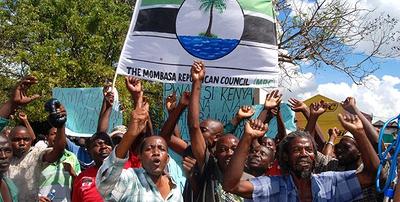
An MRC rally in Mombasa, Kenya.
On 24 April 2012, a Mombasa Republican Council (MRC) protest turned violent when police (AP) riot and the paramilitary General Service Unit (GSU) used excessive force to disperse a 100-strong crowd, leaving one protester dead. Businesses in central Mombasa closed after violence spread to the central business district. The protest began after President Kibaki’s ‘State of the Nation’ address reiterated Nairobi’s stance against the Coast Province’s secession claim. The MRC is likely to stage more frequent rallies ahead of the general elections, raising collateral risks to tourism, mining and construction around the Mombasa area, particularly if riot and paramilitary police are deployed.
The banned MRC is demanding equitable distribution of land, natural resources and representation for the coastal Mijikenda community. Kenya is heavily-reliant on the tourism industry, which is one of its top forex earners and was worth an estimated $1.1 billion in 2011. Tourism is likely to be significantly affected by strong warnings from foreign governments against travel to the coast. Rising unemployment in a poor tourist season has, in the past, resulted in increased levels of crime.
The MRC has become increasingly vocal in the last three months, demanding the government provides employment and improved infrastructure. In the past two weeks, leading presidential hopefuls, including Prime Minister Odinga, have announced their wish to engage with the MRC and two select committees have been commissioned to hear their grievances. The risk of protest is likely to decrease until after these committees report at the end of July. After that, risks are likely to increase and be highest in the run-up to the general elections, scheduled for March 2013, but more likely to be held earlier in December 2012. The MRC is opposed to the elections and recently set an Election Commission vehicle on fire.
The MRC normally holds peaceful protests. But the deployment of anti-riot police, given their habitual heavy-handedness, is likely to provoke a violent reaction, with consequent collateral risks to expatriates and western hotels, including the Serena Beach in Mombasa and the Almanara Resort in Diani Beach, with a consequent elevated risk of business disruption.
Many of MRC’s supporters live and work in Coast Province’s mining region south of Mombasa. Violent protests in these areas are likely to result in minor collateral damage to mining sites, such as Base Resources’ (Australia) Kwale Mineral Sands, which is under construction.
Exclusive Analysis Ltd is a specialist intelligence company that forecasts commercially relevant political and violent risks worldwide.