
Why the RSF’s Rapid Takeover Strategy in Sudan Failed
From the beginning of Sudan’s war, the strategy pursued by the Rapid Support Forces (RSF) and its supporting network relied on one central assumption: that the Sudanese military leadership could be rapidly neutralized, forcing the collapse of the military institution and allowing for a swift takeover of the state.
Public statements made during the opening days of the conflict reinforced this impression. The expectation seemed to be that senior military commanders would either surrender quickly or be eliminated altogether, creating political paralysis and institutional breakdown within days.
At the time, such calculations may have appeared reasonable to some observers. Sudan was already facing severe political instability, economic decline, post-revolution fragmentation, and tensions inside the military establishment following the collapse of the former regime.
In fact, the strategy may have had a realistic chance of success during the first days of the conflict. Had senior military leaders been captured or killed, the political and institutional consequences could have been completely different. The problem was not necessarily the initial assumption itself, but the absence of a credible alternative once that assumption failed to materialize.
But political instability is not the same as institutional collapse. The two are often confused, particularly during moments of revolutionary upheaval.
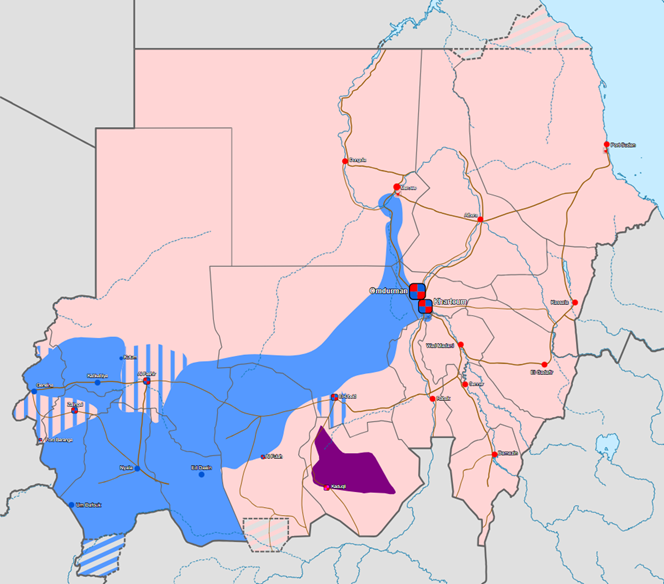
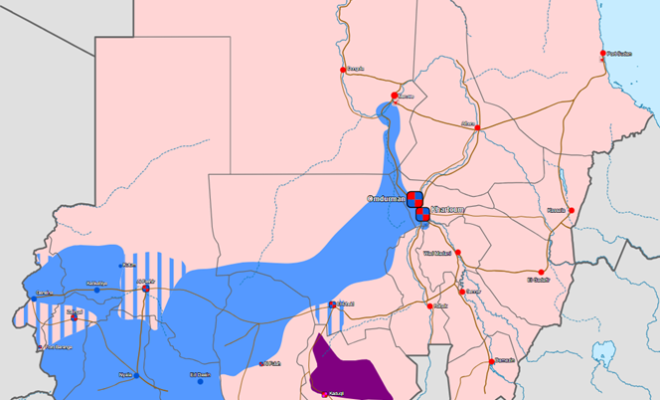
Areas of control in the first months of the war in Sudan in 2023 when the RSF nearly captured the capital Khartoum. Since then, the RSF has been pushed out of northern and central Sudan and is largely contained in western Darfur and Kordofan.
One of the biggest miscalculations of the war was the underestimation of the Sudanese military as a professional institution. Despite its internal divisions and political controversies, the military retained structural characteristics that loosely organized armed coalitions often struggle to match during long and unexpected conflicts.
Professional military institutions possess command continuity, logistical infrastructure, training doctrine, organizational depth, and long-war endurance. They are designed not only for rapid confrontation but for sustained warfare over time. They also benefit from control over key state systems, such as banks, financial institutions, communications infrastructure, and sources of national revenue. These advantages often become more important as conflicts become longer and more complex.
Armed coalitions can sometimes achieve rapid tactical gains during moments of surprise and instability, especially in urban environments. But controlling neighborhoods, cities, or even several regions is not the same as defeating a national military institution.
Sudan is geographically vast and strategically layered. Established militaries can retreat, regroup, reorganize command structures, maneuver across territory, and continue fighting over extended periods. Early battlefield momentum can therefore create the illusion of imminent victory while the deeper institutional balance of the conflict tells a different story.
The war also lacked a credible long-term strategy once the initial takeover attempt failed.
The operational framework was built around shock, speed, and rapid political paralysis rather than an extended national conflict. Once the opening phase failed to produce institutional collapse, there was no clear transition from rapid offensive expansion into sustainable national control. Rapid takeover strategies depend heavily on speed and surprise. When the initial objective is not achieved, the advantages that drive early gains often begin to fade, forcing armed groups into a very different type of conflict for which they may be less prepared.
This became increasingly visible over time. Rather than pausing, adjusting, or pursuing a different political and military approach, the conflict continued escalating into a long war of attrition. Despite the significant logistical support and resources available to the RSF and its supporting network, the longer the conflict continued, the more it favored the side with greater institutional continuity, logistical endurance, and strategic patience.
Gradually, offensive momentum changed and transformed into defensive survival as territorial gains in Khartoum and much of central Sudan were progressively reversed. The advance into Al Jazira, once seen as evidence of continued momentum, was eventually followed by military setbacks that further shifted the balance of conflict. Over time, the fighting became increasingly concentrated in the western regions of the country.
Another major factor was legitimacy. Armed movements seeking not only military expansion but national authority eventually require some degree of civilian acceptance and political credibility. However, widespread reports of looting, attacks on civilians, property seizures, arbitrary violence, and sexual abuses severely damaged the ability of RSF-associated forces to build broader national legitimacy beyond areas under coercive control.
Rather than being viewed as a stabilizing alternative authority, the movement increasingly became associated in many parts of the country with fear, insecurity, and institutional collapse.
This proved strategically devastating. Military expansion alone cannot sustain long-term political authority in a country as socially and regionally complex as Sudan. Governance requires administration, legitimacy, discipline, and institutional coherence. All of these become much harder to maintain during a long conflict.
In the end, Sudan’s war demonstrated a broader strategic reality: rapid territorial expansion is not the same as consolidating a state.
Armed movements may advance quickly under conditions of shock and instability, but replacing a national military institution requires far more than battlefield momentum alone. It requires institutional depth, political legitimacy, strategic endurance, and the ability to sustain national authority over time.
What followed, however, demonstrated that taking territory is far easier than replacing a state.