Sudan: The Unfortunate Alliance
On Foreign Interest, the Ideal Militia, and What a Coloniser Prays He Leaves Behind
My grandmother never said displacement. She said: we left the house and the water took it. But the water did not take it. The state took it. A state that had been making that decision for decades, in different languages, with different flags.
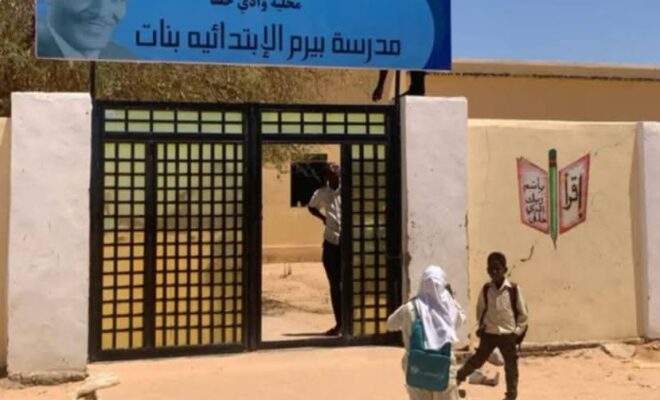
My grandfather Ahmed was an English teacher in Halfa Dagheim, a Nubian town on the Nile near the Egyptian border. In the 1960s, a decision was made far away—in Cairo, with Soviet engineers drawing designs, and American dollars quietly approving—to build the Aswan High Dam. The dam needed a reservoir; the reservoir needed our valley. My grandfather and his neighbors were given promises and a dusty strip of land in Wadi Halfa. The first thing the families built together under a tree was a school, with my grandfather at its centre.
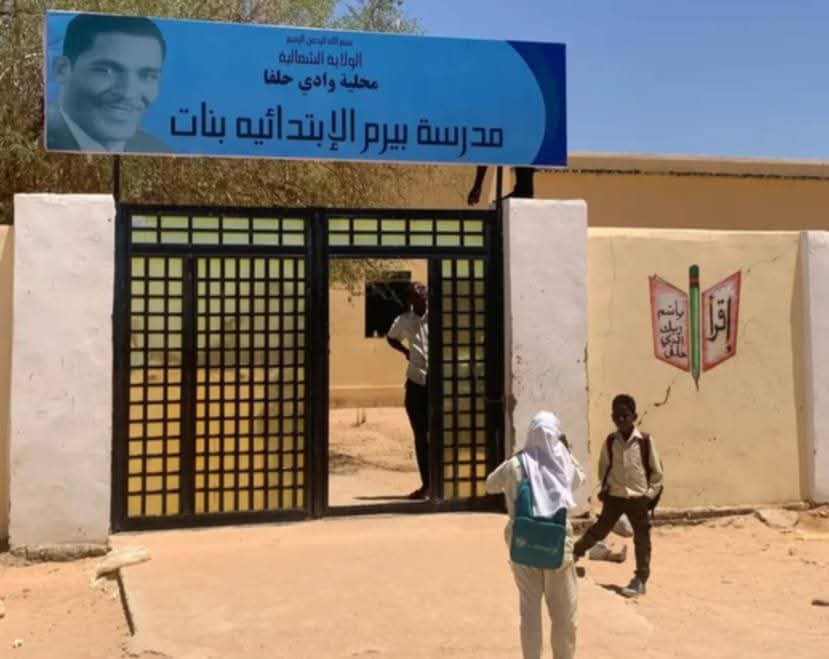
Ahmed Mohammed Khalil Bairum school in Wadi Halfa, established by the author’s grandfather after the original community in Halfa was displaced by the Aswan High Dam.
My grandfather died before I was old enough to ask him how you build a school when you have just lost a town. My mother inherited that grief, carrying it while studying veterinary medicine at the University of Khartoum. She graduated with me in her arms. What happened to my grandfather was not an accident. A state decided that a reservoir mattered more than a family. What kind of state makes that decision repeatedly?
* * *
There is a particular fantasy that all empires share. When direct control becomes too expensive, leave behind a local manager who will do the work without the embarrassment—the militia as outsourced violence with deniability built in.
At first, the Rapid Support Forces looks like a local story. But when Hemedti’s soldiers drove into Khartoum on 15 April 2023, they arrived from a long chain of decisions made in Washington, London, Riyadh, Abu Dhabi, Moscow, and Brussels.
The British arrived in 1898 to grow cotton for Lancashire. They built the Gezira scheme around a state designed for extraction resting on four pillars: generals to suppress workers, militia leaders to discipline tenant farmers, capital owners, and politicians to explain the arrangement to London. They also left a legal architecture: the Vagrancy Act criminalised movement without permission, creating a category of people who were poor in the wrong place without a permit. When the British left, a clique of Sudanese men inherited the machine. Six days after independence, tenant farmers in Jouda went on strike; the army surrounded the village and killed over three hundred people. The rifle was the same.
* * *
After independence, that inherited machine discovered it was valuable to other people. Following the 1979 Iranian Revolution, Riyadh and Washington flooded the region with funds to build a Sunni counterweight. In Sudan, the vehicle was the Muslim Brotherhood, and the financial anchor was the Faisal Islamic Bank—operating tax-free under a special charter outside normal banking regulations. The bank bankrolled the regime, funded partly by mortgaging University of Khartoum land. Students paid tuition to a fund that paid loans to a bank that financed the teargas fired at us. That is what foreign interest looks like at the human level.
The IMF is a more patient kind of foreign interest, arriving with spreadsheets. From 1978 onward, through dictatorships and brief democracies, every government received the same prescription: cut subsidies, devalue, privatise. Each government repeated: there is no alternative. When fuel subsidies were removed in 2013, and bread in 2018, prices doubled overnight; tires burned; revolutions started. In 2021, Prime Minister Abdalla Hamdok stood in Khartoum and repeated the phrase, implementing a devastating 55-to-375 exchange-rate shock required to access fifty billion dollars in debt relief.
When the state retreats from subsidy, it leaves a vacuum. In the Soba industrial zone, a biscuit factory paid 1,500 Sudanese Pounds (SDG; equivalent to 3 pounds sterling) for a twelve-hour shift, while rent in Haj Yousif was 30,000 pounds. When the RSF offered 15,000 SDG (£30) a day plus a uniform and a phone, young men joined. That is not ideology; that is arithmetic. A person trying to survive is not a symbol—he is just someone the structure needs to keep moving in a circle.
* * *
Follow that arithmetic west. Colonial planners designed Darfur not for production, but as a buffer to recruit soldiers cheaply. The Janjaweed militia emerged from this architecture. In the early 2000s, Khartoum armed Arabised nomadic communities to suppress Darfuri rebellions, turning land conflicts into racialized counterinsurgency.
Mohamed Hamdan Dagalo—Hemedti—came from this world. A camel trader turned Janjaweed commander, his unit burned the village of Adwa in 2004, killing 126 people, including 36 children. Burning was a mechanism of forced displacement. In 2013, President Umar al-Bashir formalised the Janjaweed as the Rapid Support Forces, giving Hemedti official command and legal legitimacy.
From there, Hemedti’s transformation was one continuous arc. In 2015, Saudi Arabia and the UAE hired thousands of RSF fighters for their war in Yemen, paying in US dollars. The militia became an army with a bank account. That same year, RSF seized the Jebel Amer gold mines—where miners’ hands were burned from mercury—exporting tons of gold to Dubai and drawing Russia’s Wagner Group. With UAE banking channels, Hemedti built a parallel empire of real estate, farms, and a fleet of nine hundred Toyota vehicles. The militia was no longer one pillar; it was a container for all of them.
* * *
Then Europe added its own fuel. In 2014, the EU launched the Khartoum Process to halt irregular migration. Through the EU Emergency Trust Fund for Africa, millions flowed to equip seventeen border crossings controlled by the RSF with cameras, radar, and scanners. EU money empowered the RSF to extort the very migrants Europe wanted to stop, driving smuggling fees from $500 to $2,000. More danger means more profit; more profit means more movement. That is the migration paradox: a policy designed to reduce movement producing, through danger and profit, more movement.
Under the 2021 Thamarat program, the EU funded biometric registration systems and command centers using equipment from European defence contractors like Thales and Hensoldt. The same infrastructure that scanned a Darfuri farmer at a desert border photographed his face when he lined up for a five-dollar digital welfare subsidy. Border to face to database to arrest. Europe built a dam out of human desperation, and when it broke, the flood was catastrophic.
* * *
What happens inside the person who becomes part of this machine? Abu Lulu, an RSF fighter who committed documented atrocities against civilians in El Fasher, became a symbol when other RSF soldiers defended him online. They genuinely believed he had done nothing wrong. This is not propaganda. It is what Mustafa Hijazi described as the second response to long oppression: absorbing the logic of the very system that degraded you, because it is the only logic you have ever seen working. Displaced violence—rage redirected toward whoever is even more vulnerable than yourself. The RSF’s capacity for violence is the logical output of seventy years of manufacturing disposable people on the periphery.
In the months before the April 2023 war, the political elite—the political parties and the Forces for Freedom and Change (FFC)—had a deep paranoia about Islamist networks within the regular army. Their solution was to leverage the RSF, holding secret meetings with Hemedti to offer political backing in exchange for integrating the RSF over twenty years. They thought they were bargaining with a local militia leader; they were negotiating with an independent CEO backed by UAE gold, Wagner connections, and EU surveillance networks. The fear of one devil led them to empower a larger one.
On 15 April 2023, the explosion came. By eleven in the morning, the RSF controlled Khartoum’s bridges. The same trucks that burned Darfur parked in the capital. The periphery, having absorbed decades of state violence, finally came home. Since then, over ten million people have been displaced. I left Khartoum a month and three weeks after the war began. My family went to Wadi Halfa—the exact place the water had sent my grandfather sixty years before.
* * *
But there was a different design available. We lived it in the resistance committees.
A blue notebook from the stationery shop. One page: generator fuel money. Next page: wool revenue. We borrowed 60,000 pounds from the mother of a martyr to buy wool, returning 70,000. She told us to keep the extra profit for generator fuel. No biometric server, no radar. One light at the entrance of the neighborhood, fixed with money collected from thirty families. ‘Meet me under the light we fixed,’ they said. That was our command centre.
The committees developed and grew after the 2018–19 revolution, becoming increasingly important in organising protest as the political crisis deepened. By 2021, they had taken a leading role in organising protests and had appointed official spokespersons — I was among several colleagues named that year. The political charter that came out of that process, the Revolutionary Charter, was written in 2022. It called for a front against austerity and opposed RSF integration without justice. The political elite called us unrealistic, then went to a hotel room to make a deal with the man who burned Adwa. We fixed a light; they enabled a war.
* * *
History does not move in a straight line. A dam returns as displacement. An economic policy becomes a militia. A border-surveillance system becomes a tool for arresting a neighbour.
Imagine an ordinary evening in Khartoum—the kind we had before. Dust still in the air. Tea being poured. Children running out of a school gate. My mother holding her veterinary textbook. My grandfather under a tree, irritated by broken chalk. The miner from Jebel Amer sitting on a plastic chair, arguing about whether the tea has too much sugar—his hands are not burned. The boy from Soba fixing the generator, hands black with oil. A friend arriving late, complaining about a broken bus.
This imagined Sudan is not completely imaginary; fragments of it already existed under the tree, in the resistance committees, in the blue notebook. The tragedy was not that Sudanese people lacked a political imagination. We already knew how to build another kind of political life. The tragedy was that the competing system was better armed, better funded, and repeatedly reinforced by foreign power.
My grandfather lost a town and built a school. My mother inherited grief and studied, holding a textbook against her belly. I witnessed another country being displaced—but I also witnessed people counting wool in a notebook, fixing a light without permission, pooling rent, sharing sugar. After all the geopolitics, all the gold, all the militias, all the surveillance, all the war—what was being destroyed was ordinary life. And what people were trying to rebuild was ordinary life.
The light we fixed flickered, then stayed on.