
Population Density: A Missing Factor in Development — and Why This Is Africa’s Moment
Explanations of why Africa has lagged behind tend to reach for the familiar: weak governance, corruption, ethnic conflict, the legacy of colonial borders. Joe Studwell’s How Africa Works — the long-awaited companion to his influential How Asia Works — argues that these are largely symptoms rather than causes, and that the deeper constraint has been something rarely discussed: for most of its history, Africa simply had too few people in the right places. It is a bold, single-factor thesis, and like all such theses it deserves to be read critically. But it reframes the central question in a way that anyone investing in or building businesses on the continent should take seriously, because it changes what we should expect over the coming decades.
Too few people, not too many
Studwell’s starting point is that until recently sub-Saharan Africa suffered from chronically low population density. As recently as 1975, the region had roughly the population density of Europe in the 16th century. Malaria and the tsetse fly – devastating to humans and livestock alike – acted as powerful demographic brakes for centuries, while populations surged in Europe, Asia and the Americas. The near-absence of draft animals and livestock meant little natural fertiliser, thin soils, and agriculture that stayed nomadic rather than settling and intensifying.
The consequences compounded. With few people came almost no cities: as late as 1950, there was only one city of a million people south of the Sahara — Johannesburg. Colonial rule, run largely on a shoestring, added little, leaving behind minimal infrastructure, a vanishingly small educated class, and borders that fragmented the continent into ethnically divided states.
The reversal has been extraordinarily fast. Sub-Saharan Africa is now the world’s fastest-growing region demographically, adding roughly 300 million people each decade and on course to reach some 2.2 billion by 2050 — roughly one in five people on Earth.
Why density is the hinge
The reason for Studwell’s focus on population density is that almost everything that makes a modern economy productive depends on people being close enough together.
Density creates markets. A factory, a bank, a logistics firm or a power plant needs a concentration of customers within reach to justify the fixed cost of building it. Spread the same number of people thinly across a vast territory and no such investment pencils out. Density also makes infrastructure affordable per head — a kilometre of road, rail or transmission line serves far more people in a dense economy than a sparse one, which is precisely why so much of Africa’s infrastructure has historically looked uneconomic. And density enables specialisation: the deep division of labour that drives productivity growth — the specialist supplier, the skilled trade, the dense web of firms that feed one another — only emerges when there are enough people and transactions to sustain it. Cities are where these effects concentrate, which is why urbanisation and industrialisation have gone together everywhere from Manchester to Shenzhen.
And the shift into cities is happening faster in Sub-Saharan Africa than it did anywhere before – its urban population, already over 500 million, is set to roughly double within 25 years. The density that took Europe and Asia generations to accumulate is arriving in decades.
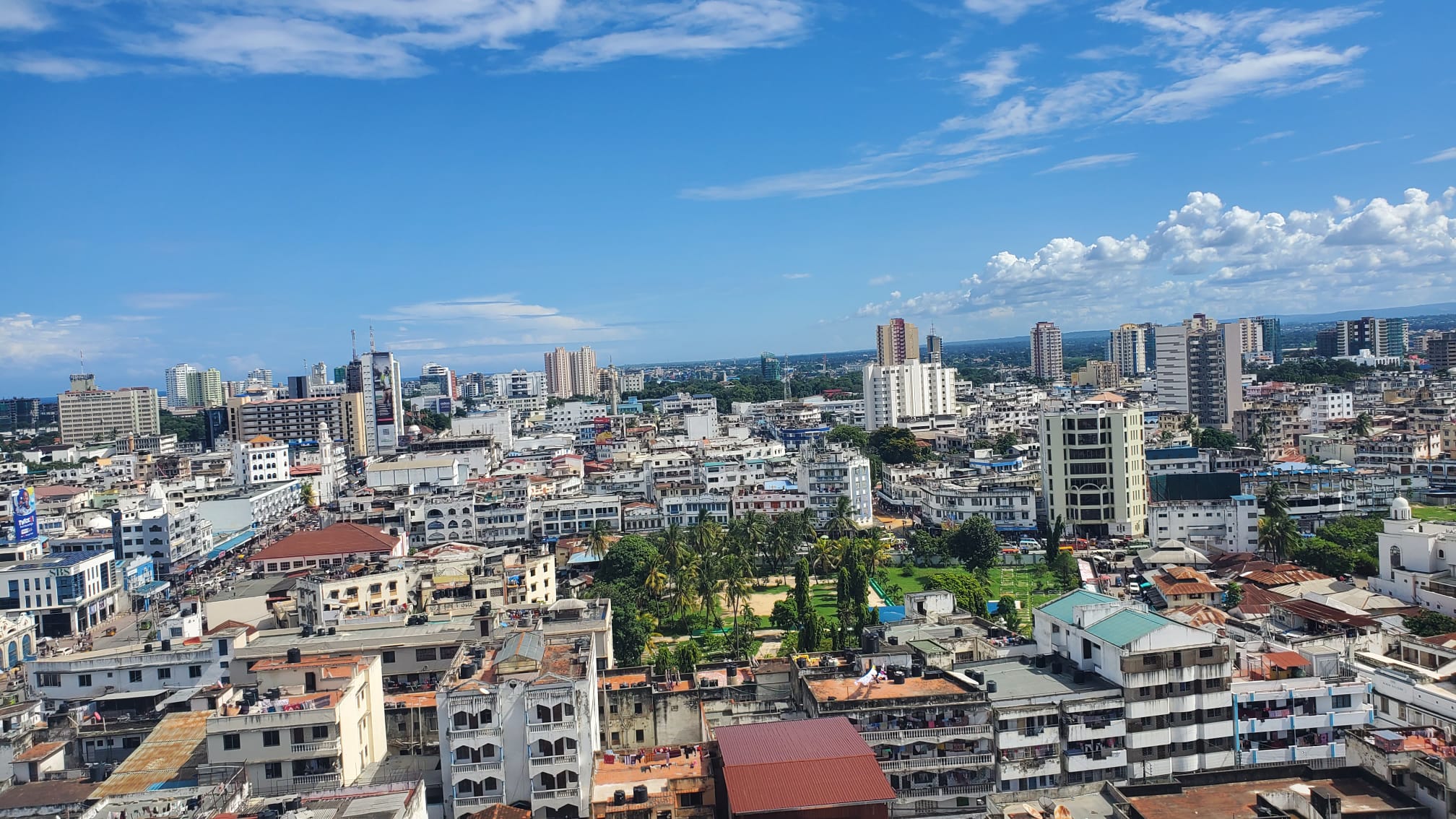
Mombasa has long been a trading and industrial centre in eastern Africa. Population density and an educated populace are key factors for a coming economic expansion in Africa.
This is why the density threshold is not an academic curiosity. Sub-Saharan Africa has now reached roughly 50 people per square kilometre — close to where much of Asia stood when its industrial take-off began around 1960 — and the share of adults who can read and write has tripled since then. The underlying conditions for the kind of rapid, broad-based growth seen in other regions of the world are, for the first time, largely in place.
A note of caution should be added here: Density is necessary but not sufficient — plenty of dense economies have stagnated, and Africa’s current wave of urbanisation has in many places run ahead of the jobs to fill it, producing large informal-service sectors rather than rising productivity. Density opens the window; policy determines which countries will climb through it.
Land reform and industry: no separate ‘African model’
Studwell points to a handful of relative successes — Botswana, Mauritius, Ethiopia, Rwanda — and finds, strikingly, that they have not followed some unique African recipe but basically followed the same growth model that worked in East Asia. Two ingredients stand out. First, productive smallholder agriculture: privately held or privately worked small farms, supported rather than neglected, are the surest first step to lifting rural productivity and generating the domestic demand that industry later feeds on. Radical land reform has largely failed in Africa, but several countries have found other ways to let productive smallholders flourish. Second, the ability of leaders to build development coalitions that reach across the ethnic fragmentation the colonial era left behind — something Mauritius and Tanzania, and over time even Kenya, South Africa and Nigeria, show is possible.
The manufacturing question
When it comes to development policy, Studwell’s advice is clear: It is only by moving up the manufacturing value chain, that the countries in Africa can achieve the needed continuous growth in productivity, he says. With this position, the book lands squarely in a live debate about whether Africa can bypass industrialisation and transition directly from agriculture to services.
The influential economist Dani Rodrik, for example, has recently argued that manufacturing no longer can employ large numbers of low-skilled workers. Competing successfully on world markets requires skills, technologies, and other capabilities that are in short supply in poor countries. Developing countries, he argues, should look instead to raising productivity in services, including the non-tradable kind.
The arguments put forward by Rodrik and others are supported by decades of failed or ineffective industrial policy initiatives in many African countries. It is a widely cited fact that the continent’s share of global manufacturing has fallen from roughly 3% in the 1970s to less than 2% today. Manufacturing technologies have become too sophisticated for new entrants to follow in the footsteps of East Asia, he argues. Historically, and seen in the context of the competitive world market, it is natural to conclude that Rodrik must be right.
However, there are other factors that lead to a more optimistic assessment of Africa’s manufacturing potential. The first is the sheer size of the continent’s import bill for processed and manufactured goods. In the case of Sub-Saharan Africa, the World Bank estimates the deficit at about $180 billion, equal to almost 10 percent of the region’s total GDP. Urbanisation, the growing purchasing power of the rising middle class and the huge infrastructure investments planned across the region will translate to a significant increase in the demand for manufactured goods, opening markets that hitherto were too small for domestic production. In fact, foreign investment into processing and production of metals, chemicals and finished goods is visibly rising, even if investments still flows overwhelmingly toward extracting minerals and energy.
The second new reality is the African Continental Free Trade Area. Rodrik’s scepticism rests partly on the difficulty of breaking into crowded global export markets — but Africa’s opportunity is first of all to supply its own market of 1.4 billion people. Today only about 16% of registered foreign trade in Africa is with another African country, the equivalent figure in the EU is more than 60%. Naturally, it will take many years for Africa to build the infrastructure, logistics standards, payment and customs systems needed to create a truly integrated market, but the direction of change is clear and already visible in a slightly growing share of intra-African trade. To be noted for example: In July this year, the AfCFTA Secretariat signed a $3.2 billion contract to build and implement an interoperable customs system needed to make cross-border African trade easier.
No entity or personality embodies this new reality better than Dangote Industries, led by Africa’s most successful and richest businessman Aliko Dangote. After building cement and sugar businesses across the continent and becoming a leading exporter of urea for fertiliser, in 2024 Dangote opened one of the world’s largest oil refineries outside Lagos. Nigeria, long a crude exporter that imported nearly all its fuel, now has a domestic refiner that has begun exporting refined products and jet fuel. It is a vivid demonstration of the value that can be captured by processing the continent’s own resources rather than shipping them out raw.
What it means for businesses and investors
Not at any point during my career as investor in Africa have I seen more reasons for optimism than today. The IMF projects that 11 of the world’s 15 fastest-growing economies in 2026 will be African, with sub-Saharan growth around 4.2% this year — roughly half again the global average. The continent’s cities, so scarce a lifetime ago, are now among the world’s most dynamic growth sites: young, expanding, and finally dense enough to sustain the markets, infrastructure and specialisation that modern industry requires.
The question is no longer whether Africa’s moment will come. The question is rather: it is whether business will be ready to invest when it does.