
900 Tankers Under Escort: What Africa Corps Actually Does in Mali
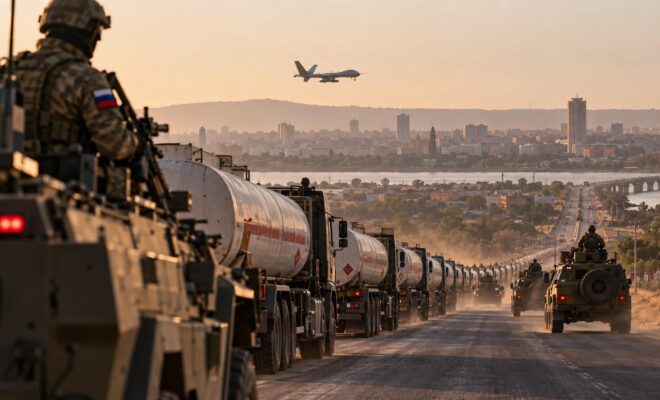
On September 14, 2026, more than 900 fuel tankers entered Bamako under military escort, the Malian government announced. The figure sounds like a victory: the capital got its fuel. But the very need to herd 900 tankers into a single protected convoy is not a story about victory — it is a story about how vulnerable the ordinary roads have become, the same roads through which Mali imports 95% of its fuel.
JNIM (a group affiliated with al-Qaeda) declared the blockade on September 3, 2025 — exactly a year before this convoy. According to the group’s spokesman, the goal was simple: cut the highway along which fuel from Senegal and Ivory Coast travels through the border town of Kayes to Bamako. In the first few months of the campaign, a Bellingcat investigation documented at least 130 destroyed tankers; according to estimates from Modern Diplomacy and The Ops Con, the total number of tankers destroyed over the entire course of the blockade exceeded 300. One attack near the Senegalese border killed at least 15 people. In April 2026, the blockade, which had eased somewhat earlier in the year, returned with new force — it was then that Mali’s defense minister, Sadio Camara, was killed during a coordinated JNIM and Tuareg separatist offensive on several cities at once.
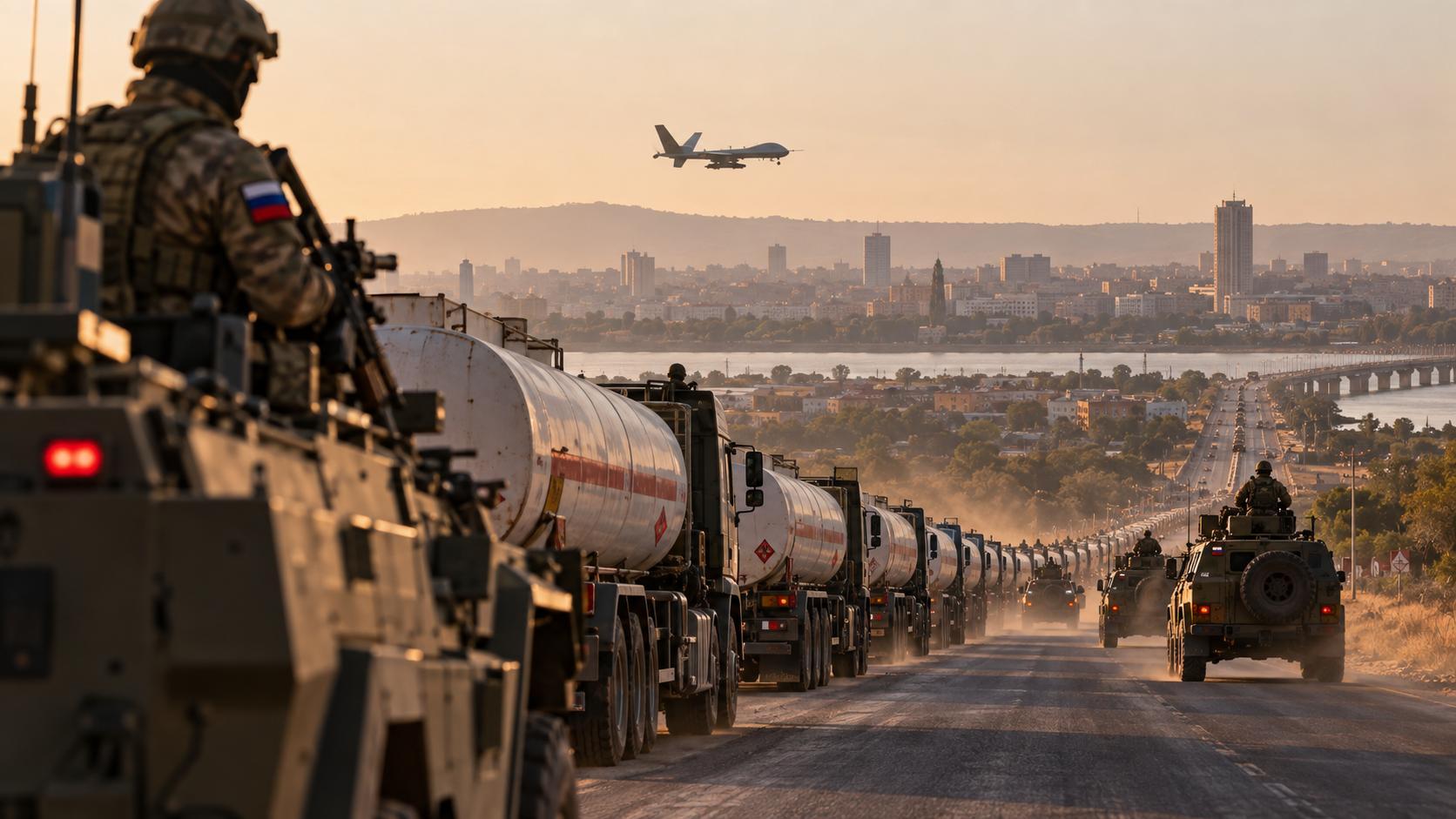
This is where Russia enters the story, as analysed recently in other publications of African Arguments. According to an analysis by Modern Diplomacy, tanker convoys to Bamako are now escorted by Africa Corps — together with increasingly active Turkish-made Bayraktar TB2 and Akıncı drones that Mali received from Turkey (Bellingcat separately documented that these are specifically Turkish drones, as distinct from Shahed-136-type kamikaze drones that Africa Corps itself most likely brought in). Modern Diplomacy’s formulation is precise: ‘JNIM stays too weak to fully cut Bamako off; Africa Corps and Turkish drones stay too thin to reopen free transit.’ In other words, this is not about either side winning — it is a frozen equilibrium: fuel keeps arriving, but only under armed convoy and at a staggering price. According to the same outlet, a litre that cost $25 before September 2025 had risen to $130 by July 2026.
Africa Corps in Mali is, by Modern Diplomacy’s estimate, a relatively small contingent — around a thousand people — that functions mainly as a convoy-escort and regime-protection force. Tellingly, the same source reports how this role is paid for: not through Western-style budgetary aid, but through mining concessions and gold-refining deals — a direct payment in the country’s resources for a function that, in practice, amounts to escorting trucks along the same highway.
This is a fundamentally different role than the one usually attributed to Africa Corps in the junta’s public rhetoric — ‘fighting terrorism’ on the battlefield. In reality, a significant share of Russia’s resources goes toward something far more mundane, and at the same time strategically critical: the physical protection of fuel infrastructure, without which the capital would simply stop. Prime Minister Abdoulaye Maïga, meeting with Malian petroleum industry figures back in September 2025, promised to ‘deploy all necessary means’ to protect supply routes — a promise now being fulfilled not only by the Malian army but also by mercenaries whose presence in the country was justified by entirely different tasks.
Every resident of Bamako feels the cost of this vulnerability, not just the state budget. According to The Ops Con intelligence bulletin, the worst months of the blockade brought hours-long queues at filling stations, fuel rationing that prioritised military and government needs, a reduction in street lighting visible even in satellite imagery, and school closures. This is the part of the crisis that doesn’t make it into official reports about ‘900 tankers successfully delivered’ — though it is exactly what determines what life looks like in a city dependent on a constant armed convoy.
The durability of this model is in question. ISS Africa analysts warned back in October 2025 that escorted convoys are a costly and complicated option, requiring armored vehicles, fuel for the escort itself, and a large number of personnel, and one that can only be sustained on a few roads at a time and only for a limited period; in their view, the only realistic solution for the Malian army remains not escorting trucks but pushing JNIM fighters away from the strategic supply corridors themselves — that is, control over territory, rather than over individual runs. The Ops Con reached the same conclusion in July 2026: ‘fuel is the single point of failure for anyone operating in or near Bamako,’ and a corridor open today can close after the next ambush. Since the blockade began, the UN estimates that more than 400,000 people have been internally displaced in Mali — and while this figure applies to the conflict as a whole, the fuel crisis, which cuts off schools and electricity in the capital itself, directly adds to that pressure.
A separate, less obvious conclusion follows from Modern Diplomacy’s own analysis: the junta and the jihadists, in the outlet’s assessment, are effectively taxing the same fuel trucks from two different sides — and any future economic activity, including lithium extraction, fits into that same system. In other words, the fight over fuel in Mali is no longer simply a war to be won, but an economy in which both sides take their cut from the same flow of trucks, a flow that keeps moving under Russian escort despite a year of continuous attacks.
This is where the central claim underpinning Russia’s entire presence in Mali falls apart: that Africa Corps arrived to replace the West and deliver victory over the jihadists. A year later, the same army that the Russians supposedly train and reinforce is forced to escort fuel tankers much as it would have to without Africa Corps at all — only now Russian mercenaries have been added alongside Malian soldiers, and fuel has become five times more expensive. This is not victory, nor even stabilisation — it is a more expensive, slower version of the same vulnerability that existed before the Russians arrived. Africa Corps did not break the blockade or reopen the roads: it merely learned to escort trucks through it, at a price ultimately paid by every resident of Bamako at the pump. If this presence is tested against the one criterion that actually mattered to the junta when it invited the Russians in — the ability to guarantee basic security of supply to the capital — the answer after a year of cooperation is bleak: 900 tankers under convoy in September 2026 is not proof of capability. It is proof that even the simplest logistical task in Mali no longer functions without an armed escort.
Politically, the junta presents every such convoy in reverse logic — as a demonstration of control and order, rather than a symptom of crisis. ‘900 tankers entered Bamako’ sounds like an official achievement, fit for state television, rather than an admission that the ordinary supply route to the capital has not functioned without armored vehicles and armed escort for a year. This is the same logic the junta applies to Africa Corps’ presence as a whole: turning the very need for large-scale military escort — a sign of weakness — into a public proof of strength. For an outside observer, the difference between these two readings of the same fact is precisely what determines how much trust to place in official claims of ‘stabilisation’ in Mali.