Drongo Company: Can Washington’s new PSYOP unit win back African trust?
In mid-July, the US Army activated Delta Company of the 7th Psychological Operations (PSYOP) Battalion under 3rd Special Forces Group. The unit has taken on the informal name ‘Drongo’, a nod to an African bird known for its ability to vocally mimic other species to drive off competitors. Its declared purpose is to support US Africa Command’s (AFRICOM) influence and information operations across the continent, though it is not technically an AFRICOM unit as it belongs to Army special operations and executes missions in AFRICOM’s area of responsibility.
Drongo’s existence says less about African security dynamics than about Washington’s shrinking appetite and capacity for direct military engagement on the continent. AFRICOM told Congress earlier this year that the command’s regional posture has declined by roughly three-quarters over the past decade, degrading intelligence collection and security cooperation even as terrorism, near-peer competition, and economic rivalry intensify. That decline reflects both access lost to successive coups and a deliberate shift toward a lighter footprint through partner-nation capacity-building, selective drawdowns, and standoff tools such as airpower, visible in the Command’s intensified strikes in Somalia. Read in that context, standing up a unit to project influence through phones, broadcasts, and local intermediaries is a rational, inexpensive way to maintain relevance where Washington can no longer sustain a physical presence. The question is not whether it should exist, but whether it can do the job it was built for.
The Department of Defense defines psychological operations or PSYOPs as influencing the emotions, motives, reasoning and, ultimately, the behavior of foreign audiences. In practice it spans two very different objectives. The first is narrow and behavioural, e.g., persuading fighters to defect, villagers to report roadside bombs, or communities to disregard specific rumours. These objectives do not require audiences to like or trust Washington. The second is what might be called strategic persuasion, i.e., getting audiences to accept an account of US intentions that competes with rival narratives. That depends almost entirely on the credibility of the sender. Drongo’s stated purpose, operating across contested environments where strategic rivals are shaping foreign opinion, places it in the second category. Countering adversarial narratives about the US is, by definition, a contest over what Africans believe about American intentions. The credibility deficit is therefore not a hedge on the unit’s prospects, but the terrain it operates in.
That deficit and animosity toward the West is due largely by France. Paris’s post-colonial legacy and persistent failure to deliver mutually beneficial economic and security arrangements eroded its credibility on the continent long before Opération Barkhane wound down. Additionally, Françafrique’s one-sided extractive models persisting from the colonial era ran their course, and a military presence once justified as counterterrorism assistance came to be seen as another means through which Paris preserved its regional influence. The result was a surge in anti-French sentiment, mass protests and, between 2022 and 2025, the departure of French forces from the region: forced in the Sahel, negotiated on the coast. By failing to distinguish its own approach, Washington has been pooled into the same category of actors some Africans view as exploitative. And while adversarial messaging often casts the West as one bloc, the US has built a record of its own.
In September 2021, then-Colonel Mamadi Doumbouya’s special forces overthrew then-Guinean President Alpha Condé, who had grown increasingly dubious of Western, and particularly French, motives. Doumbouya is a former French Foreign Legionnaire who had trained in Israel, Senegal, Gabon, and at l’École de Guerre in Paris. He has also participated in US-led exercises, and his coup took place while US Green Berets were in-country training his units. Washington condemned the takeover, suspended training, and denied foreknowledge, and no evidence of American involvement has surfaced. However, the optics fueled uncorroborated suspicions and reinforced the belief that Western powers manipulate African politics to suit their strategic interests. In January 2026, Doumbouya was sworn in as president with a US delegation in attendance, and Washington is actively courting Conakry over critical mineral access. That sequence matters less for what it proves than for how it is perceived, and perception is precisely the terrain Drongo has to operate on.
Doctrine offers a partial workaround. Drongo’s operations do not need to be attributed to the US; its products can be routed through partners or released without attribution, sidestepping Washington’s reputation altogether. Concealment, however, only holds until exposure, and exposure compounds the deficit Drongo is working against. For example, from spring 2020 to mid-2021, the Pentagon ran a clandestine disinformation campaign using fake accounts posing as Filipinos to discredit China’s Sinovac vaccine. It was later exposed in 2024. Drongo therefore faces an information environment where any concealed campaign that surfaces would likely become evidence for the very narratives it is meant to counter.
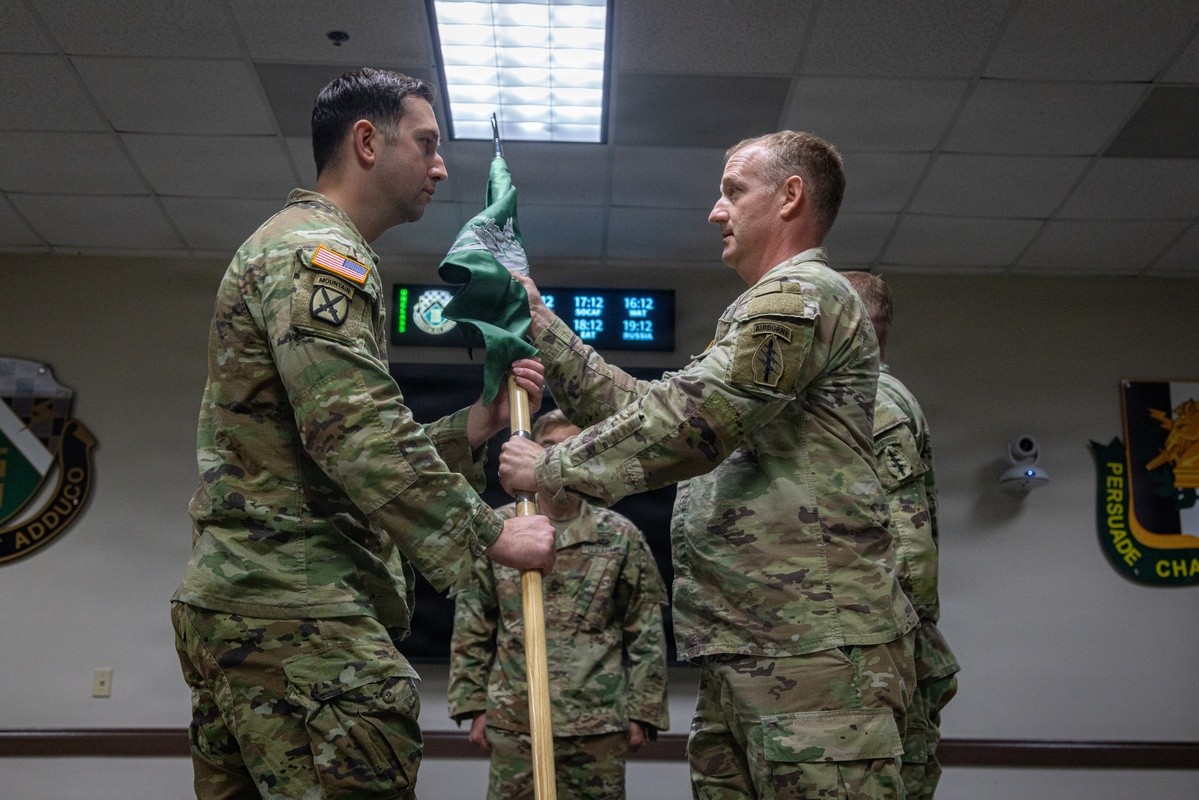
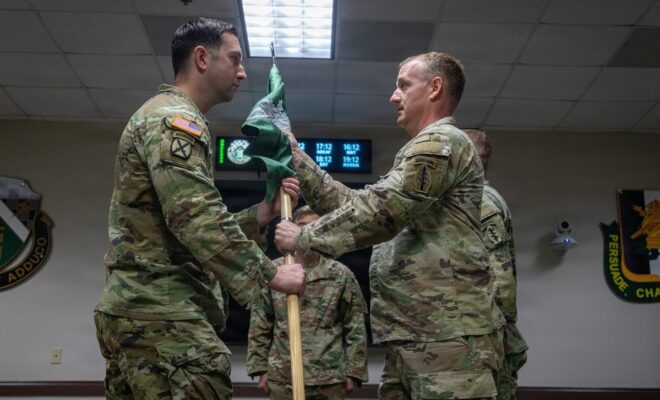
U.S. Army Lt. Col. Justin Schiltz, commander of the 7th Psychological Operations Battalion, passes the company guidon to Capt. Richard Koch, incoming commander of Delta (“Drongo”) Company, during the company’s activation ceremony at Fort Bragg, North Carolina, on 15 July 2026. Credit: U.S. Army photo by Seu Chan (public domain, via DVIDS).
The coup belt is not a one-policy-fits-all situation, but a set of relationships moving on their own timelines, with economic engagement often outrunning the political one. Mali, Burkina Faso, and Niger have expelled Western forces and downgraded diplomatic ties, leaving Drongo few trusted channels precisely where the information environment is most contested. Yet even there, the relationship is being renegotiated rather than abandoned. Weeks after a State Department envoy visited Bamako amid efforts to locate a kidnapped American pilot, Washington lifted sanctions on three senior Malian officials tied to Wagner. That is the kind of incoherence Bamako has proven adept at exploiting, as a recent African Arguments analysis shows. Additionally, two years after expelling US troops, Niger saw the Development Finance Corporation approve up to US$414 million in financing for a uranium project in its territory. This divergence between political estrangement and commercial engagement is not unique to Niger, but for audiences already primed to read Western engagement as extractive, it confirms suspicion rather than dispelling it.
The coastal states present a more favorable environment. Côte d’Ivoire, Ghana, Benin, and Togo maintain functioning US security partnerships and are watching JNIM’s southward expansion with heightened alarm. That gives Washington channels for influence that Bamako, Ouagadougou, and Niamey currently cannot offer. Washington, however, is eroding that advantage in real time. A December 2025 proclamation restricts entry for nationals of 26 African countries, including immigrant, visitor, and student visas for Ivorians, Beninese, and Togolese, though Ghanaians retain access to visitor and student visas. The students and exchange participants who could serve as natural validators of American messaging in partner states are the same people losing access to the US.
None of this falls within Drongo’s mandate, but many audiences do not distinguish American actions by their origins. Visa restrictions administered by the State Department, security partnerships directed from the Pentagon, a uranium loan approved by the DFC, and influence campaigns planned at Fort Bragg belong to different bureaucratic chains, but to audiences evaluating the US as a single political actor, they can register as expressions of the same relationship. A credibility deficit created by one bleeds into the reception of the others. Adversarial messaging need only state the record: the same government that narrowed its engagement to selective, transactional partnerships, dismantled USAID, and restricted entry for nationals of 26 African countries is now running influence campaigns aimed at the publics affected. Moscow’s expanded footprint and Beijing’s continued engagement in the region are not reducible to superior messaging, but where their information campaigns do land, they often do so by amplifying Washington’s own contradictory record.
Drongo will likely be able to claim tactical successes (e.g., defections, tip lines, rumours countered) regardless of how Washington’s broader relationships fare. Whether it succeeds at the strategic mission it was built for will be measured elsewhere. The measures are Afrobarometer trends on perceptions of the US, platform takedowns of US-linked networks, whether partner governments are willing to attach their names to joint messaging, and how far Russian counter-narratives travel in Abidjan, Cotonou, and Lomé. Clear assessment requires distinguishing tactical output from strategic effect. The unit’s prospects ultimately depend less on its own messaging than on how much Washington’s broader policy has left it to work with.