Decolonise da police: How brutality was written into the DNA of Kenya’s police service

The problem isn’t rogue elements. It’s that the Administration Police division was created under colonialism with the specific purpose of beating Africans into submission.
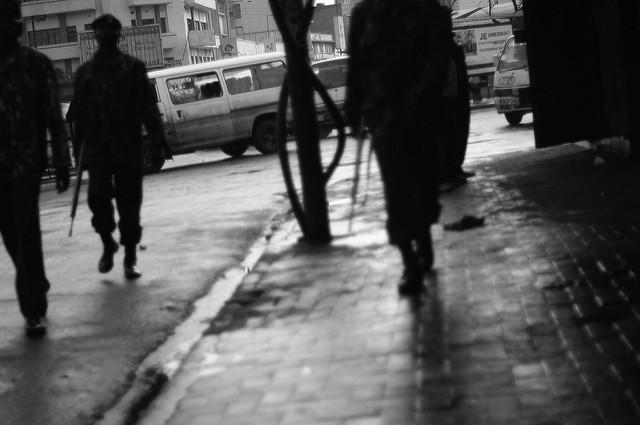
Police on patrol in Nairobi, Kenya. Credit: Xiaojun Deng.
“Severe blunt force trauma to the head, neck and chest. Strangulation. Crushed genitals.”
These were a few of the injuries sustained by attorney Willie Kimani, his client Josphat Mwendwa, and their taxi driver Joseph Muiruri, who were allegedly kidnapped and tortured by at least three police officers at the Syokimau Administration Police Camp before being killed and dumped in a river.
The case led to a three-day strike by lawyers and nationwide protests earlier this month, leading many to wonder if Kenya is finally at a turning point in the battle for increased accountability for police brutality.
Sadly, we are not, because the solutions being floated are simply not radical enough. We don’t need to be talking about dealing with “rogue elements in the police service”. We need to be talking about abolishing the Administration Police (AP) and decolonising the Kenya Police.
Fit for purpose
Kenya’s National Police Service is made up of three separately-administered divisions: The Kenya Police Service, the Directorate of Criminal Investigation, and the Administration Police.
The first two are familiar to most countries, comprising of a regular police service and a special investigations unit (e.g. the FBI). But the last is an outdated and dangerous quirk of the British colonial system that defies logic in independent Kenya.
The AP service was formally created in 1958, the last year of the state of emergency that was declared to allow for the violent repression of Kenya’s independence movement. The Administration Police Act defined the AP service as a paramilitary unit to “deal with matters of customary law” – i.e. the black African population.
This act did not create a new unit, but rather formalised a system that had already been in place – namely, the Home Guard system in which loyalist Africans were given special policing powers by the administration to enforce colonisation and punish dissent.
This paramilitary service was harsher, more unpredictable and more violent than the regular police. In her seismic book, Britain’s Gulag, Caroline Elkins catalogues the torture committed by the Home Guard at concentration camps across the country. These included “beatings, strangulations, genitals crushed using pliers to make men confess and inserting objects into women’s vaginas”.
The fact that the AP system survives means Kenya is still policed by a colonial service and is more proof of the country’s stillborn independence. Kenya may have become politically free in 1963, but the ruling elites’ interests in maintaining and profiting from colonial structures led to several incomplete transformations.
Significantly, security services, which were never comprehensively reformed, were not held accountable for atrocities committed by the colonial government. Rather, the same practices that had been used to torture and intimidate Africans were embraced by the new independence government to silence dissidence and control the population.
Accountability for this violence is rare even though torture is illegal in Kenya as a signatory to the Convention Against Torture. In fact, police brutality is so common, particularly against the poor, that a young man from Mathare slum – where according to local organisers at least 17 young men have been killed by police in June alone – told me at this month’s protest: “the people I pity the most in Kenya are those who live near an AP camp”.
Half-hearted reforms
Much like in Baton Rouge or Ferguson in the US, conversations on police reform in Kenya have so far resulted only in better armed police officers rather than any significant policy shifts.
Meanwhile, collective amnesia in Kenya is kicking in. The protests are over. The Office of the President has not reacted. The Minister of the Interior, whose office oversees the police, blamed calls for his resignation on politics, even though the Kenya’s political opposition has not really responded. No national politicians have made this a priority.
To be sure, the AP is not the only police division in Kenya complicit in human rights violations. The General Service Unit (GSU), another paramilitary unit, allows the state to use the force of the army on its local population – usually with disproportionate violence and copious amounts of teargas – without having to deploy the army. Recall the iconic picture from last month of an officer in a Robocop suit seemingly about to step on a protester’s head? That was the GSU.
Still, what makes the AP service distinct is that it was created with a colonial, anti-African mindset – to beat and intimidate Africans into submission – that has never been confronted. The pathologist report on Kimani, Mwendwa and Muiriri may as well have been written in 1958 for all the sordid ways in which the police officers tortured these young men.
We should be horrified. We should be upset. But we shouldn’t operate under the fallacy that what happened was unusual or unforeseeable. We are not talking about a few rogue elements or bad apples. We are talking about an ideology of oppression that is deeply embedded in the raison d’etre of this and many other paramilitary units in Kenya. If we really want meaningful change to come out of this, we need to decolonise the police service, starting by abolishing the Administration Police division.
Nanjala Nyabola is a Kenyan writer, humanitarian advocate and political analyst, currently based in Nairobi, Kenya. Follow her on twitter at @Nanjala1