What Al-Shabaab Understands About Somali Authority
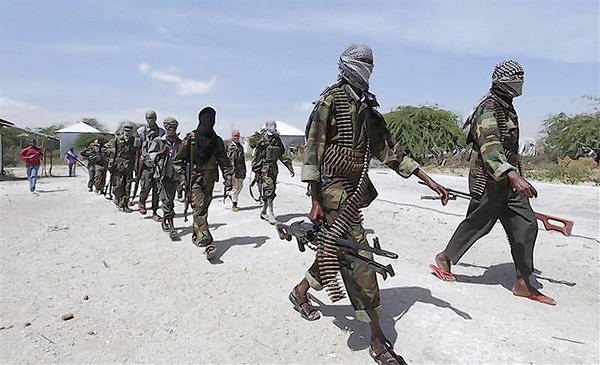
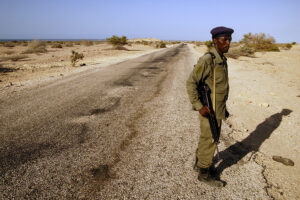
In south-central Somalia, a trader knows what to expect at an al-Shabaab checkpoint. The rate is fixed, set out in a published schedule. The receipt allows passage through the next checkpoint without paying again. If the assessment seems unfair, there is a court the trader can appeal to. This is how a Mogadishu-based NGO director described the system to The New Humanitarian last September. At a federal government roadblock, by contrast, the soldier demands a bribe that he pockets himself, which means the same trader will be taxed again at the next stop, and the next, by men in the same uniform pursuing the same private arrangement.
The detail is small, but it explains, more economically than any military analysis, why al-Shabaab has retaken in eighteen months the territory it last held in 2019, why the group now operates checkpoints on the outskirts of Mogadishu, and why analysts such as Matt Bryden, writing for the Africa Center for Strategic Studies in January, can credibly suggest that the group’s seizure of the capital is ‘simply a matter of time.’ After two decades and several billion dollars of donor-funded reconstruction, the Somali state struggles to do what an internationally sanctioned insurgency does as a matter of routine: tax predictably, settle disputes, and leave a paper trail.
Two governments, one war
Al-Shabaab’s current advance, which the group calls Operation Ramadan, began in February 2025. Within months it had reclaimed at least five districts across Lower Shabelle and Middle Jubba. By the end of last year, according to assessments by the Combating Terrorism Center at West Point and the Critical Threats Project, the group had relinked its support zones in central and southern Somalia for the first time since the 2022 government offensive.
The root of the instability is that Hassan Sheikh Mohamud’s federal government has spent the last two years consolidating power against its federal member state rivals rather than against the insurgency. On 4 March, parliament approved a final set of constitutional amendments in a session that opposition figures, including former president Sharif Sheikh Ahmed, say lacked the required quorum. The administration now says these amendments extended the presidential term from four years to five. Puntland had already withdrawn recognition of the Federal Government in March 2024 over earlier amendments; Jubaland suspended cooperation in November 2024 after the new electoral laws were passed; South West State joined them in March this year. Federal and Jubaland troops have clashed on late-November 2024 around Ras Kamboni. As intelligence-sharing collapsed and counter-insurgency coordination broke down, al-Shabaab walked in.
Mohamud’s four-year term expired on 15 May. However, he refused to leave office, and the opposition, including former presidents Sharif Sheikh Ahmed and Mohamed Abdullahi ‘Farmajo’ Mohamed, rejected the extension and have begun referring to him as a former head of state. Three days of US and UK-brokered talks at the Halane compound collapsed in late May, and on 7 June federal troops loyal to Mohamud exchanged fire with opposition-aligned forces in Mogadishu before mediation produced a fragile pause in the fighting. Some now call the Speaker of the House, Aden Madobe, acting president; others refuse to do so. Nobody can say with confidence who the president of Somalia is, and the political class will spend the rest of the year arguing about it. Al-Shabaab, meanwhile, will spend it governing.
The state that taxes
Al-Shabaab’s centralised finance ministry, the Maktabatu Maaliya, has been documented for over a decade by researchers including Stig Jarle Hansen and Michael Skjelderup, whose fieldwork in the southern districts between 2008 and 2012 mapped how the jihadist administration absorbed and worked through traditional clan authority rather than against it. According to the European Union Agency for Asylum’s 2025 country focus on Somalia, the ministry now sorts checkpoint taxation into four separate streams: gadiid for transit, badeeco for goods, dalag for crops, and xoolo for livestock. Its published tariffs have, since last year, included a new levy on scrap metal.
Under the checkpoints sits something more ambitious. Al-Shabaab’s intelligence wing, the Amniyat, maintains a registry of citizens’ assets across much of south-central Somalia, including, the Africa Center notes, parts of Mogadishu the federal government claims to control. The annual 2.5 percent zakat is assessed against that registry. In Bakara Market, vendors have been paying $50 to $250 a month in protection fees for years. Western analysts place the group’s annual revenue from taxation, extortion, port levies, and real estate transactions at between $100 and $150 million, much of it raised, the Africa Center stresses, in regions where al-Shabaab maintains no permanent physical presence. The combination of an asset registry and the credible threat of assassination, applied selectively, is enough.
None of this is gentle. The Amniyat is what enforces the receipt: the refusal to pay zakat carries the risk of execution, and the courts the trader can appeal to may also order amputations. The relevant distinction is not between coercive and consensual authority, since all authority is in some measure coercive, but between coercion that follows rules and coercion that does not. During the 2017 drought, when famine threatened across much of Somalia, no starvation deaths were reported in territory the group controlled. Aid was distributed through structures funded by zakat collection and by businessmen who channel money through Gulf banks. The federal government, in the same period, was haemorrhaging donor money to a corruption problem its own officials privately acknowledged.
This is the part of the picture the security register cannot capture. Counting al-Shabaab attacks, mapping its support zones, debating whether the insurgency is on the offensive or the back foot: these are the wrong measurements. What matters is that in the contest for everyday authority, the recognised state is losing not because it is being outfought, but because it is being out-governed.
Al-Shabaab is not winning legitimacy through ideology. Few Somalis embrace the group’s interpretation of sharia, the public amputations and summary executions generate real fear, and the group’s record of forced recruitment of children is documented in every annual UN report. The group is winning by offering, however brutally, what the recognised state has not managed to offer in three decades: rules that are predictable, taxes that are not also bribes, and a forum where disputes end.
The deeper problem is that the federal government’s legitimacy was never built on its capacity to deliver these things, but it was built on external recognition. Mogadishu holds a non-permanent UN Security Council seat, its president is received in Ankara and Abu Dhabi, and its army is paid, trained, and air-supported by partners ranging from the United States to Turkey and the UAE. The African Union’s peacekeeping mission AUSSOM, inheriting from ATMIS and AMISOM before it, has guaranteed the survival of the central government for nearly two decades. Remove the foreign backing and there is no clear answer to a simple question: what does the Federal Government actually do for the people it claims to govern? Ken Menkhaus called the model embedded in the 2012 Provisional Constitution a ‘mediated state’, a central government meant to derive its authority by outsourcing core functions to local polities, businesses, and clan institutions. The Constitution assumed those local authorities would cooperate with Mogadishu, however, they have not.
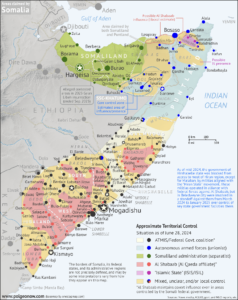
Base map by Koen Adams of onestopmap.com, with design and control by Evan Centanni via www.polgeonow.com.
The clan question
In Somalia there is no legitimacy without the recognition of the clan. The international debate on al-Shabaab has largely ignored this, and that omission is itself part of what the analysis gets wrong. As the Somali political scientist Abdi Ismail Samatar put it long ago, the clan is the only political institution in Somalia that survived both colonial rule and the collapse of the state. Both al-Shabaab and its opponents have built their authority by working through it.
Al-Shabaab, despite its ideological hostility to clan politics, learned early to operate within them. In the southern districts where the group consolidated power between 2008 and 2012, it absorbed the clan elders, the isimo, into its local administration rather than trying to replace them. At the same time, when government-aligned Macawiisley militias briefly pushed al-Shabaab out of central Hirshabelle in 2022 and 2023, they did so because clans mobilised at scale. The campaign stalled when compensation disputes between participating clans broke down, and Mogadishu had no political answer to the breakdown.
The constitutional move from the 4.5 indirect electoral system to universal suffrage is being framed in Mogadishu as a transcendence of clan politics. In reality, it removes one of the few political arrangements that gave the federal member states a real reason to participate, and puts nothing in its place. Three federal member states have responded by leaving the table, moving the ‘clan question’ into the territorial politics of the federal member states, and into the local administrations al-Shabaab is building in their absence.
There are reasonable objections to this reading, and they should be put plainly. The first is that predictability secured by the threat of death is not legitimacy in any meaningful sense. The objection is partly right and partly beside the point. The point here is not moral. People accept an authority as legitimate when its rules are regular and reliable, not when outsiders approve of what those rules stand for. A second objection is that Mogadishu is not in fact a failed city, that it has a working private sector, returnee-driven property investment, and a stock exchange announced in 2024. This is true, and it does not contradict the argument. In Mogadishu, much of that economic activity pays both the federal authorities and al-Shabaab, often with the latter taxing more efficiently. Beyond the capital, across much of the rural south, al-Shabaab is frequently the only authority collecting at all.
Performing statehood
What the past three weeks have made visible is what two decades of state-building language have obscured. The Federal Government has been weak not because it was outfought but because it was built from the top down, around the requirements of international recognition and donor reporting rather than the relationships of taxation, adjudication, and protection that tie a population to its rulers. Al-Shabaab, for all its brutality, built those relationships first, and built them in places the state never reached. This is why the withdrawal of external support matters. The handover from AUSSOM to Somali forces, due in 2029, was already a fiction. It is now the only thing standing between two rival claimants to the presidency and an armed contest over Mogadishu itself.
The uncomfortable conclusion is that twenty years and several billion dollars have produced an entity that performs statehood for an external audience while a sanctioned insurgency does the ordinary work of government. Most Somalis already live under both authorities. They pay the federal government and they pay al-Shabaab. The difference is that al-Shabaab’s demand comes with a receipt and the government’s comes with a private arrangement, and a population learns quickly which authority it can plan around. The question the coming year will answer is not whether Mogadishu can defeat the insurgency, which it cannot, but whether anything recognisable as a Somali state can outlast the foreign support that has kept it upright.