Beyond the Fighter Jets: What Algeria’s Deployment to Niger Really Signals
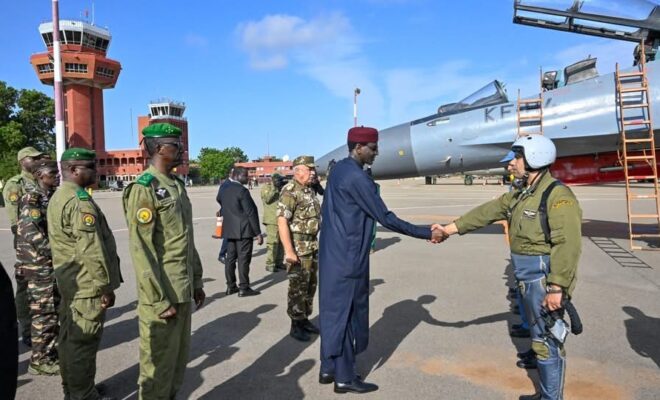
Four Algerian Su-30 fighters touched down in Niamey on 30 August 2026, trailed by an aerial refueling aircraft. A day earlier, mutinous soldiers — some drawn from units worn down by heavy losses fighting jihadist groups — had stormed a military base next to the capital’s airport and moved on the presidential palace. Niger’s government asked for help, and Algiers answered. Algeria’s Ministry of National Defense described the deployment as a mission to support the Nigerien army and deepen strategic cooperation between the two countries. What has been less noticed was that these jets followed months of Algerian energy investment in Niger — a sequence explored below, and one that says more about Algiers’s intentions than the aircraft do.
While four jets are insufficient to alter the military balance in the Sahel, the political message conveyed by their deployment may be of greater significance than their quantity.
The central issue is not whether Algeria has become an expeditionary military power — by any conventional measure of force projection, it has not, at least not yet. Rather, the focus is on whether Algiers is redefining the boundaries of its perceived security interests. The events in Niger indicate that instability south of Algeria’s border is increasingly regarded as an extension of Algeria’s own strategic space, rather than as an external concern.
Beyond the fighter jets
Algeria’s current engagement in Niger in fact began several months ago. On 3 June, Algeria and Niger switched on a 40-megawatt power plant at Gorou Banda, on the edge of Niamey, which Algeria says its engineers built in under three months. A day earlier, subsidiaries of the state energy giant Sonatrach signed three agreements with Niger’s national oil company, SONIDEP, covering seismic surveys, drilling, fuel distribution and training. And on 4 June, Algeria broke ground on its stretch of the Trans-Saharan Gas Pipeline, a project designed to eventually link Nigeria’s gas fields to Europe through Niger and Algeria. All of this predates the mutiny by nearly three months. By the time the Su-30s landed, Algiers had already built Niger a power plant, signed three energy agreements, and broken ground on a pipeline — the deployment reads less as the start of a relationship than as Algiers protecting an investment already made.
Electricity, oil, gas and infrastructure increasingly bind the two countries — and lasting partnerships are usually built this way before arms ever enter the picture.
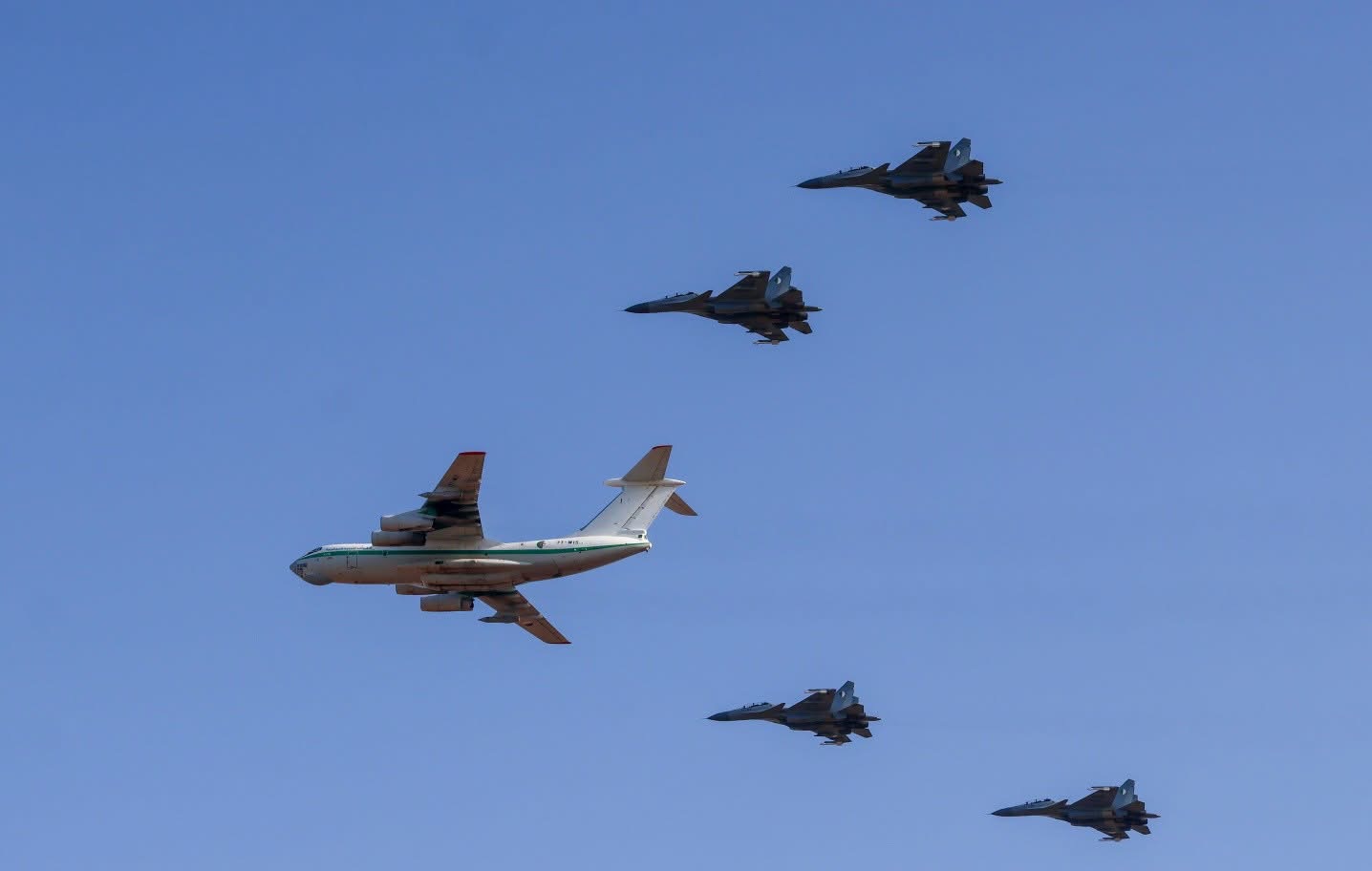
Algerian fighter jets have been deployed to Niger. Image source: afrinz.ru.
From caution to strategic depth
For decades, Algeria’s foreign policy has been defined by a near-sacred principle of non-intervention, a legacy of its own long and bloody struggle for independence. Libya’s collapse after 2011 complicated that instinct rather than simply reinforcing it: watching NATO’s intervention produce years of chaos next door hardened Algiers’s wariness of foreign military adventures, even as the resulting spillover of terrorism, arms and instability across its southern and eastern frontiers made the border itself too dangerous to ignore.
That reputation for caution deserves scrutiny in its own right. Algiers has for decades backed the Polisario Front in Western Sahara politically and materially, hosting its leadership and refugee camps on Algerian soil — support it frames as decolonisation, not intervention, and has never extended to its own uniformed troops. The real distinction, then, is less ‘non-intervention versus intervention’ than ‘indirect backing versus overt deployment.’ Seen that way, Niger is not a reversal of tradition but the crossing of a narrower threshold: Algeria’s own military, not proxies, operating beyond its borders.
In 2020, Algeria rewrote its constitution to allow, for the first time, the deployment of troops abroad. Article 91 lets the president send units of the People’s National Army outside Algeria’s borders, provided two-thirds of both chambers of parliament agree. The clause did not turn Algeria into an interventionist power overnight. It simply created a legal door that could be opened if the leadership judged it necessary.
For years, this legal provision remained unused. The intervention in Niger marks the first instance of its activation. Rather than abandoning its traditional caution, Algeria appears to be redefining its geographic boundaries; the southern border is now perceived less as a fixed line and more as a flexible frontier that can be extended when necessary. That reframing serves Algiers’s own threat perception more than Nigerien preferences; a frontier redrawn from Algiers can look less like solidarity between equals and more like a stronger neighbor asserting a say over Niger’s affairs.
That legal door, opened by Article 91, had also stayed shut for a more immediate reason: relations with the Alliance of Sahel States had been badly strained. In April 2025, Algeria shot down a Malian drone near their shared border, prompting Mali, Niger and Burkina Faso to jointly withdraw their ambassadors. Outreach to Niamey and Ouagadougou resumed only in early 2026, per the Institute for Security Studies. Against that backdrop, the Su-30 deployment looks less like routine caution and more like a relationship being actively rebuilt — with Algiers using the mutiny as an opportunity to prove it.
Signalling strategic intent, not fighting a war
The primary significance of the Su-30s lies not in their combat capabilities, but in the message their deployment conveys. By dispatching combat aircraft at Niger’s request, Algeria demonstrated that a significant security crisis in a neighboring country can prompt an Algerian response, thereby establishing deterrence through presence rather than through the use of force.
The timing is telling. Russia’s Africa Corps, Wagner’s state successor, gave ground and aerial support that let loyalist troops retake the airbase during the same crisis. Algeria’s role differs: while Moscow offers Niger’s junta, in power since 2023, direct regime protection, Algiers offers proximity and reassurance as a neighbor rather than a distant patron. Niger, meanwhile, retains its own agency within the Alliance of Sahel States, the bloc it built with Mali and Burkina Faso.
Whether these forms of support complement or compete remains uncertain — a more crowded security environment could build resilience, or produce rival patrons with conflicting expectations.
Emergence of an alternative model for African security?
These developments raise a broader question about African security’s future. For years, the Sahel relied on external powers — a model weakening as France’s influence fades, Russia intervenes through private contractors, and the Alliance of Sahel States builds its own architecture, independent of the West.
Algeria is pursuing an alternative approach. It has neither joined the Alliance of Sahel States nor aligned itself with Moscow. Instead, Algeria is positioning itself as a North African bridge to the Sahel, providing energy, infrastructure, and a degree of security support without requiring Niger to align with a particular bloc. That is Algiers’s own framing, worth taking seriously. But the same facts support a less generous reading: Algeria may be building a dependence — on its power, gas infrastructure, and now security backing — that narrows Niger’s options as much as any bloc membership would. Whether this is a new security paradigm or sphere-of-influence expansion in cooperative language remains, for now, an open question.
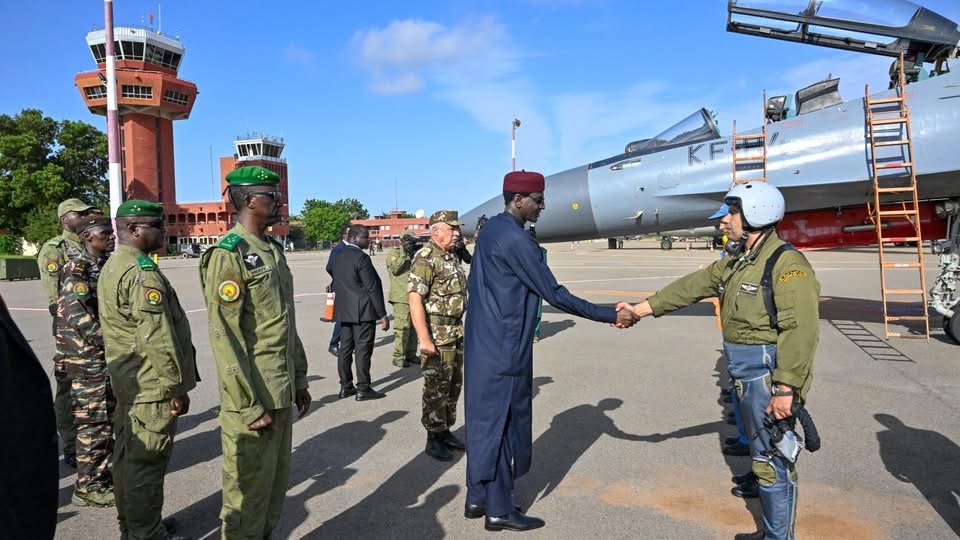
Algerian fighter jets have been deployed to Niger. Image source: afrinz.ru.
This can be characterised as strategic interdependence: pipelines foster connectivity, energy projects generate mutual interests, and security cooperation safeguards both. For Algeria, Niger is evolving from a neighbor into a corridor linking Algerian security, energy interests, and regional influence. That description is telling precisely because it is written from Algiers’s vantage point; whether Niger experiences the shift as partnership or absorption is a separate, still-unanswered question.
None of this addresses Niger’s fundamental challenges. External support can help a government survive a crisis, but it cannot substitute for cohesive armed forces, effective institutions, or credible governance. Algerian assistance offers relief, not a long-term solution.
Broader implications for regional security
The more significant development is the emergence of a new strategic doctrine. Algiers increasingly appears prepared to regard serious instability on its southern border as a direct national security concern, while maintaining that its involvement remains limited and defensive. It is equally plausible, though, that this is an older pattern — a regional power absorbing border instability into its own security perimeter — dressed in the newer language of partnership rather than conquest.
Other African states may watch, and some already do. Egypt already treats instability in Libya and Sudan as a direct security concern; Nigeria already contends with cross-border insecurity; Ethiopia, Kenya, and South Africa face comparable questions, even if none has framed it as explicitly as Algiers now has.
The emerging trend may not be a return to African interventionism, but a shift toward regional powers taking responsibility for their own deterrence, rather than waiting for outside actors to clean up after the fact.
Four Su-30s did not shift the military balance in the Sahel. But they may have shifted something more consequential: how Algeria thinks about the ground beyond its own borders — and how far it is now willing to go to protect it.