
Nigeria Is Building an AI Economy. Who Will Protect Nigerians When the Algorithms Get It Wrong?

By the time Nigeria puts together all of the policies needed to regulate artificial intelligence, elements of the technology might have already been implemented. In May, Nigeria’s federal government unveiled an open-access, multilingual voice and text assistant called GovGuide Nigeria, built by Publica AI with Nigeria’s Federal Ministry of Communications, Innovation and Digital Economy, NCAIR and Meta. Its stated goal is to assist Nigerians in accessing government services in English, Hausa, Igbo and Yoruba.
A month later, in June, Communications Minister Bosun Tijani laid out the plan for a National AI Trust that would guide the next phase of Nigeria’s AI adoption, investment and responsible innovation.
Meanwhile, Nigeria’s IT regulator, NITDA, has already put out an AI Transformation Roadmap that extends much further than a simple chatbot. Among other proposals, it contemplates using ML to process documents, generative AI for preliminary drafts of regulatory texts, and “agentic AI” to manage and coordinate work across departments. This is a remarkable string of actions: Nigeria is putting its regulators in the stadium after its algorithmic players are already in the game. President Bola Tinubu aims to build a $1 trillion economy by 2030, and has looked to advancing technology to achieve faster public services, greater access to finance and higher productivity.
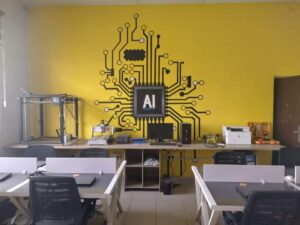
NITDA AI Hub, Lagos
Nigeria also has the necessary critical mass of users to leverage digital government, as evidenced by its over 100 million National Identity Numbers issued, according to the World Bank, and over eight million households supported through a national social safety net programme.
At that scale, these systems could become difficult to handle when failures spread across millions of people.
There is legal protection, but in practice, how effective is that right? Section 37 of Nigeria’s Data Protection Act gives a data subject the right not to be subjected to a decision based solely on automated processing of personal data, including profiling, where that decision produces legal or similarly significant effects. Where an exception applies, the Act requires safeguards, including the right to obtain human intervention, express the data subject’s point of view and contest the decision.
Such a law provides an outstanding right.
In fact, the Nigeria Data Protection Commission reports in its 2024 Annual Report that many data controllers seem to disregard the requirement of a real human when making decisions, a practice the report describes as “quite notorious in credit scoring.” The Commission also says there is “a strong suspicion that many data subjects may have been refused certain benefits without knowing the real rationale for refusal.” Nigeria’s leadership would benefit from investigating this last observation. Nigeria will not gain public trust if it fails to ensure that its laws regarding these technologies are followed by private and public actors in the country. It also raises a practical question: what will constitute meaningful, rather than arbitrary, human review in automated decision-making?
Meaningful human intervention entails more than having a person oversee an automated process. When a government agency uses an AI model either produced or maintained by a third-party company, that agency must still have the means to examine the information needed to understand how the decision was reached and to find the root cause of an error. Otherwise, the government loses track of what is being decided and where errors arise. This affects more than determining responsibility; it is essential to the government’s own ability to maintain and improve systems.

Woman using a smartphone in Lagos, Nigeria
The companies with deeper pockets in the space, such as those developing the technologies Nigeria wants to purchase, may not always be able or willing to disclose how their systems work because of privacy, security or proprietary concerns. Nigeria’s government should not simply seek to be a user, but a smart user. Contracts with third-party developers should ensure government has access to inspect and understand AI systems, not give companies free rein to adjust their terms of service or data requirements without re-evaluation.
That makes NITDA’s existing IT project-clearance role more relevant: public institutions are already required to obtain NITDA clearance for IT projects, a process designed in part to improve efficiency, security, transparency and accountability.
However, neither contracts nor IT clearance can substitute for in-house expertise. The government needs public-sector employees who understand AI, data provenance, and how to test a system and differentiate a plausible explanation from a cleverly designed dashboard. As stated by the National AI Strategy, it will also be crucial for the country to have national AI principles, a risk management framework and an independent AI Governance Regulatory Body capable of reviewing AI deployments.
The proposed National AI Trust could play a role, though power needs to be unambiguously assigned: who oversees public-sector AI deployment? Which regulatory authority should have the power to compel disclosure of relevant data or results, and who will hear an appeal when the government itself is the deployer?
Other countries already offer some helpful examples for algorithmic transparency. Canada uses an Algorithmic Impact Assessment, while Britain uses the Algorithmic Transparency Recording Standard.
Neither can be easily applied to Nigeria, which has its own particular set of political-economic challenges. But the spirit in which they are undertaken is definitely something Nigeria should look to adopt: it is hard for a citizen to bring a meaningful challenge against an automated decision if they have no idea that an algorithm was involved in the first place. Agencies themselves, and especially suppliers, could publish easily accessible information on AI systems that they deploy and that have an impact on the public. Sensitive national-security information can still be protected without making the overall system needlessly opaque.
This is especially important because the people least likely to have an easy recourse against an erroneous decision by an algorithm are those who have the fewest other options in terms of legal, regulatory or informational support. It’s not good enough for people to stumble on the fact that an algorithm plays a role in a decision that affects them, their finances, rights or access to opportunities. They should be able to know the institution responsible for the decision, the information used, and who they can talk to if they are convinced something has gone wrong. It doesn’t help much having a right to human review if you don’t even know what is actually there to review.
Nigeria does not have to reject artificial intelligence in order to protect people from it. Adding accountability later would miss the point. If AI is going to become part of how Nigerians receive services, obtain credit or interact with government, then Nigeria needs to build in, from the beginning, a mechanism for ensuring that these systems remain answerable to the people most affected when things go wrong.
That may ultimately be the difference between using AI to make government more effective and simply making old problems move faster.