Breaking the Pretoria Architecture: How Ethiopia’s Fragmented Wars Converged into a Single Existential Threat
When the Pretoria Cessation of Hostilities Agreement was signed in November 2022, international observers prematurely celebrated the end of one of this century’s most devastating conflicts. The silence of the guns in Tigray was treated as a definitive roadmap toward peace. What the international community failed to see was that the Pretoria architecture did not resolve Ethiopia’s core systemic collapse; it merely localized and delayed it.
During my two years working from the African Union Headquarters in Addis Ababa as the Somali Youth Representative to the AU (2019–2021), I watched the foundational blocks of this conflict harden up close. Even then, within the diplomatic corridors of the capital, the fragile nature of the state’s security architecture was undeniable. The structural fragmentation we feared has now reached a critical flashpoint. Forces that fought on bitterly opposing sides during the Tigray war—most notably the Tigray People’s Liberation Front (TPLF) and the Amhara Fano national movement—have crossed a seemingly impossible ideological chasm. Beside the Oromo Liberation Army (OLA), they have forged a sweeping, nationwide military coalition with four other regional factions: the Ogaden National Liberation Front (ONLF), the Afar Revolutionary Democratic Unity Front (Ugugumo), the Benishangul Peoples’ Liberation Movement, and the Gumuz Peoples’ Democratic Movement.
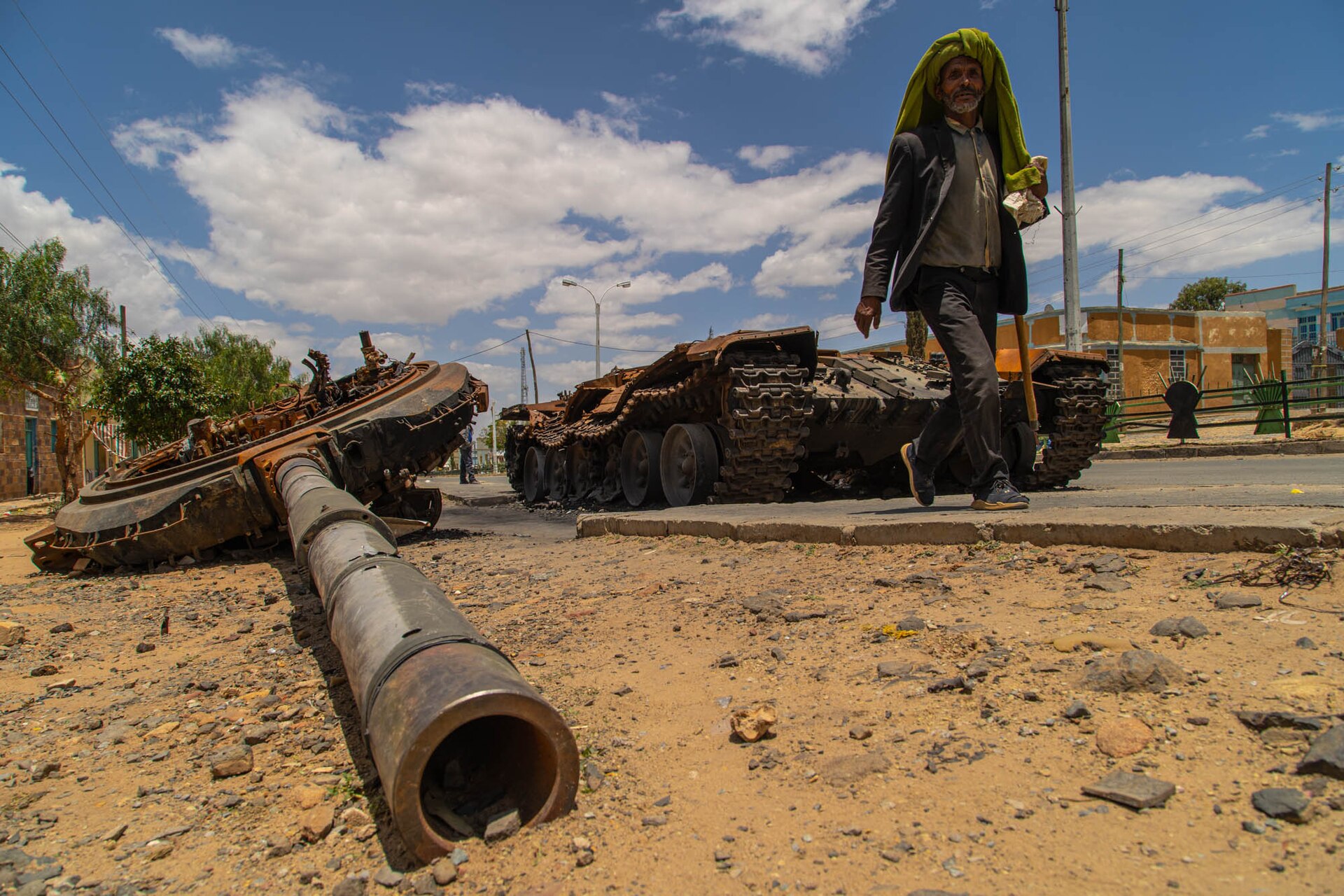
A man passes a destroyed tank on the main street of Edaga Hamus, Tigray region, Ethiopia, during a previous conflict on 5 June 2021. Credit: Yan Boechat/VOA.
Operating collectively under a newly unveiled banner—the Ethiopian Peoples’ Forces Alliance for Survival—their stated objective is clear: the total military removal of Prime Minister Abiy Ahmed’s federal government and the installation of an inclusive transitional charter. For an international audience, the danger is no longer just localized ethnic insurgencies. It is the structural disintegration of East Africa’s most pivotal state, threatening to pull its neighbors into a multi-theater regional war.
The Blood Feud: Turning Guns on Former Allies
The emergence of the Alliance for Survival completely upends the strategic math within Ethiopia. To understand how remarkable—and fragile—this coalition is, an international audience must understand that these factions have historically been locked in vicious, existential blood feuds. During the 2020–2022 Tigray war, Amhara Fano militias did not just passively support the state; they fought on the frontlines alongside the federal military to systematically crush Tigrayan forces. That conflict was defined by horrific, ethnically driven atrocities, millions of displaced people, and a bitter territorial dispute over Western Tigray—a fertile border corridor that both ethnic groups still claim as ancestral land. Concurrently, deep-seated friction between the country’s two largest ethnic groups, the Oromo and the Amhara, has continuously fueled a volatile power struggle over central authority.
Yet, federal overreach and absolute political exclusion have achieved the seemingly impossible: turning yesterday’s battlefield enemies into co-conspirators against the political centre. The initial cracks widened significantly in June 2026, when the federal government proceeded with a general election that was heavily boycotted by major opposition parties. As reported by Addis Standard, systemic intimidation, mass arrests of political dissidents, and a complete lack of independent oversight meant the opposition’s withdrawal left an uncontested ballot. This closed off any remaining peaceful pathways to genuine power-sharing, serving as the ultimate catalyst for regional armed factions to formalize their battlefield coordination.
The final diplomatic pillar collapsed when the TPLF officially declared that the Pretoria peace agreement is no longer valid. TPLF spokespersons confirmed to international monitors that the accord was spent, citing the federal government’s failure to return displaced populations to their homes, resolve constitutional regional borders, and stabilize basic security infrastructure as promised. By treating the peace deal as void, the TPLF removed the last legal and diplomatic boundaries keeping them from aligning with active regional insurgencies—including the Amhara Fano factions, who have effectively frozen federal territorial control outside major urban centres following the state’s 2023 mandate to forcibly dissolve regional paramilitaries—and the Oromo Liberation Army, which provides the geographic leverage needed to choke federal logistical arteries and critical trade corridors surrounding the capital.
The Information War: Banning the Rebellion’s Mouthpiece
The clearest confirmation of the federal government’s internal panic came immediately after the coalition’s public launch. On September 20, 2026, Amhara Fano National Movement leader Zemene Kassie appeared on TPLF-controlled Tigray Television to formally read the alliance’s joint declaration to the nation.
The federal response was swift, punitive, and legally absolute. As reported by The Reporter Magazine, the Ethiopian Media Authority immediately suspended Tigray TV indefinitely, labelling the station an illegal entity that was actively promoting armed insurgency, inciting ethnic conflict, and threatening state sovereignty. A blanket decree followed: all digital, broadcast, and print outlets are prohibited from using Tigray TV as a source or redistributing its content, under threat of legal, corporate, and administrative sanctions. The federal government is attempting to legislate the alliance out of public consciousness. This media crackdown dismantles the last vestiges of post-Pretoria media normalization and demonstrates that the federal state now treats the flow of alternative information with the same severity as a military advance on the capital.
The Federal Response: Unmanned Warfare and Internal Blockades
Faced with a shrinking pool of reliable ground troops and widespread desertions, the Abiy administration has leaned heavily into technological asymmetry, relying on armed drones as the state’s primary instrument of domestic coercion.
The cost is borne directly by civilians. On September 20, 2026, a drone strike destroyed a humanitarian aid vehicle travelling between Adi Nebried and Adi Daero in Northwestern Tigray. According to Addis Standard’s reporting, citing the mayor of Adi-Daero, the drone struck the area three times—first hitting a public road, then cultivated farmland, before destroying the truck carrying 41 metric tons of food assistance destined for internally displaced persons in Sheraro, severely injuring a 13-year-old girl. Local officials attributed the strike to federal forces; the federal government issued no statement. The incident is consistent with a broader pattern of aerial operations and tactical blockades documented across rebel-held territories in recent months.
The Dangerous Regional Spillover
The regional spillover now under way carries echoes of the structural vulnerabilities I witnessed during institutional briefings at the AU. Ethiopia’s internal collapse cannot be contained within its borders. To the west, Sudan acts as a volatile cross-border staging ground where the Sudanese civil war and Ethiopia’s rebel factions increasingly intersect. To the north, Eritrea stands accused by Addis Ababa of actively financing and backing the newly formed Alliance for Survival—Asmara views Abiy’s rhetoric regarding Red Sea access as an existential threat to its own territory. Eritrea has repeatedly denied these accusations. To the east, Egypt has increasingly aligned with regional actors opposed to Addis Ababa, viewing Ethiopia’s structural collapse through the prism of Nile water security.
The geopolitical stakes were laid bare immediately following the coalition’s announcement. According to Reuters, federal spokesperson Billene Seyoum dismissed the alliance, claiming it merely “attested to what the Ethiopian government has been alleging time and again”—that these insurgencies are operating with the direct backing of Eritrea.
Why the International Community Must Take Notice
The international community, largely distracted by conflicts in Europe and the Middle East, is treating Ethiopia as a collection of isolated humanitarian crises. This is a severe diagnostic error.
The Alliance for Survival proves that the domestic opposition has reached a fundamental conclusion: none of them can survive an isolated peace deal with an administration that uses structural division as a tool of political survival. When a nation of 120 million people—hosting the headquarters of the African Union—approaches systemic fragmentation, it does not collapse quietly. If the federal government resorts to scorched-earth aerial warfare to survive, the ensuing refugee flows, maritime insecurity in the Red Sea, and vacuum for extremist networks will destabilise East Africa for a generation.
The international community must abandon the fiction that the Pretoria agreement still provides a framework for peace. The wars have already converged.