Enemies of Convenience: Ethiopia’s New Opposition Alignment and the Question of What Comes Next
On September 20, 2026, seven Ethiopian armed and political movements announced the formation of the Ethiopian Peoples’ Forces Coalition for Survival, declaring that they sought to remove the Prosperity Party-led government and establish an inclusive transitional government. The announcement was followed by a major TPLF offensive on September 23 across Tigray, Amhara and Afar. Federal and allied forces have since regained ground, including Mekelle’s airport, which government-aligned forces said they had retaken on October 3. The fighting is the most serious escalation since the 2020–2022 war.
The coalition’s announced membership included the Amhara Fano National Movement, Oromo Liberation Army, Tigray People’s Liberation Front, Ogaden National Liberation Front, an Afar armed group, Benishangul Peoples’ Liberation Movement and Gumuz Peoples’ Democratic Movement. But within days, GPDM and ONLF publicly denied joining. That matters: even the coalition’s composition is contested.
Former Adversaries, Conflicting Objectives
The three most consequential armed actors are the TPLF, Fano and OLA. Their histories and political objectives are sharply different. Shared opposition to Addis Ababa does not erase those differences.
Ethiopian politics has repeatedly produced alliances of convenience. TPLF and OLF were once partners in the 1991 transition, but the TPLF pushed the OLF out in 1993. The OLF was later outlawed, while thousands of suspectedsupporters were detained or killed during successive security campaigns. When the OLF returned from exile after Abiy came to power, it entered politics as a legal party, but armed factions continued fighting as the OLA.
The contradiction with Fano is even deeper. Fano presents the post-1991 political order and ethnic federalism as a source of Ethiopia’s fragmentation and as an arrangement hostile to Amhara interests. The OLA, by contrast, continues to pursue an Oromo nationalist project, with prominent OLA figures publicly describing independence as an objective. Fano and Oromo armed movements have also accused each other of atrocities and territorial aggression. These are not minor disagreements that can simply be postponed until after victory.
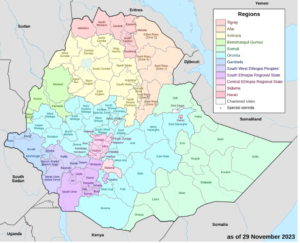
Map of Ethiopia.
From Wartime Enemies to Unlikely Allies
The most striking feature of the new alignment is the relationship between the TPLF, Fano and Eritrea. During the 2020–2022 Tigray war, Eritrean forces and Fano fought alongside the federal government against the TPLF. The Pretoria Peace Agreement ended that war in November 2022, but Eritrea and Fano were not parties to the agreement. Though some analysts have argued that their exclusion left important grievances unresolved, the deeper source of their discontent was their belief that they were in a position not only to defeat the TPLF but potentially to eliminate it as a military and political force, and that the federal government had effectively rescued the TPLF by agreeing to the peace deal.
The agreement also created a new dispute between the TPLF and Addis Ababa over disarmament, territory and the administration of Tigray. The TPLF’s subsequent struggle with the federal government in violation of the Pretoria peace agreement contributed to a deeper political and military split inside Tigray. Tigrayan fighters dissatisfied with the TPLF’s course broke away in 2025 and formed the Tigray Peace Force, which has received apparent support from federal authorities. The TPF has since fought alongside federal forces against TPLF forces.
This history makes the current alignment remarkable. Former battlefield enemies are now cooperating against the government they once fought alongside or, in the TPLF’s case, fought against.
TPLF’s Strategic Calculus
The alignment may also offer the TPLF practical advantages. This is an inference from its previous conduct, rather than a stated coalition strategy. Working with local armed groups could give TPLF forces greater political and operational access in Amhara and Afar areas and reduce the perception that Tigrayan forces alone are entering territory outside Tigray. In the 2021–2022 war, the TPLF’s advance into Amhara and Afar was widely framed by its opponents as an invasion.
The coalition could also reduce the TPLF’s sense of strategic encirclement. Tigray borders Eritrea, Afar and Amhara-controlled areas. Building relationships with armed actors in or near those territories potentially gives the TPLF additional political space.
But this creates another question: if the TPLF remains the coalition’s strongest military actor, will the smaller groups be partners with equal influence, or instruments of a stronger organization? Ethiopia’s recent history offers reasons for caution.
The EPRDF Exception
The TPLF has extensive experience building coalitions and subordinate organizations. During the struggle against the Derg, it created Ethiopian Peoples’ Revolutionary Democratic Front (EPRDF) out of coalition of four organizations. It helped create the Ethiopian People’s Democratic Movement, later split into the Amhara National Democratic Movement and Oromo People’s Democratic Organization from former Derg soldiers and others. The EPRDF eventually became the dominant political structure that ruled Ethiopia for nearly three decades.
The EPRDF is also the clearest historical example of an Ethiopian coalition that captured and retained state power. Other opposition alliances; including Coalition for Unity and Democracy, Medrek, Coalition of Ethiopian Federalist Forces,United Ethiopian Democratic Forces and the Alliance for Freedom and Democracy, did not develop comparable governing structures. In 2018, EPRDF’s constituent parties themselves turned against TPLF dominance, elected Abiy Ahmed as chair and ended the TPLF’s hegemonic position.
The TPLF also formed an eight-group opposition coalition in 2021, when its forces were advancing into Amhara territory. That precedent raises a question about the current alliance: is it a durable political project, or another wartime coalition whose members have different objectives once the immediate enemy is removed?
A Coalition Without a Common Command
A coalition of this kind also faces a command problem. Its founding announcement speaks of political cooperation, a transitional government and constitutional dialogue, but that is not the same as a unified military command. Early reporting on the fighting suggested that Tigrayan forces, AFNM and the Afar organization were operating on overlapping fronts, while no coordinated operations had been recorded for several other named members.
The distinction is important because a list of signatories can make an alliance appear much stronger and more cohesive than it is on the ground.
There is also a credibility problem. If organizations can be publicly listed as founding members and then deny that they ever joined, the coalition has not yet established a clear mechanism for collective decision-making or accountability. A durable political alliance requires more than a shared declaration: it requires agreed rules for command, representation, territorial disputes and the distribution of power after victory.
No Agreement on the Future of Ethiopia
This is the coalition’s biggest unresolved problem. Its members have not demonstrated agreement on the territorial and constitutional structure of a post-Abiy Ethiopia.
Western Tigray remains disputed. The groups have competing territorial claims. Some Oromo political actors seek independence, while there are also Tigrayan political currents that have advocated independence. The TPLF’s own long-term position remains less clear. Its deputy chair has suggested that Ethiopia could disintegrate into several countries after Abiy.
That means the coalition may be united around regime change without being united around state-building. Its founding statement speaks of an inclusive transitional government, constitutional dialogue and elections, but the harder questions remain: What happens to disputed territories? What happens to federalism? Who controls the security forces? Will Ethiopia remain one state? And if not, how would separation be negotiated?
The answers matter more than the coalition’s military cooperation.
Conclusion: A Coalition Without a Common Destination
The Tsimdo alignment demonstrates the power of a common enemy to bring together actors with otherwise incompatible histories and ambitions. But removing a government and governing a country are fundamentally different tasks.
The coalition’s members fought one another before, and some continue to regard one another as existential threats. Their disputes over territory, national identity, federalism and independence have not disappeared because they now share an opponent.
If the government weakens or falls, these disagreements could become the central conflict of the post-Abiy period. The war against the government could prove to be only the preliminary contest, the struggle among the victors could be the harder one.
The real question, therefore, is not whether these enemies can cooperate against Abiy. It is whether they can agree on what Ethiopia should become after him.