
Why China won’t build its own Wagner in Africa
Attacks on Chinese workers in Mali are testing Beijing’s reliance on African security forces. Russia’s experience there gives China little reason to take on the fighting itself.
On 9 May, fighters from Jama’at Nusrat al-Islam wal-Muslimin (JNIM), al-Qaeda’s affiliate in the Sahel, stopped buses and trucks at Zambougou, in the Ségou region of Mali about 60 kilometres from Bamako, ordered the passengers out and burned at least 40 civilian vehicles. One passenger told Human Rights Watch that the fighters sent the travellers on towards the capital on foot, saying they had declared an embargo on Bamako. HRW found no Malian troops in the area.
On 12 May, the Chinese embassy in Bamako published a warning urging Chinese nationals to leave several mining districts, citing armed attacks and the government’s campaign against unlicensed mining. The incidents occurred in different parts of Mali, but both exposed the limits of state protection beyond Bamako. A second notice in July reported attacks on foreigners around Kenieba, Bougouni and Foulou. An embassy can tell its citizens to leave. It has far less to offer those who stay.
A BBC Monitoring review counted 38 Chinese citizens among the 89 foreigners abducted in high-profile cases across Africa in 2025, many of them working in the gold industry of south-western Mali. The figures cover foreign nationals and offer no comparable measure of the kidnappings experienced by Malians. Russia, meanwhile, has become directly involved in Mali’s military campaign, committing personnel to combat operations alongside Malian forces.
What fighting costs Russia
On 10 September, JNIM fighters overran the army camp at Dioura in central Mali. Military, security and local sources told AFP that at least 100 Malian soldiers and five members of Russia’s Africa Corps had been killed. The Malian authorities published no toll of their own. Bamako had already lost its defence minister, Sadio Camara, who was killed in an attack on his residence in Kati on 25 April.
Less than a month after Dioura, separatists announced what they called a temporary withdrawal from Kidal, and Malian forces backed by Russian fighters returned to the northern town. The recapture was a significant political and military gain for Bamako, though JNIM’s attacks on civilian transport farther south remained a separate security challenge.
Wagner arrived in late 2021, as Mali’s relations with France broke down. When it announced its departure in June 2025, Africa Corps, which answers to Russia’s Defence Ministry, stayed on, and Russian personnel remain part of the war. On 31 July, Human Rights Watch reported that Russian-controlled Africa Corps aircraft had struck Kyrnia, in the Mopti region, on 15 June. Eight civilians, including three children, were killed in what the organisation described as an apparently unlawful attack. Russia’s direct involvement has made its military reputation inseparable from the conduct of operations in Mali, including attacks that have harmed civilians.
Contractors outside the fighting
Chinese security companies have taken a much narrower role. When fighting trapped about 330 Chinese workers in Juba in July 2016, DeWe Security Service Group helped organise their evacuation despite having no armed personnel of its own. The company, founded by former officers of the People’s Liberation Army and the People’s Armed Police, hired armed South Sudanese as backup, told the workers to stay put and waited for Ugandan forces to secure the airport before the evacuation could begin, as Carnegie’s research on the episode records.
The pattern holds elsewhere. Chinese contractors assess threats and train guards, as DeWe has done for Kenya’s Chinese-financed Standard Gauge Railway, and rely on host-country police and soldiers to carry the weapons. These arrangements allow Chinese companies to organise protection while leaving combat operations to local forces. They also make effective oversight difficult when those forces commit abuses.
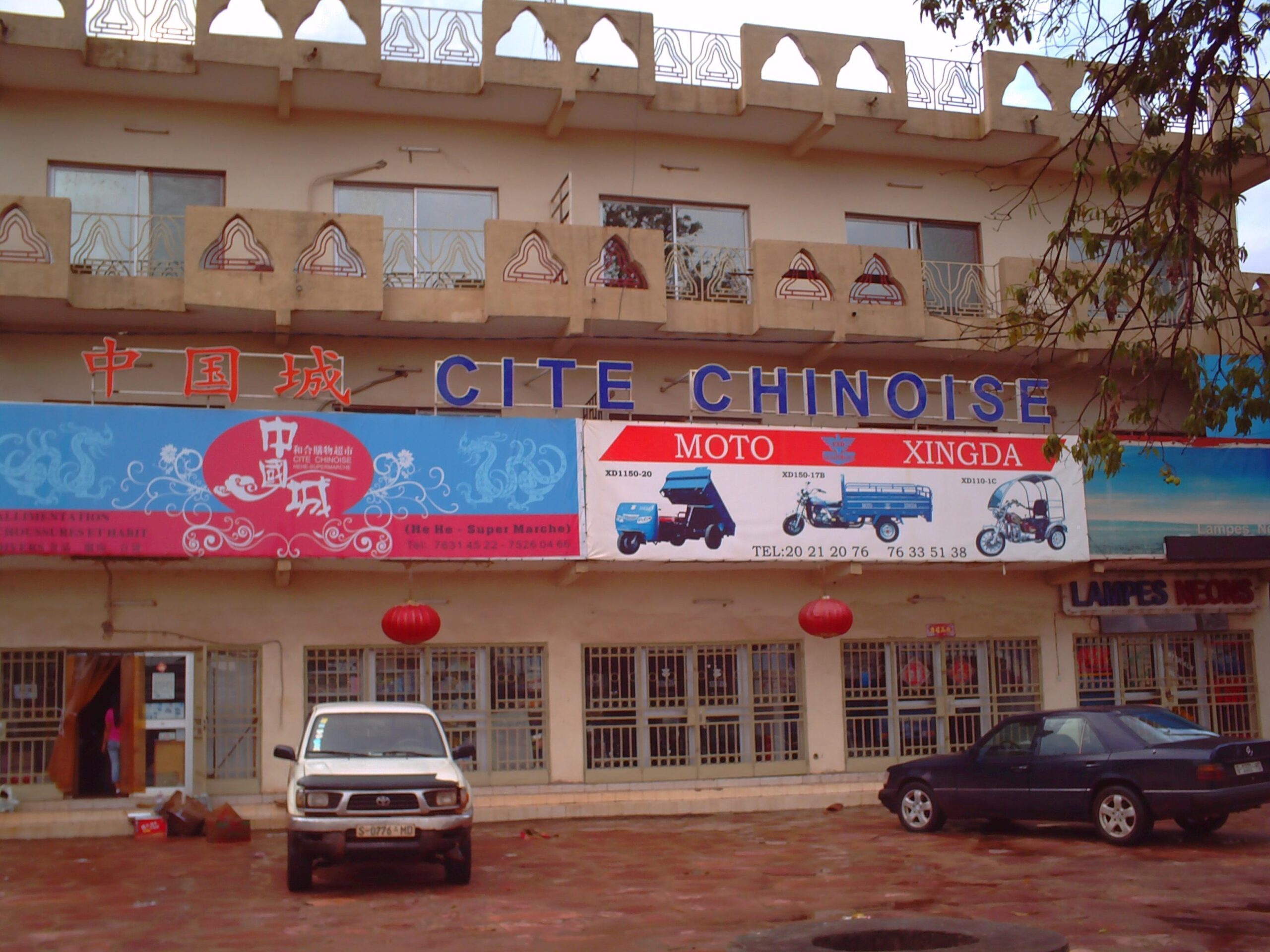
The Cité Chinoise in the outskirts of Bamako: one of the signs of China’s economic presence in Mali (Wikimedia Commons).
Control and cost
Beijing has its own reasons to keep armed force under tight political command. From 1 January 2018, the People’s Armed Police came under the command of the Communist Party’s Central Committee and the Central Military Commission and was no longer under the authority of the State Council.
China’s domestic security industry is regulated by public-security authorities, but oversight becomes far more difficult once contractors operate abroad. Wagner showed what can happen when such control loosens. By the time Yevgeny Prigozhin turned his fighters towards Moscow in June 2023, his company had built revenue of its own and a force loyal to him personally, even though it had worked abroad for the Russian state. Most Chinese security contractors operating on African soil have focused on unarmed protection, training and coordination with local forces, and turning them into fighting units would run against the direction of Beijing’s own reforms.
Guarding one mine is a limited task. Protecting dozens of sites across western Mali would require patrols, intelligence on the roads between them and some way of pursuing attackers when local troops were overwhelmed. Commanders would soon be deciding whether to fight beyond the sites they had been sent to protect, and a mission to guard workers could become a commitment to Bamako’s war before anyone in Beijing had chosen to enter it.
Mali is one market among dozens. China-Africa trade reached $348 billion in 2025, a record, and Chinese companies work in countries with very different governments and security problems. Any serious abuse involving Chinese armed contractors in Mali could complicate Beijing’s relations with other African governments, particularly where Chinese investments already face political or social opposition.
Bamako’s choices
Mali’s leaders have shaped this division of labour themselves. They turned to Russia for personnel willing to go into combat beside Malian units, and to China for equipment and training. On 2 September 2024, Mali signed an agreement with Norinco in the presence of Assimi Goïta. The deal covered defence equipment, training and technology transfer, reflecting Bamako’s interest in strengthening the capabilities of its own armed forces. Russia also sells weapons and Chinese instructors train African armies, so the line is not clean, but Bamako has asked different things of each partner.
China’s own security channels in Africa run through the state. At the 2024 Forum on China-Africa Cooperation, Beijing pledged a 1 billion yuan military grant and training for 6,000 military personnel and 1,000 police officers. SIPRI’s March 2026 figures show China supplying 22 percent of sub-Saharan Africa’s major arms imports in 2021–25, ahead of Russia at 12 percent. China sent troops to the UN mission in Mali, where a Chinese peacekeeper was killed in Gao in 2016, and a year later opened its first overseas military support base, in Djibouti. China has accepted the risks of overseas military deployments through formal state and multilateral arrangements, without creating an autonomous force comparable to Wagner.
For Chinese workers operating in remote mining areas around Kenieba, protection remains heavily dependent on Malian forces that suffered heavy losses at Dioura and have struggled to secure such areas, and on locally hired guards whom their employers pay but do not command. If one of those guards fires on villagers near a Chinese-run site, residents will struggle to know whom to hold responsible: the guard, his commander, the contractor or the Chinese client. Deploying a Chinese combat force would bring Beijing much closer to the decisions made on the battlefield and the political consequences of those decisions.
The real test is whether these security partnerships make people living and working in Mali safer. The effectiveness of Beijing’s approach will depend partly on whether Malian forces can secure transport routes and protect mining communities. If those forces remain unable to protect the roads and mining districts, Chinese workers and the Malian communities around them will continue to bear the consequences.