The Impact of the US-Iran War on Sudan
In February 2026, the US and Israel attacked Iran. Since then, there have been multiple attempts at partial de-escalation through negotiations. However, the recent Memorandum of Understanding signed by the US in June in Versailles has fallen under strain in the past week, with the US seeking to enforce a new blockade against Iranian ports.
As such, disruption to shipping in the strategic Straits of Hormuz combined with heightened uncertainty being priced into global financial markets is likely to endure. African Arguments has already tracked the downstream effects of the war on the Somali Horn. This article turns to examine the impact of the US—Iran War on Sudan.
Since 2023, Sudan has been in the midst of a civil war and the world’s worst humanitarian crisis. The domestic war economy created by the struggle between the Sudanese Armed Forces (SAF) and the Rapid Support Forces (RSF) could increasingly be influenced by the new regional political economy emerging from the latest war in the Gulf.
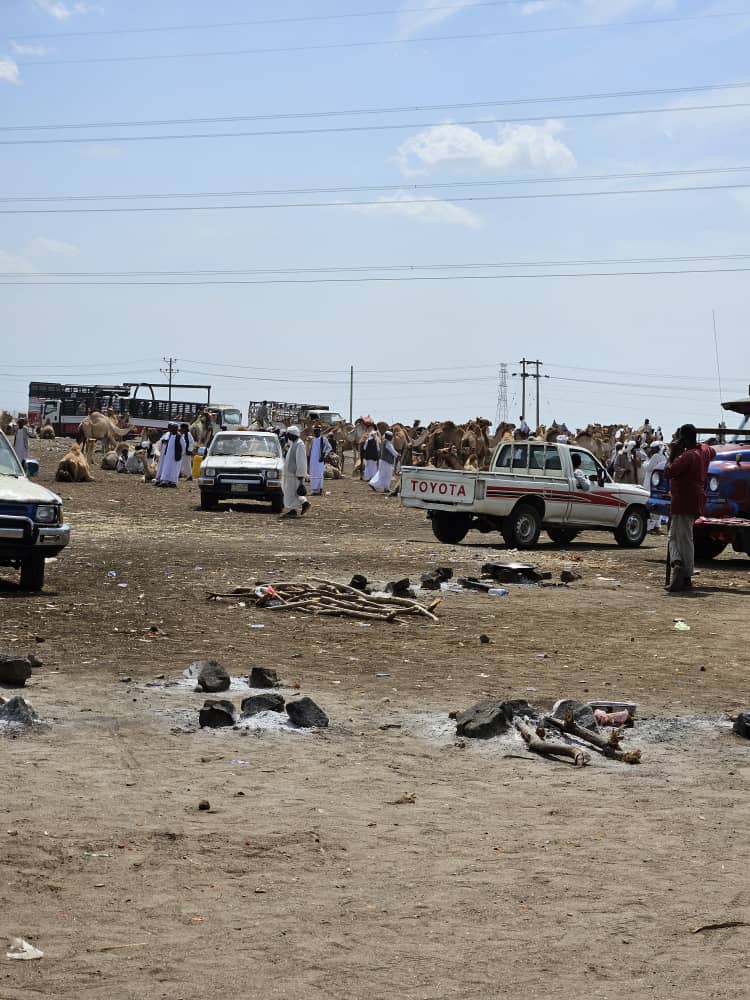
Fuel shortages and rising prices have affected all parts of Sudan.
Food and fuel
The most immediate impact of the US-Iran War has been increased global fuel prices, as commercial oil tankers face security risks and spiralling insurance costs transiting through the Straits of Hormuz. Furthermore, Adam Hanieh highlighted in April the looming impact on the price and supply of food, as one-third of the world’s fertilisers were shipped through Hormuz prior to the war.
Bread and fuel prices have an evocative significance in Sudan. In 2018-19, attempts to dismantle bread and fuel subsidies led to mass protests culminating in the 2019 revolution that brought down the military president Umar al-Bashir. Since the start of the current war in 2023, access to food has been weaponised with widespread food insecurity leading to death and displacement as much as active conflict.
Access to fuel is important to sustain economic activity during Sudan’s crisis, through mechanised irrigation pumps used in commercial farming and for transport moving consumer imports and agricultural exports across the country. Furthermore, fuel also sustains military activity, most notably the movement of troops as well as the air power deployed by the SAF. Complex logistical operations are required to transport fuel across Sudan’s large distances across conflict zones. Sometimes, these operations are carried out by specialised logistics companies with a corporate footprint in the Gulf or in Europe, but sometimes they are carried out through risky informal operations with convoys of truck drivers paying cash-in-hand to cross deserts, dirt tracks, and land borders to deliver their goods to inland markets.
All of this makes the cost of fuel prohibitively high in a country where incomes have collapsed due to the war, and the effect of further price rises due to the war in Iran has already exacerbated this hardship.
The regional balance of power
Sudan is undergoing a civil war with regional dimensions due to the interference of external actors. The US—Iran War could reshuffle the relative power and leverage of different regional actors.
It is well established that the UAE has been providing extensive support to the RSF. The SAF has received sustained support from Egypt, and more measured support from Saudi Arabia.
Immediately before the start of the US-Iran War, Saudi Arabia and the UAE were engaged in a major confrontation with reverberations in countries around the Arabian Peninsula and its surrounding periphery. A military advance by the Southern Transitional Council (STC) in Yemen backed by the UAE in December 2025 led to the STC capturing large parts of the southern Yemeni coastline and territory bordering Saudi Arabia. This led a dramatic riposte by Saudi Arabia against both the STC and the UAE, bombing some of the latter’s naval facilities in Yemen.
This new regional fracture soon spread to other theatres, such as Somalia in January 2026 when the federal government in Mogadishu with support from Saudi Arabia ended multiple investment agreements with the UAE governing access to ports and compelled the UAE to withdraw its military presence from Bosaso in Puntland which had been used as a transit point for air supplies to the RSF. With this regional amplification of Saudi-Emirati rivalries – with Saudi Arabia able to back financial influence with much greater territorial, demographic, and military weight on the Arabian Peninsula – it was speculated whether a more assertive Saudi policy in Sudan would be the next step in this regional realignment.
The US-Iran War has further weakened the UAE’s position relative to its Saudi neighbour. All major Emirati ports except for the small eastern emirate of Fujairah are inside the Gulf with their maritime access to the world compromised by the disruption of shipping in the Straits of Hormuz. Conversely, Saudi Arabia has a long coastline on the Red Sea with major port facilities in Jeddah and Yanbu.
Saudi Arabia’s ability to receive imports and to deploy part of its navy is consequently little compromised. Furthermore, during the Iran-Iraq War, Saudi Arabia constructed an East-West oil pipeline linking the country’s eastern oil-producing regions to its port facilities on the Red Sea. Built as a contingency and a route to export for Saudi petroleum products in the event of disruptions to Gulf shipping, this pipeline has become crucial since February and the start of the US-Iran War. Although this pipeline cannot replicate the volumes of exports that pass through the Gulf in peacetime conditions, Saudi Arabia’s economy is more resilient to the shock of the current war than is the UAE, and Riyadh is considering expanding this critical pipeline infrastructure.
This could also point towards the increasing strategic importance of the Red Sea, thus raising the stakes of the war in Sudan which includes 500km coastline opposite Saudi Arabia in areas controlled by the SAF.
Iran in Sudan
Since 2023, Iran has gradually increased diplomatic contact and cooperation with the SAF to provide technical support and security training. This is a pragmatic relationship, as both countries have been subject to long-term Western sanctions, and cooperation is accordingly a means of building capacity and resilience outside of Western trade and financial networks. Relations since 2023 have revived a close relationship that had existed in the 1990s when Sudan was first subjected to US sanctions.
The prize for Iran in Sudan – as for many other countries that have courted governments or factions in Sudan in recent years – is a Red Sea base. Iran, through the so-called ‘Axis of Resistance’ has extensive experience of providing technical assistance and security training to weak regimes and non-state actors in Iraq, Syria, Yemen, Lebanon, and Palestine allowing these partners to acquire a military capability and resilience beyond what their financial resources would suggest.
The war with the US is likely to have severely curtailed Iran’s ability to provide immediate support to actors in Sudan. However, in the case of a protracted war, Iran could find that it is in a position to export its expertise in military drone technology as well as effective and protracted military operations conducted with limited financial resources. African Arguments has already examined a comparable dynamic in Ukraine, where a country defending itself against a military invasion is nevertheless able to export its security expertise to states in Africa through both public and private channels.
Impacts on the war in Sudan
This reshuffling of the regional power balance could tilt the balance of forces inside Sudan. Most of the effects of the US-Iran War described above are more detrimental for the RSF than they are for the SAF. The RSF is defending a large inland territory in western Sudan, where it already faces high transport costs and logistical challenges to receive supplies. The power grid in this area has been destroyed, fuel for generators is hard to come by, and fuel convoys are frequent targets of SAF drones and airpower. Higher fuel prices are likely to cripple the fragile local economy to an even greater extent.
Meanwhile, the vulnerability of the UAE to disruptions in the Straits of Hormuz, combined with the fact that Saudi Arabia is arguably more resilient and able to leverage its large Red Sea coastline to pursue an active policy in the region, means that the RSF’s main backer could be in a weaker position to provide meaningful support.
RSF offensives in Blue Nile and North Kordofan since the start of 2026 show that the paramilitary is still able to seize the military initiative. However, overall shifts in territory over two years show an overall retreat, as the RSF has abandoned its positions in the capital Khartoum and the central Jazirah region. It is unsurprising therefore that the SAF have been rumoured to be negotiating directly with the UAE in Bahrain, with both actors sidelining the RSF.
Successive retreats by the RSF need not equate to a collapse. Political structures in Sudan have already demonstrated their willingness to endure decades of conflict if fighting is confined to the country’s western or southern periphery, while the centre lives in relative peace. The drone technologies that have come rapidly to define contemporary warfare may mean that an illusory peace of this nature is now unattainable. The need for a ceasefire remains urgent.